Gloucester, Easter Sunday morning

Easter Sunday, and a forecast of dullness belied by brilliant sun, and a blue sky which set off the white stone of Gloucester Cathedral. 8pm, early morning communion in the choir, before the high altar. Above us the great 14th century window reputedly commemorating the battle of Crecy. About thirty people at communion, come 11pm the cathedral will be packed, chairs await them in every corner of nave and aisle. After communion I waited awhile, and stood at the back of the nave, looking toward organ and altar, and all was (for a few minutes) empty, not a soul, just the great Norman columns in stately procession toward the transept, and the simple vaulted ceiling, in sharp contrast to the wonderful fan vaulting of the choir.

(Should anyone wonder why a blog with zen in its title should be comfortable with early communion… There’s a silence, a time for contemplation, in the early morning. I’ll say no more than that.)

In the cathedral precinct there’s major landscaping, and fences everywhere, but lift your eyes to the cathedral walls, the tower and the sky, and there is all the space, and all the serenity you could wish for in the world.

Ivor Gurney has a close association with the cathedral.  The son of a Gloucester tailor, he was composer, writer of songs, poet, and a celebrant of the Gloucestershire landscape, in his poems from the front, and in his letters. Windows in the Lady Chapel commemorate him, and I always pay a visit when I come to the cathedral – but not today. The Lady Chapel is fenced off, major renovations until the autumn. They will make for easier access, and maybe more people will find sanctuary there, and take in the wonderful stained glass (by Tom Denny) of the Gurney memorial. He survived the first war, but his mind didn’t, incarcerated in a mental home in Kent he longed for his home county, and the Severn vale, where he’d walked countless times…

One place he walked was Cranham, whose woods he celebrated, and where I am now. Reached via the Portway, down and up which I drove an hour or two ago. Gurney would have walked, and he’d have seen that amphitheatre of woodland and meadow opening up ahead, farms either side, and a vast sky above. He was obsessed with the idea of beauty, above all the beauty of his home county. It gave him comfort in France. He recalls in a letter home how the tower of the church of Merville reminds him of Gloucester’s tower. Both churches rise above the landscape, are landmarks, and inspirations.

Walking back to my car, I passed along pedestrianised streets, stained, a little ragged, forlorn, and empty on an Easter Sunday morning. Only Macdonalds and Burger King open, and they only just. How would Gurney have responded to the decay of his old city? To the contrast between shops, and cathedral and precinct, an absolute contrast. How I wondered as I walked back could the city be revived, made vibrant and colourful as a city centre should be – and keep all the while the quiet and sanctity and celebration of the cathedral and its surrounds.

One of many questions this Easter, an Easter where questions seem to crowd in on all sides – so many questions where there are no obvious answers.

The day after…

So we’re the day after. Theresa May has invoked Article 50, officially received by Donald Tusk. From a Brit to a Pole, a document that’s tantamount to a surrender of our status in the world. Ironic, remembering 1939, when we went to war for Poland.

I’ve often thought post referendum that this blog belonged to another age. Might a Zen approach to politics, bringing wisdom and compassion, as understood in Buddhist terms, to bear, no longer be of its time?

Engagement, street-corner politics, arguing, rallying, taking sides, contrasting opposites – we may seek to hold to the truth but when the other side embellishes or distorts then we have to counter – and the language of attack and counter-attack isn’t always sweet. I tried the counter-attack last year. But that’s for another blog. For now, a simple statement, from the Buddha, no less:

How wonderful, how miraculous that all beings are endowed with the wisdom of the Tathagata [someone who has achieved enlightenment]. Only sadly human beings because of their attachments are not aware of it.

The ultimate attachment is to ‘I’, which is out there all the time asserting its identity, in a state of more or less insecurity, seeking reassurance, arguing, shoring up its position.

24-hour news is part of this. Listening every few hours, even every hour. Always engaged with the minutiae, and responding yea or nay to each news item – agreeing, disagreeing. Encouraged, depressed. Even if we’ve escaped the high and lows we’re always in there with the buzz of it all.

As a contrast, take a simple image, water in a glass vessel, conforming to its size and shape. We want to change the moment, or change the world. We pour the water out, find another vessel.

But imagine the universe as a vessel, and the laws which govern it – the laws of the tao (see the Tao Te Ching), the Buddha wisdom, the Christian gospel message of love, which is universal – as the water within.

The day-to-day is about change. That is what life is, change and becoming. But chucking out the water, changing the vessel, endless agitation, that can never be the way forward. The way of wisdom moves more slowly, wisdom lies in silence and in a quieter, more measured understanding.

And that is not the mood or way of our times!

The sleep of reason (2) – Goya

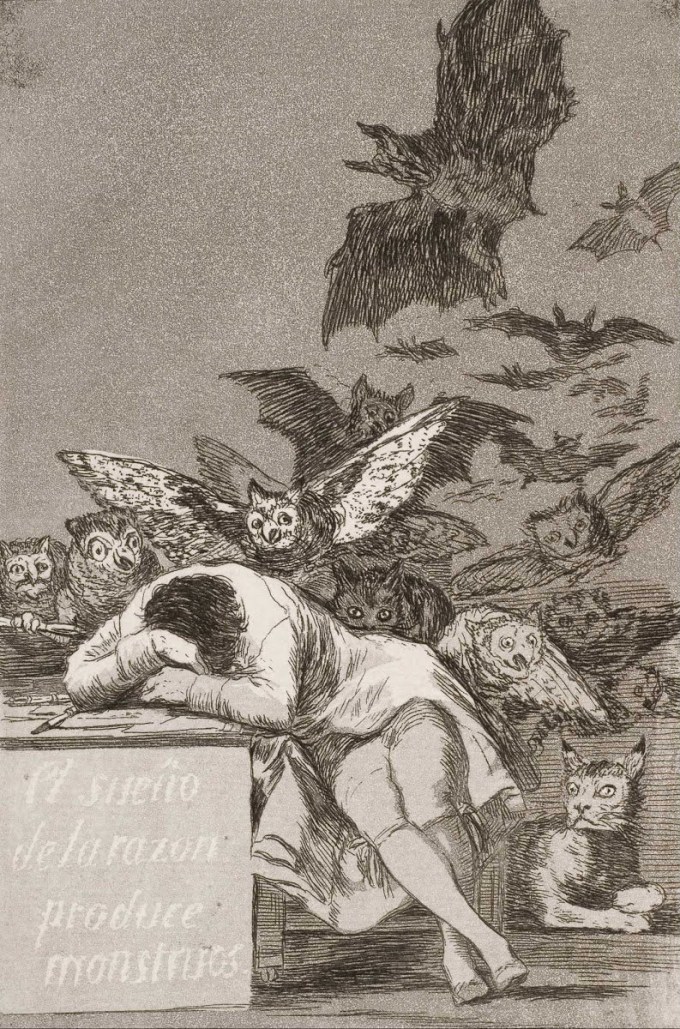
I mentioned ‘the sleep of reason’ in my last post. I had in mind Goya’s Los Caprichos print series, and specifically plate 43, ‘the sleep of reason produces monsters’. Owls gather above the sleeping artist’s head, no owlish wisdom here, just confusion, compounded by bats swarming behind – the owls lit, the bats unlit, and below two cat-like creatures look out, lynxes maybe, one directly at us, black and ominous, drawing us in.

By 1799 when Goya published Los Caprichos the high hopes of the Enlightenment had faded – his time maybe not too similar to our own.

Sleep of reason

Goya is clear that we cannot live by reason alone. ‘Imagination abandoned by reason produces impossible monsters; united with her, she is the mother of the arts and source of their wonders.’

We have in recent times been short-changed on both. Imagination looking back not forward, reason pilloried as ‘expertise’. And for many us, for the first time in our lives, we feel the tide of human improvement, I won’t say progress, is running against us.

Can music help? Leonard Cohen’s words from his song, Anthem, have helped me. (I love singing it!) Simply the idea that there’s a crack, however formidable the surface textures might seem just now, there is a crack. A crack in everything.

Rings the bells that still can ring/Forget your perfect offering/There is a crack in everything/That’s how the light gets in.

Applies to the whole Brexit edifice. And the Trumpian. We haven’t come so far that we could now go back. Surely not.

I see that the artist Sarah Gillespie has made ‘the crack in everything’ the title of a painting. Maybe I’ll make it the title of a poem.

And another artist, Turner Prize-winner Wolfgang Tillmans, quoted in the RA Magazine: ‘ …this amorphous, right-wing, nationalist sentiment … has become the central issue of world politics …how, as a sort of avant-garde artist, do you engage with the number one political subject?’

How does an artist respond? Or a writer? A musician?

Propaganda has its place, but propaganda and art are not easy bedfellows. Caricature if it points up absurdity, gross behaviour and the like has a powerful role to play. But not if it only appeals to the already converted. In the hands of Hogarth, Rowlandson and Gilray caricature becomes an artform in itself. But we must tread carefully.

What we can’t do, in our anger or frustration, is allow ourselves to abandon reason, to let reason sleep awhile.

‘Imagination abandoned by reason produces impossible monsters; united with her, she is the mother of the arts and source of their wonders.’

A puzzling innocence

Back in January I wrote a poem which touched on a nightmare which I trusted with the bright and clear skies, and warmth, of June would evaporate. It didn’t, of course.

There is a foolish innocence abroad in the land. I thought back in January that we could all handle it with gentle irony. Now it’s for real – and the irony, still gentle, has a sharper focus. Irony better than anger? I’m not sure!

*

A puzzling innocence
at home on English shores

Is it a puzzling innocence, that we should wish
to shake ourselves free of all the sand and salt,
a dog out of the waves,

more than sand and salt –
we would be somewhere else, another beach –

the same waves, the same wrack and kelp,
but the sea would be somehow different,

the tide driven by another moon and
under that new moon we’d trade our goods

beyond our shores unfettered, be more English –
the moon an English moon –

ours would be
a calculated innocence, a glorious future,
an imagination of a past when we rode oceans –

grew rich on other lands – unshackled, the sea
we’d command would stretch no more than

a few miles off our shores, yet we would
still be lords –  you say,

                         it’s bright-eyed innocence
to see only the benign, the old navy afloat,
a few new tugboats on calm and peaceful waters –

but who needs containers in this grand design –

where once we traded pounds we’d trade in pence
and who are you to say, that’s not a better way

(c) Chris Collier, January 2016

All Hallows

Yesterday was All Hallows’ Eve, which makes today All Saints’ Day. Yesterday was also in warm and brilliant sunshine the last day of autumn (by my calculations anyway!) – the autumn colours burnt in the sun as I’ve rarely seen them, a multitude of shades, with their own luminescence – as if they didn’t need the sun to make them glow. Today is the first day of winter – the cloud is down on the hills, there’s a chill, the fire must be lit soon, and the leaves are thick on the ground. I raked them in the sunshine yesterday, but they’ve returned, and if I rake again, this time in the damp and gloom, they will return again, until the last one has fallen and I can put the rake away.

Yes, there’s an elegiac quality to all this. I listened to the adagio from the Elgar violin concerto driving back along the A419 heading toward the Cotswolds yesterday. That caught the mood. I knew this was the last day, the last of autumn, and there were not two hours till sunset.

The day before I’d listened to David Mellor on Classic FM, playing music from the Philharmonia under Otto Klemperer. A recording of Mahler’s Resurrection symphony when the great conductor was already in his 80s. He took it slowly. About the same time the recording was made I was, I remember, at a party at Professor Gombrich’s house. Ernst Gombrich was my professor at the Warburg Institute. Frau Gombrich mentioned they were going to hear Otto the following day. Otto being Klemperer. All with Viennese Jewish backgrounds, and the connections were still strong.

Klemperer had been recommended sixty  years before by Gustav Mahler (also that Jewish connection) to an orchestral position, and I felt my own connection listening to the final ecstatic bars of the symphony to Klemperer and Mahler. Almost a laying on of hands. Ridiculous in its way, but the music took me to another level. Triumphant – but also elegiac, and intensely moving.

Mahler died young, and two world wars had to work themselves out before Klemperer stood before the Philharmonia in the late 1960s.

I’ve felt betrayed by events this year – my values betrayed, values by which I’ve conducted by life over almost seventy years. The autumn leaves, the music, a sense of loss I wouldn’t ordinarily indulge. But I did this time, this once, just this once.

Back to Brexit ….

A brief note – in the end not quite as brief as I intended! My reason for this post – to explain why I am not one of those who voted Remain but is now prepared to accept Brexit, to accommodate – accept that the vote has happened, argue we should make the best of it and get on with life.

A few reasons, in no particular order, as they say on Strictly Come Dancing, as follows….

The vote was won on a basis of a false prospectus and false promises. Even now – press headlines pick up James Dyson and Lord Bamford, two of the rare industrialists who supported Brexit.

We are a parliamentary, representative democracy, and we should live and die by that. Not be ruled by plebiscites, which are the first and last resort of populists and demagogues. (We currently have an unelected government, governing to its own and not the 2015 Tory manifesto, and which anticipates pushing Brexit through using the royal prerogative without, if it can help it, reference to parliamentary discussion or vote.)

The European Union is a remarkable institution. Unwieldy, bureaucratic, fractious, but it is the extraordinary coming together of 28 different nations, each passionate about its own interest, but likewise seeing the benefits, after two thousand years of conflict, of coming together. Our efforts should be concentrated on reform not withdrawal. (The EU has been pilloried for its poor handling of the refugee crisis, but I wonder how it could have been handled well, given all the fear and anxieties felt by 28 countries with very different histories. Had here been no EU, how would the crisis have been handled? With any less agony, any less suffering?)

A war which tore Europe and then the world apart ended only seventy years ago, a year before I was born. Before that another war, arguably even more terrible. We’ve had seventy years of peace, unprecedented peace. The EU symbolises and acts out that peace.

As an economic union, despite all the talk it’s a significant success. No serious economist would argue otherwise. Run a business which trades with other European countries, which I’ve done, and you’re aware of all the benefits. The danger is you take them for granted – assume they’d have happened anyway. There are also extraordinary levels of scientific, environmental and cultural collaboration, for which the EU has provided both the mechanism and inspiration.

The EU isn’t restrictive – unless you’re opposed to workplace and environmental rights. And we’re not going to do without the regulations by asserting our independence – if we want to trade with Europe, the regulations are the terms.

Where there is unnecessary red tape we need to be in there, ensuring it’s removed, instead of being passive observers. We are sacrificing engagement, and influence. We’ve used that influence well over the years.

Immigration is a perceived threat – where immigrant numbers are highest we had the highest Remain votes, where they were low the highest Leave votes. A perceived threat – nowhere near the actual threat that much of the press played up. Likewise no evidence that immigration has held wages down. Yes, pressure on schools and housing in certain areas – and the last government singularly failed to recognise that immigration, and other changes in our working lives, must be reflected in improved infrastructure. (Levels of immigration in recent years have been too high – I’m not arguing otherwise – and politically they’re unsustainable at this level. How you handle this while preserving freedom of movement is a mighty challenge, but not remotely a sufficient reason for Brexit.)

Behind immigration lies the identity politics, aligned with nation and race and social group, which we should be fighting every step of the way. Espouse patriotism not separatism. Patriotism based upon British values of openness, tolerance, free speech – and a tradition of welcoming strangers, bringing them into the fold, and letting them benefit our life and culture – blending in as countless immigrants have done before. Likewise refugees – there are limits of course, but our first instinct must be to welcome.

Related to this, the argument that British, the U.K., England, isn’t the country it used to be. The old generational cri de coeur. True, the pace is faster, and the landscape much impaired. But there have been many radical improvements, too easily discounted. As for the negatives –  the EU takes the rap. I may personally be in the old codger bracket, but I’m with the younger, pro-EU generation.

There’s a mood out there, encouraged by the right-wing press, and played along with by the BBC, that somehow it will all work out. In Philip Hammond’s words, there will be bumps in the road. There’s another much more likely scenario where we find ourselves out on a limb, with an agreement which is dictated to us, and which we accept out of necessity. The economic auguries are not good. Put simply, a crisis awaits us.

There is so much else that matters out there in the world which we were just about facing up to, and they’re now on the back burner in terms of government and public attention. Global challenges, new technologies, fundamental changes in our working lives. At home, infrastructure, the NHS – requiring focus and funding when attention is elsewhere.

We have a hugely inflated view of our presence and reputation in the world. We embody as a nation tolerance, free speech, we pioneered modern representative democracy, the world plays many major sports by rules we laid down. But this is Britain as was. Our current behaviour simply alienates.

To end, two further points –

I’ve mentioned openness above. We have always been open to the world, and the danger now is that we shut ourselves off. Look to the past. Seek one-off deals when others work together. Openness is state of mind, and in an atmosphere of fear and apprehension, in great part built up by the media, it is now challenged as never before in my lifetime.

In direct contradiction to Theresa May’s comments, whether we like it or not we are citizens of the world, citizens, along with all our neighbours, of Europe, and citizens of the U.K. My patriotism is undiminished, I’m British to my last breath, but I also share a common humanity  with every man and woman on the planet.

And finally – never imagine that the change you wish for works out as you anticipate.  It will not, and never has. Gut instinct will never provide. A wing and a prayer will never suffice.

I remember one egregiously daft piece imagining a post-Brexit Britain in 2025 by Daniel Hannan in the Telegraph. It was the stuff of dreams, and typified the dream world in which Brexiters exist.

Now isn’t the time to buckle under.

On the road 

Afoot and light-hearted I take to the open road,/Healthy, free, the world before me,  /The long brown path before me leading wherever I choose.              Walt Whitman, Song of the Open Road

Whitman walked, we’re driving. We’re in the USA. A far cry from the Camino. And yet….

We’ve not planned our journey, we don’t have expectations, there isn’t a goal. There’s no history along the way, the road is open, everyone and no-one has trodden this route before us. Encounters with God are accidental not planned. We don’t walk or shuffle, we drive. Our minds picks up the blisters, wheels the wear and tear, not our feet.

We travel in a straight line, travelling west, heading for the sierras and the ocean. America travels in straight lines. Or back east. Start in New York, or California. Route 1 or Route 66, or the Pacific Coast Highway. Keep travelling.

The hobo, riding the blinds… rootless … looking for work: ‘I’ve been doing some hard travellin’, as Woody Guthrie sang.

The Beats by contrast had it easy. Kerouac was out of Columbia University. But like the hobos they were footloose, in mind and body. Searching for God, as Kerouac put it, not work.

Heirs of Whitman, and Emerson, and Thoreau. Even John Muir, though the Beats travelled the road not the wilderness.

They’d escaped the impact of war, the road network arrowed across America, an invitation, the cars that travelled it were streamlined. How lucky and how unlucky they were. War and its aftermath were three thousand miles away, too young to fight or worry, they didn’t have to agonise over combat or parade a political conscience. They were beyond their upbringing… drugs and sex came easily. And jazz. California Zen was a convenient religion – Dharma Bums as well as On the Road.

The Midwest and California have their own dreams and myths. The Beats were originally out of New York, but found California. California lifestyle reinterprets America. Putting up a different dream against New York. Not a Hollywood dream. Precursors to hippies, but they didn’t seek to change the world – not just yet. Challenge because they couldn’t help it – witness the obscenity trials – but not change it. America was their head space, not a place beyond.

They could be measured, a little bit lyrical:

‘Nothing behind me, everything ahead of me, as is ever so on the road.’ (Kerouac, On The Road)

And out of their minds:

‘I saw the best minds of my generation destroyed by madness, starving hysterical naked,/dragging themselves through the negro streets at dawn looking for an angry fix,…./who passed through universities with radiant cool eyes hallucinating Arkansas and Blake-light tragedy among the scholars of war,/who were expelled from the academies for crazy & publishing obscene odes on the windows of the skull….(Howl, Ginsberg)

And as for me…

It’s 1971 – I’m on the open road, on the Beat trail, starting in New York, ending in California. A road journey, yes, but no automobile of my own. And I’m not hitch-hiking. Taking Greyhound buses city to city. The bus has its own iconography. Bus stations, hostels, camping out with friends in New Jersey, Toronto, Atlanta, Colorado, San Francisco, San Diego. Sleeping rough in Chattanooga. I couldn’t listen to music – but I could read. So Whitman and his streams of consciousness my companion. And Albert Marcuse. Mine was a counter-culture. I might teach history on California, but I wasn’t planning to sully myself with any other work along the way. No encounters with God, but charity from a Baptist preacher who paid for my breakfast and invited me to lunch with his family – but first I must attend his Sunday morning service, and hear him preach.

The long road north out of Texas, straight and parched and empty. Colorado I sensed was still Indian country. San Diego: we were all still hippies at heart. Barefoot and beaten by the sun. I could have tried surfing but instead I headed south, took to the road again, to Mexico. But the Mexicans wouldn’t let me in. Hair too long. Strange irony. They weren’t sure they wanted me back in America either. They cut back my visa to one month. I returned to Mexicali my hair shorn and my ears, unaccustomed to the sun, grew burnt and blistered, as I headed south to Oaxaca, the Yucatan and Chichen Itza.

Did the road came first, or the need to travel it? The road without destination, always going somewhere. Road movies aren’t about physical, but personal destinations. About setting out and avoiding arriving. Not seeking self-knowledge …but maybe achieving it. Though not knowing what to do with it.

My trip was my own road movie, before they invented the genre.

The road’s just one agenda for America. America has multiple agendas, it’s own powerful myths and images, but they have a kind of surface quality. Still a dream. Europe has multi-thousand years of history interwoven into its structures, artefacts and traditions. They root us, define us, hold us back and lift us up – America isn’t tied down – it looks for, loses, its way, finds it again.

James Dean on the one hand, Howl on the other. Drugs, sex, Zen … they are unto themselves, not adjuncts of another culture, a music, a street culture.

I’ve avoided the noise and anger and foolery of America for a while. But I’ll go back. Maybe because there’s no place for complacency – and no place for rebellion – quite like it. It has open spaces, and straight roads, and you can still be alone there. And the skies are big. And there are millions there like me. Chugging along, rebels at heart.

And who is working class these days?

Working class – who is working class these days? The numbers of Americans defining themselves as middle class are in decline: 48% now consider themselves lower or working class. There are similar shifting sentiments in the UK.

And where do the old values of social liberalism (for a definition of social liberalism see * below) and social justice fit within this changing spectrum?

In both the USA and UK a new identity (nation, race, interest group) politics is taking hold. At the expense of both a more liberal outlook, and ‘the more conservative Labourism that might still stand the best chance in small-town England’. (David Marquand)

Taking Labour first, what the old Left hasn’t accepted is that the working-class solidarity of old, which has inspired the Labour movement for 150 years, is gone forever. And that could include Marquand’s ‘more conservative Labourism’. Left-intellectual radicalism and working-class aspirations no longer gell as once they did. Grinding poverty is no more, the old Marxist underpinning likewise, and there’s an alienation, a boredom and increasingly an hostility toward the political process.

And intellectuals, never too popular in the UK, are out of fashion as never before.

The popular instinct, as the Brexit result revealed, is to hold on to what we have. Immigration, globalisation, new technologies, the old politics, all are suspect. There’s support for renationalising the railways, but not for wider state intervention.

Maybe the Corbynite left will convince us otherwise, but I think they’re simply out of tune with the popular will.

So too social liberals – they’re also out of tune with broad sections of the population, who only see government indifference to unwanted changes in their lives – housing shortages, pressures on services, regional development, immigration.

It’s addressing these issues, rather than an overtly radical political prospectus, that will win people back to a liberal agenda.

Likewise, this should be Labour’s policy focus. Radical at heart, but pragmatic in practice. Unless you’re happy in the wilderness.

*Wikipedia has a helpful definition of social liberalism: Social liberalism is a political ideology that seeks to find a balance between individual liberty and social justice. Like classical liberalism, social liberalism endorses a market economy and the expansion of civil and political rights and liberties, but differs in that it believes the legitimate role of the government includes addressing economic and social issues such as poverty, health care, and education. Under social liberalism, the good of the community is viewed as harmonious with the freedom of the individual. Social liberal policies have been widely adopted in much of the capitalist world, particularly following World War II. Social liberal ideas and parties tend to be considered centrist or centre-left.

1968 and all that

There’s a perverse pleasure in wading through reviews of books and articles on subjects I know nothing about and may never encounter again. On occasion something hits home. One example: Terry Eagleton in the special Cheltenham Festival Times Literary Supplement edition, on everyone’s favourite subject, post-structuralism:

‘In its curious blend of scepticism and euphoria post-structuralism is a form of libertarian pessimism – one which dreams of a world free from the constraints of norms and institutions, but which is not so incorrigibly naïve as to believe it could ever come about.’  

I could dine out on that one!

‘The revolutionary elan of 1968’ was followed by ‘the disenchanted mood of its political aftermath’. I remember 1968. Too well.

It’s a pattern oft-repeated. More recently we’ve had the frustrations of the Obama years, when ‘yes we can’ didn’t quite happen. (Maybe it never will.) The aftermath of the 1989 and the fall of the Wall. Occupy and the now empty squares of New York and London. Above all the Arab Spring, and its brutal aftermath.

But we won’t and can’t let our optimism die. I’m one of millions now and forever who believe in social justice, opportunity, capability, compassion. We rejoice when we see progress, we’re despondent when we see it pushed back. But we don’t despair.

We don’t of course always agree with each other. Do we work with the system, or oppose it – and by what means? The divide between global and anti-global perspectives is vast. Many (not all) proponents of big government and small government have the same end in view but believe in radically different ways of getting there.

I supported and support Obama, always believed Occupy wasn’t sustainable … Bernie Sanders I admire, Corbyn I don’t. We will bicker and insult and traduce the motives of others, while still aspiring to the same humanity.

And we will undermine each others’ efforts. Refuse to vote for Hillary. Battle it out for the soul and machinery of the Labour Party. And if we’re not careful – and we haven’t been of course – let another party in, a party which doesn’t define compassion and social justice quite as we do… which puts up barriers rather than engage with the world. Abandons institutions rather than seeks to reform them. Follows the populist piper, who advocates easy solutions, and plays to prejudice.

There are many good reasons for retiring to a monastery or a country cottage or sitting room and TV, and disengaging – and yet we hang in there. If we keep open minds, listen to each other, avoid scorn and hubris, remember that we’re ultimately on the same side – then we might just make progress.

Countering Extremism 

Another remarkable discussion at the Cheltenham Literature Festival. This time on countering extremism. How best to handle radical Islam is a contentious issue. And that’s a significant impediment in itself. But first and foremost, we have to be better informed.

Peter Frankopan, who chaired the panel of three (see * below for the participants) asked the audience, a full house in the town hall, how many of us had read the Koran. Maybe two or three put up their hands. We rely too much on opinions, commentators and hearsay, selective reporting and prejudice. Sadly I guess most of us won’t be rushing off to buy and read copies. But we owe it to ourselves, to the Muslim communities in our midst, and to our own futures, to be better informed.

Continue as we are now, and we will continue as polarised communities.

Radical Islamists argue that the West and Islam are incompatible, put a distorted view of Islam up against a immoral West beyond redemption. So young Muslims, already feeling excluded, feel they have to take sides.

As a society, whatever faith or non-faith we profess, we need counter-arguments, and at the core of these arguments must be inclusion – Muslims should be, must be, as much a part of this society as Christians. Prejudice is a conflicting and self-defeating agenda.  Achieve inclusion, and we can make  democracy, liberty, free speech shared values, across all communities.

Inclusion requires commitment on both sides, on all sides. We have a long way to go.

*Chaired by Peter Frankopan, and drawing on the experience of Sara Khan, founder of the charity Inspire, which challenges extremist ideologies in Muslim communities, Peter Neumann, academic and author of ‘Radicalised’, and Hanif Qadir, a one-time recruit to radical Islam now working with young people in danger from radicalisation.