Working class – who is working class these days? The numbers of Americans defining themselves as middle class are in decline: 48% now consider themselves lower or working class. There are similar shifting sentiments in the UK.
And where do the old values of social liberalism (for a definition of social liberalism see * below) and social justice fit within this changing spectrum?
In both the USA and UK a new identity (nation, race, interest group) politics is taking hold. At the expense of both a more liberal outlook, and ‘the more conservative Labourism that might still stand the best chance in small-town England’. (David Marquand)
Taking Labour first, what the old Left hasn’t accepted is that the working-class solidarity of old, which has inspired the Labour movement for 150 years, is gone forever. And that could include Marquand’s ‘more conservative Labourism’. Left-intellectual radicalism and working-class aspirations no longer gell as once they did. Grinding poverty is no more, the old Marxist underpinning likewise, and there’s an alienation, a boredom and increasingly an hostility toward the political process.
And intellectuals, never too popular in the UK, are out of fashion as never before.
The popular instinct, as the Brexit result revealed, is to hold on to what we have. Immigration, globalisation, new technologies, the old politics, all are suspect. There’s support for renationalising the railways, but not for wider state intervention.
Maybe the Corbynite left will convince us otherwise, but I think they’re simply out of tune with the popular will.
So too social liberals – they’re also out of tune with broad sections of the population, who only see government indifference to unwanted changes in their lives – housing shortages, pressures on services, regional development, immigration.
It’s addressing these issues, rather than an overtly radical political prospectus, that will win people back to a liberal agenda.
Likewise, this should be Labour’s policy focus. Radical at heart, but pragmatic in practice. Unless you’re happy in the wilderness.
*Wikipedia has a helpful definition of social liberalism: Social liberalism is a political ideology that seeks to find a balance between individual liberty and social justice. Like classical liberalism, social liberalism endorses a market economy and the expansion of civil and political rights and liberties, but differs in that it believes the legitimate role of the government includes addressing economic and social issues such as poverty, health care, and education. Under social liberalism, the good of the community is viewed as harmonious with the freedom of the individual. Social liberal policies have been widely adopted in much of the capitalist world, particularly following World War II. Social liberal ideas and parties tend to be considered centrist or centre-left.
There’s a perverse pleasure in wading through reviews of books and articles on subjects I know nothing about and may never encounter again. On occasion something hits home. One example: Terry Eagleton in the special Cheltenham Festival Times Literary Supplement edition, on everyone’s favourite subject, post-structuralism:
‘In its curious blend of scepticism and euphoria post-structuralism is a form of libertarian pessimism – one which dreams of a world free from the constraints of norms and institutions, but which is not so incorrigibly naïve as to believe it could ever come about.’
I could dine out on that one!
‘The revolutionary elan of 1968’ was followed by ‘the disenchanted mood of its political aftermath’. I remember 1968. Too well.
It’s a pattern oft-repeated. More recently we’ve had the frustrations of the Obama years, when ‘yes we can’ didn’t quite happen. (Maybe it never will.) The aftermath of the 1989 and the fall of the Wall. Occupy and the now empty squares of New York and London. Above all the Arab Spring, and its brutal aftermath.
But we won’t and can’t let our optimism die. I’m one of millions now and forever who believe in social justice, opportunity, capability, compassion. We rejoice when we see progress, we’re despondent when we see it pushed back. But we don’t despair.
We don’t of course always agree with each other. Do we work with the system, or oppose it – and by what means? The divide between global and anti-global perspectives is vast. Many (not all) proponents of big government and small government have the same end in view but believe in radically different ways of getting there.
I supported and support Obama, always believed Occupy wasn’t sustainable … Bernie Sanders I admire, Corbyn I don’t. We will bicker and insult and traduce the motives of others, while still aspiring to the same humanity.
And we will undermine each others’ efforts. Refuse to vote for Hillary. Battle it out for the soul and machinery of the Labour Party. And if we’re not careful – and we haven’t been of course – let another party in, a party which doesn’t define compassion and social justice quite as we do… which puts up barriers rather than engage with the world. Abandons institutions rather than seeks to reform them. Follows the populist piper, who advocates easy solutions, and plays to prejudice.
There are many good reasons for retiring to a monastery or a country cottage or sitting room and TV, and disengaging – and yet we hang in there. If we keep open minds, listen to each other, avoid scorn and hubris, remember that we’re ultimately on the same side – then we might just make progress.
Another remarkable discussion at the Cheltenham Literature Festival. This time on countering extremism. How best to handle radical Islam is a contentious issue. And that’s a significant impediment in itself. But first and foremost, we have to be better informed.
Peter Frankopan, who chaired the panel of three (see * below for the participants) asked the audience, a full house in the town hall, how many of us had read the Koran. Maybe two or three put up their hands. We rely too much on opinions, commentators and hearsay, selective reporting and prejudice. Sadly I guess most of us won’t be rushing off to buy and read copies. But we owe it to ourselves, to the Muslim communities in our midst, and to our own futures, to be better informed.
Continue as we are now, and we will continue as polarised communities.
Radical Islamists argue that the West and Islam are incompatible, put a distorted view of Islam up against a immoral West beyond redemption. So young Muslims, already feeling excluded, feel they have to take sides.
As a society, whatever faith or non-faith we profess, we need counter-arguments, and at the core of these arguments must be inclusion – Muslims should be, must be, as much a part of this society as Christians. Prejudice is a conflicting and self-defeating agenda. Achieve inclusion, and we can make democracy, liberty, free speech shared values, across all communities.
Inclusion requires commitment on both sides, on all sides. We have a long way to go.
*Chaired by Peter Frankopan, and drawing on the experience of Sara Khan, founder of the charity Inspire, which challenges extremist ideologies in Muslim communities, Peter Neumann, academic and author of ‘Radicalised’, and Hanif Qadir, a one-time recruit to radical Islam now working with young people in danger from radicalisation.
Last year walking the Camino across Spain I put all thoughts of politics out of my mind. I posted a blog when I returned, entitled ‘On being a European’. I had confidence a European and international outlook would win out in the end, whatever the short-term travails. The Brexit vote hit that confidence hard, but walking the Camino Portuguese, and the passing of the weeks, has helped bring calm and perspective. And a shrug of the shoulders – can we really be so daft?
At Cabo Fisterra, Cape Finisterre, where I ventured after Santiago, I clambered down the rocky slope below the lighthouse, and looked out west, over a stretch of ocean which to the Romans would have been at the very edge of the known world – finis terrae. The ocean as the Styx, and somewhere out there would have been Charon, with his boat, ferrying souls.
High cloud patterned the sky but didn’t reduce the sun’s intensity. Mist held to the coast behind me, but not out to sea.
In medieval times, likewise, this was the end of the world, and pilgrims would continue beyond Santiago to Finisterre. In the voyage of St Brendan he sails out west from Ireland and passes over into paradise.
I’ve this fantasy of May, Davis, Fox and Johnson, sitting in a restaurant, at the end of the world (borrowing from Douglas Adams!), having a last meal before they cut ties with Europe and venture off into the unknown. The ocean is peaceful just now but the autumn and winter storms will be mighty.
On another tack, but still in Spain, there’s a quote I like from Gerald Brenan’s classic book, The Face of Spain, about Spain, but more applicable to the UK just now: ‘I do not know where we are going, but I do know this – that wherever it is we shall lose our way.’
And China…. thinking walls, not oceans…. I’ve a sense that the Emperor Shih Huang Ti’s behaviour, as recorded in Richard Flanagan’s novel, The Sound of One Hand Clapping, might just have relevance to our own times: he ‘ordered the construction of the Great Wall and the destruction of all books preceding his reign, so that history would henceforth begin with him and his wall.’
In this post-expertise age, we are in a not dissimilar place. We might just finding ourselves using a new, unknown and very friable building material, not stone, not brick – but brexit. On one side of the wall, the old Europe, and on the other, the ocean.
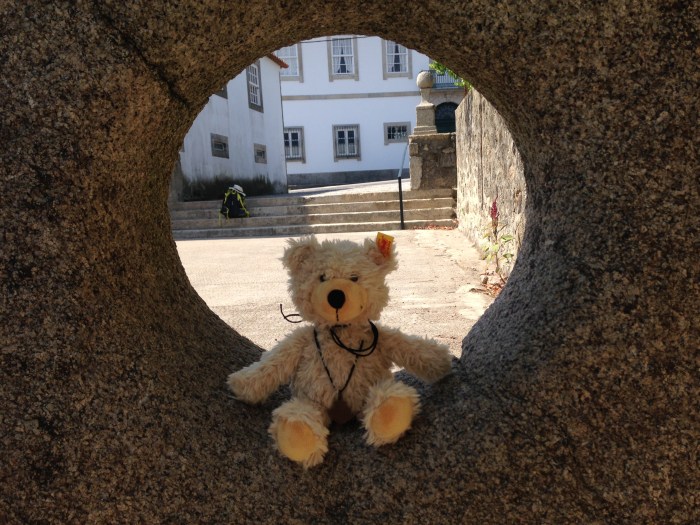
This is the alternative blog – based on messages home to my partner, Hazel. Carlos, by the way, is a small Steiff bear she gave me before I set off on the Camino Frances last year. He sits, usually with his head out, in a small side pocket of my rucksack.
Wednesday 31st August:
Eating a very good octopus and bean stew after a stroll round the very lively streets of Porto. One girl belting out an Eric Clapton blues. Marvellous evening views of the river from the cathedral, the port houses of the likes of Cockburn and Sandeman still lining the shore. Hotel OK. I’ve bunk beds in the room as well as double bed – should I need them!!!
Thursday 1st September:
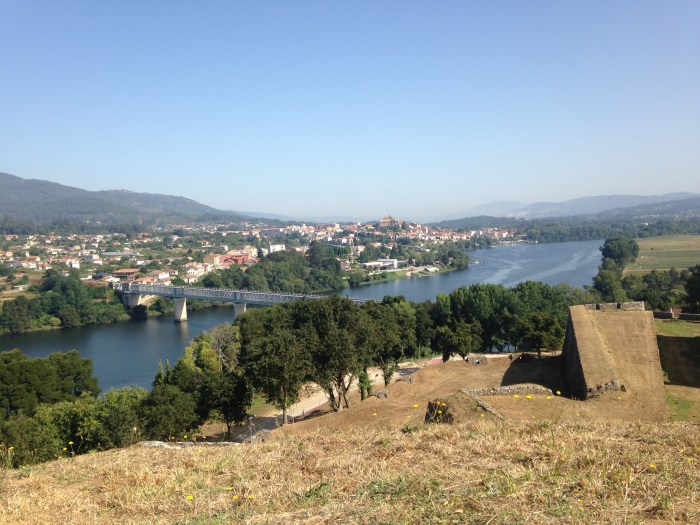
I’m sending a photo of Carlos (now on his second Camino!) taking in the view (the Atlantic, lost in the heat haze) just before we finished our walk. We (he and I!) are staying at the monastery in Vairao – beautiful location. Countryside surprisingly green, given the hot weather. Walked 17 miles in the hot sun.
Started 10.30, after exploring Porto by daylight, especially the cathedral – I loved the cloisters. Slept well and walked well. Only problem might be a plantar fasciitis recurrence – felt sore even before of started walking. Not bad, doesn’t really hurt… Staying in the high 80s here. I think I like it! Carlos thinks Portugal is …cool!
Friday 2nd September:
18 miles in 88 degree heat. Yes I did wear my sun hat! Shade always came to my rescue. Eucalyptus woods have a sweet smell! Two great cafes en route – they love peregrinos and make you feel like a celebrity. Barcelos is delightful – somewhere for you and I to visit when we do our northern Portugal trip!! (Did you know about that?) Tomorrow – 20 miles and no cooler – I’ll probably do 12 miles [I didn’t – I did 21] and stop off at an earlier albergue. Ponte de Lima does sound special.
There’s a spiritual quality in all this, somewhere, must remember that, and too much mega hot sun doesn’t help! Don’t worry – I will be sensible.
Saturday 3rd September:
Today probably the toughest of any Camino day – close on 21 miles in 90 degree heat. Took a longish lunch break, mega amounts of water – camels have a good plan, and did the last three hours down to Ponte de Lima in stages – 15 mins then water, then shade. Think feet OK, but they’re sore, and a blister needs watching! Wonderful rolling wooded country, maize and vines in abundance, but too little shade. Carlos complains he’s getting a tan! …Tuesday forecasting 40 degrees here – over 100F. Won’t walk after 10 – will begin at 6 maybe and make it a short day! [That at least was the plan!]
Ponte de Lima beautiful and bridge medieval, long and narrow, for pilgrims and horses, but the whole place is touristy. Currently sitting outside after a shower (communal!) and drinking a local craft beer….
Sunday 4th September:
Got to Rubiaes about midday after five hours walking – and that is enough! Sheltering in the albergue, as is everyone, no-one daft enough to be out there walking! Wonderful walk from the Lima valley – a high pass only 1400ft but rugged and the sun already hot. They’re collecting pine resin from the trees – plastic bags attached to capture – so a sweet smell. And big views. Hot tomorrow again – aiming for the Spanish border…[News that Strictly Come Dancing has started already]… God help us all! They’d all die dancing in this heat… Planning a 6.30 start – not too early – Roman bridges don’t look special in the dark!… Flip-flops a big success. Sore left foot no longer sore! But sore spot on right foot. Such is life!
Monday 5th September:
Having a coffee in Valenca, fortress above the Minho – view upriver takes some beating! Left at 6.10, arrived 11.30. Off to Spain in a few minutes – just 2km to Tui….
Now well-settled in Tui. Mixed dorms but we’re spared mixed showers! Breakfast with eccentric ex-postman from Wigan and chatted to Polish guy who has his own travel magazine, takes own photos and hates smartphone cameras! Otherwise I’ve been swinging along through beautiful country, Roman bridges – it was once a Roman road, wooded paths, a few red-barked cork oaks, and singing, and happily lost in thought – walking as the good Lord meant it to be. Heat building, but OK. Tomorrow is the mega heat day – should I leave at maybe 4.30? Could be 2 hrs walking in the dark… Time now an hour ahead – funny gaining an hour going north. Mega hot out there – can it really be that tomorrow will be 6 or 7 degrees hotter still?
Tuesday 6th September:
Our international party, Polish photographer, Antonio, Czech student, Michaela, and me, walked 22 miles from Tui to Redondela, leaving at 5.40 and arriving 2.10, in 97 degree heat. Feet done in but otherwise beginning to recover, aided by beer, water, bread and cheese. We kept talking and and helped push each other along. On my own – would I have made it? Other people on the Camino today included – more Poles, a group of Spanish scouts, and a Mexican couple. No Brits save me!… [Tomorrow] heading for Pontevedra. Easy walk, I think. Assuming I can walk! Feet in rebellion!…
[Message from home: ‘No Brit would be mad enough to walk in that heat.’] Are you suggesting I’m not British?! I’m not one of your lily-livered Brexiters! Antonio called out a moment ago – ‘How is Brexit?’ (meaning me) ‘Do not call me Brexit!’ I shouted back. Such are the burdens we old-school Eurobrits have to bear!
Talking of bears, Carlos got some serious attention today – he’s feeling better about things. Brave bear – coping with the heat. And I’m doing the walking for him, of course.
Wednesday 7th September:
Arrived Pontevedra 12.45, having left at 7.40 – last person out of the albergue. Most are gone by 6, but sunrise 8.10 here, and I want to see where I’m walking! Easy day, two healthy climbs, but sun came out late and I had my favourite breakfast – fresh orange juice, croissant and café con leche. Bounced along after that. Lesson for and from today – think of nothing, just take it all in! Staying in a cheap hotel – Hotel Virgin del Camino – better than vergin’ – it’s actually on the Camino! Now off to eat and sight-see.
Carlos’s fur trapped in zip but I think he’s OK…[‘Might Carlos like his head out of the rucksack, so he can enjoy the views…’] Carlos does have his head out of the rucksack, all the time. Only the rain would keep him in. Sometimes he stretches out a paw and waves as well!… I loved Pontevedra but wandered around too long, and my feet are very sore…
Thursday 8th September:
Arrived Caldas de Reis at 12.15 – walked non-stop from Pontevedra, not far short of 4 miles/hr pace. Too many slow Spanish walking groups and I needed to get well away from them! They talk! Beautiful gentle country, bright sun, and temperature high 60s. That makes two happy bears – Carlos tambien! Wondering whether to call him Carlito – little Carlos. Ibuprofen and blister plasters helping – feet doing better than I expected. Now enjoying bread and tapas lunch!… Amazingly I’m now halfway through this jaunt!
Friday 9th September:
Arrived Padron 12.30. Enjoying a very good menu de dia in a local restaurant! …very modern albergue – bunk beds with curtains! Big plus – they’ve done all my laundry! Shortish but beautiful walk – oak, pine, chestnut, under a deep blue sky. Chilly first thing. Bumped into Martin, who I’d met in Tui, and we did a short tour – walking up the hillside to where St James [doesn’t sound right if you’re a peregrino – has to be Santiago!] is reputed to have first preached the Christian message in what must have been about 40AD. Martin an Irish Catholic so a good companion for this! House/museum of a legendary Galician poet – Rosalia de Castro – up the road so I trekked off for a visit. Early start tomorrow – will be tight to get there in time for midday mass.
Saturday 10th September:
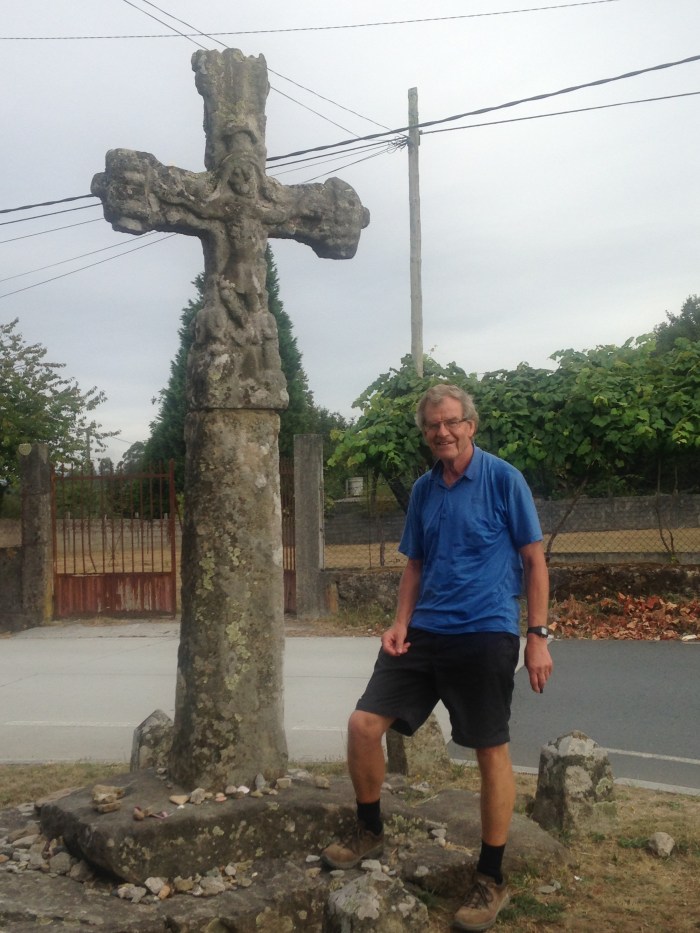
Photo [sent home, to Hazel, and to my son and daughter] taken a moment ago, 10.30, local time, 8 miles out from Santiago [I’m looking remarkably sprightly, all considered!] …
Arrived to music and carnival an hour ago. A mere 16 miles this morning and I chose to explore the longer way in – being a glutton for punishment (and I knew I’d missed the mass). Once I start moving I do walk fast – all that running and marathons and the like. Wonderful place to be – on the steps above the Praza do Obradoiro. Met my Czech friend, Michaela, from our big walk from Tui. Big shout of – Chris! Antonio around somewhere. And others I recognise – we’ve all walked a long way!
Sunday 11th September:
Mist down low over Finisterre [I took a bus, and did feel a bit of a cheat], there’s a little overhead sun but wherever I walk I won’t see much. Maybe it will add to be mystery, and there’s a lot out there….
The mystery is now the view, on a perfect evening! The mist cleared over the last hour. This is where you would, in classical times, pass over the horizon, to the other side, to the spirit world. No-one is closer than I am at this moment. Back in the now – you’d love it here – sun, sea and waves breaking gently. And warmth…. a wonderful day, in the end. I’d set out for the cape about 4pm and walked and scrambled and stopped and pondered and took photos till about 8.30. Magic, all a big surprise. No idea what I’ll do tomorrow. Just got back to the port (the cape is 2½km away) and I’ve a plate of salad, and a jug of wine, in front of me….
View from Cape Finisterre
Monday 12th September:
Damp, cloud down, forecast dreadful, no point walking 17 miles to Muxia [there will be, has to be, another time!], left Finisterre on an early bus, back to Santiago, thought I’d go to midday mass, but refused admission – my rucksack too big! Must have been by a centimetre! Maybe I look dissolute. [Tonight in a cheap hotel] tomorrow back at my favourite, the Balalada. So far a bit of a damp squib of a day!… Bought a shirt, so feel less scruffy, had a snooze, and a coffee with Martin … wonderful evening mass, felt inspired. A bit of a downer of a day early on but you can’t have the ups without the downs! Tomorrow it will rain, but I will smile!
View from my bedroom window over Santiago
Tuesday 13th September:
Sitting on the steps of the Praza do Quintana, near the Holy Door specially opened this year for Pope Francis’s Year of Mercy. But it seems to be just another entrance for the usual tourists – the message lost. Pilgrim mass in English this morning, lots of Irish, and an Irish priest officiating. We all introduced ourselves, said where we’d walked from – which was nice. Then I toured the monastery of St Martin, hard by the cathedral – full of altars and choir stalls which put San Millan to shame – but nothing quite to compare with the sculptures of Santo Domingo de los Silos. Galician (!) hamburger for lunch, with Stones tracks in the background. Sun now, after rain, but a chilly wind. Latest invasion of pilgrims has arrived – they’re everywhere! Each day they invade – proud to have been one of them. Funny to think – back home tomorrow night.
Wednesday 14th September:
Wrote a Santiago blog late on yesterday – still work in progress. But now fired up to get out and see things again! Funny being on your own – you can go anywhere, anytime you choose, yet you want to share it, and share coffees, and chat, as we did back in May [Pamplona, Roncesvalles, Castrojeriz…].
[Two big events, not mentioned in messages home – searching out the statue in the Alameda park of Rosalia de Castro, who is already my hero, and then the Museum of Sacred Art, with paintings and statues and much more on the Camino and on pilgrimages worldwide – few people there, and yet it’s one of the best museums I’ve seen anywhere.]
For cool damp weather, come to Santiago… Now queuing to board my flight…Bus to the airport took me via the last stages of the Camino Frances route into Santiago. Everyone wearing ponchos, and the rain then got harder. Lots of sun for them on the way – shame that Santiago lets them down now. But if they don’t know already – they’ll soon discover it’s one of the most remarkable places on earth!
[Carlos, sensibly, has stayed all the while inside his pocket!]
Reading Seamus Heaney’s Glanmore Sonnets, sitting beneath a tamarisk tree on the north Cornish coast.
…hankering after stone
That connived with the chisel, as if the grain
Remembered what the mallet tapped to know.
That ties in well with the landscape all about me, which has memories of many millennia stored within its rocks, ancient tracks, stone-hedged fields and sand dunes.
I love its blooms like saucers brimmed with meal,
Its berries a swart caviar of shot,
A buoyant spawn, a light bruised out of purple
Might that change the way you look upon the elderflower forever, or might it just be, depending on your mood, overwritten and overblown?
The tamarisk was planted long ago, when houses were cottages, and the land was ploughed, and the season was the farmer’s all year round, and not just the holiday-maker’s summer months. The wind scurries the fronds, a Cornish blue beyond and above, but they’re so fine that their susurrations lose out to the ash tree, which with the freshness of youth is a sounding-board for the breeze.
The tamarisk branches move uneasily, they creak, and the ash sways. The ash is all deep shade, the tamarisk a light touch of sun. A gull squawks, and when the wind falls low, there’s the distant sound of a combine harvester, for fields still do run away inland, when you climb beyond the pitched roofs and white facades of the holiday homes.
Inheriting books – that sets up a whole further range of problems. Problems I’m delighted to have but I’m also inheriting a responsibility. To a great aunt, who I knew well, but now I know her library – and I wish I’d known her better. Her books which take me through from 1910 to her death in the late 1990s are the story of her life – the intellectual, literary story. She read English at Oxford in the 1920s, but never worked, other than as a companion to a fierce-looking great-grandmother of mine, who I never knew.
When I downsized from house to flat I threw away some of the cheap novels (Everyman’s Library and the like) which had been her everyday reading staple – many duplicating books where I already owned copies, and others by authors hardly ever read today. But – for a few years now I’ve felt guilty. They were a mini-library, a personal story, and I wish we hadn’t parted company. I do sometimes imagine her up there, Auntie Frances, with a stern look and a gently wagging finger.
She was born in 1900 and her grandfather was the manager of a cotton mill, or so I understand, in Manchester, and he lived in Prestwich, and he was educated, a member of the new affluent middle class, that Manchester middle class which was the first real middle class in the whole wide world, and he was a book collector, and his books which my great aunt inherited were a pride and joy to her. And now to me.
As examples, two marvellous volumes, London City and London Suburb, which he subscribed for in the 1870s, and his name is in the back, along with all the other subscribers. Bound sets of Studio magazine. Beautifully bound volumes with tinted and tissued paintings of birds and flowers. Macauley’s History of England, in five volumes. Five – but I can only find four. I must have the fifth, surely? (I will be searching.) A middle section of binding on the spine of volume two has come away, and that is on a small pile of books to be repaired. The metal clasp on a miniature prayer book has already been repaired.
But my biggest puzzle is a volume where the front cover hangs by a thread, and the opening pages are missing. Two books are bound together – a bible from the 1730s and a prayer book from the 1780s. Don’t ask me why they’re bound together. I will need to research.
The more I explore behind the old bindings the more conundrums, and the greater my pleasure. I now have a bookbinder who can help me out. And I will read – in so many ways Victorian books are superior to those of our own time – finer bindings, and illustrations each one of which was a labour of love.
Thirty years ago my great aunt took one book from her collection and gave it to me as a present. Pigot’s County Atlas of England, from 1840. Individual county maps, and a four-way fold-out map of England. I loved it, and when I set up my own publishing company in 1989, the little-lamented Garamond, I published it as a facsimile edition. It looked and looks superb, and I took delight seeing it featured in bookshop window displays. But, the book itself, well, it had to be broken apart before being sent for repro, and it came back to me with the counties as individual parts, the boards (cover) intact, but unbound. And it stayed that way until a month ago, and now at a cost of £230 I’ve had it rebound, and I’m as chuffed as can be to have it there, on my coffee table.
There’s another story to the book. My great-grandfather, whose second wife was the fierce-looking (and black-robed) lady I mention above, was a successful builder – he built many the houses and shops which line the streets of Bramhall, my home village in Cheshire. And a young man, he’d worked for the rector of nearby Mobberley, the Reverend Herbert Leigh Mallory, the father of George Mallory, long a hero of mine, who lost his lfe along with Sandy Irvine somewhere above the Second Step just below the summit of Everest in 1924. His body was found in 1999. So my atlas would have been in George’s library in the Mobberley rectory when he was growing up. I like that idea, and wonder if he might have perused and pored over it as I like to do.
I asked Noel Odell, the last man to see Mallory alive, disappearing into cloud, when I met him thirty years ago at the Royal Geographical Society, whether he thought Mallory and Irvine had made it to the summit – he was sure they had.
There will be other stories, I’m sure. More bookish adventures.
A friend of mine lent me ‘Ex Libris: Confessions of a Common Reader ‘ by Anne Fadiman. And I will be forever in her debt.
Lending books – something Fadiman doesn’t have a chapter on in her wonderfully erudite and obsessive and mesmerisingly enjoyable book. I’m sure she does lend books to friends but books are for her, as they are for me, about ownership. Norma will get her book back – and I’ll buy my own copy.
One problem when you borrow a book: you can’t annotate – scrawl untidily in the margins. For Fadiman a well-annotated book is better than a clean one – so much better a used and loved and cherished book than a virgin tome, maybe even (sacrilege) with pages still uncut.
She loves typos, as we all do, especially if we’ve been editors. And I started my publishing life as a Penguin copyeditor. She quotes a prize find from a friend of hers, a sentence in a manuscript sent to a San Francisco publisher:
‘Einstein’s Theory of Relativity led to the development of the Big Band Theory.’ (Could, I wonder, E be for Ellington and M for Miller?)
She’s also wonderful on plagiarism, and I fully acknowledge my source. Ex Libris, by Anne Fadiman.
‘One day when Sir Walter Scott was out hunting, a sentence he had been trying to compose all morning suddenly leapt into his head. Before it could fade, he shot a crow, plucked a feather, sharpened the tip, dipped it in crow’s blood, and captured the sentence.’
I like this and would like to replicate it, out on one of my walks, or long-distance runs, but I don’t hunt, and I don’t think I’d be too keen on plucking a dead crow. Writing in blood? Maybe. To establish an undying bond, over a dead crow? Maybe not. But there are sentences which occur, phrases, at the wrong moment, with no pen or pencil to hand, and typing into ‘notes’ on my iPhone seems a bit feeble. So what to do? I could carry a catapult and practise my skills, in the manner of David, with a stone or two. But I might kill a Philistine and miss the bird…
Fadiman having put aside a much-loved pen now uses a word processor. And she does what I do, she ‘moves the rejected phrases to the bottom of the screen, where they are continuously pushed ahead of the text in progress like an ever-burgeoning mound of snow by a plough’.
Great, but snow hardly describes my mis-spellings and mis-statements. I’ve used the same ploy writing serious e-mails, pushing rejected text to the bottom just in case it’s useful. Then forgetting it’s there and sending the e-mail with gibberish attached.
Both Fadiman’s parents were writers. A distinct advantage, if you as the offspring are also that way inclined. If not I guess you take up pogo-stick dancing, or similar, and pretend that’s your passion. It’s not just in the blood that books are found. They’re also out there, on the shelves, in your library, your attic. (‘No way will we have books in the dining-room,’ I remember being told.)
My problem is that while the shelves are bespoke and individual shelf heights can be adjusted, that means removing all the books from one section of my library, adjusting the shelves, and then discovering that, yes, you can now display your art books upright, but you’ve no longer room for those awkward over-sized B-format Penguins. I can cope with the Adeles (A-format), it’s the Emperors that cause the problem.
Fadiman quotes from three-times prime minister William Ewart Gladstone’s inspired and obsessive 29-page tome ‘On Books And The Housing Of Them’. He fantasised about library shelves on (tram)rails, so the shelves can be pushed together, and pulled out as need be. But maybe not in my sitting room, which doubles as my main library. (The Benedictines at Douai Abbey spent £1/2million on doing just that, building a wonderfully compact library containing tens of thousands of volumes from the libraries of now defunct and monkless monasteries. The books had nowhere else to go. How often are they consulted, I wonder? Theology I guess does go on forever.)
They read aloud a lot in the Fadiman household. Not least bedtime reading, when she and her husband read aloud to each other. She approves of the poet Heine, who ‘read Don Quixote to the trees and flowers in the Palace Garden of Dusseldorf’. That’s the kind of snippet I like. Not just any book, or any place. And not just quoting or murmuring, but reading aloud to the trees and flowers.
There were empty benches in the Parks in Oxford this afternoon. The sun was shining. I had my book with me, I could have sat down – and read aloud. I had trees and flowers all around me.
Books do get squashed between other books, and if they’re thin and almost spineless, they’re forgotten. A problem I recognise. But worse for me is having to tuck books behind, in a second rank, as a necessity, being the only way I can house all my books. (Yes, I have thought of buying a large house in the country, or a small house, with one very big room. Two can share a single bed, and we all had galley kitchens once.)
My Penguins, hundreds of them (once a Penguin always a Penguin), already on an unreachable top shelf, have a front and a back row. (The back row isn’t happy.) I’ve catalogued them all, so I know what’s there, but sometimes it seems almost quicker to go out and by a new book.
But, one big advantage – surprise. ‘I never knew I had that,’ I’ve exclaimed a few times.
Gladstone believed that his shelving system might ‘prevent the population of Great Britain from being extruded into the surrounding waters by the extent of their own libraries’. Maybe he imagined a future where we’d all be literate, and we’d put away all trivial pursuits, and buy books, and read – but instead we have our televisions, and our computers. We and our surrounding waters are safe…
I’m on the side of libraries, but say that to almost anyone these days and they look askance, they look amazed. Serious bibliophiles who mull and mutter through endless happy hours in libraries were then and are even more now a breed apart.
There is too much woolly talk and poor journalism on the subject of Brexit. Too many people asserting that one referendum vote is enough – enough to turn history on its head. One moment in time – and we have a paradigm shift.
An example was on Radio 4’s The Long View, with Jonathan Freedland, this morning (1st August). I missed much of it, so if I do it an injustice I apologise. One of the contributors recognised that the way the country is split is a big issue – with big Remain majorities among the young, the educated, and city dwellers.
But another suggested that academics (I think we’d consider them educated) were horrified because, whereas elections over the years had been squabbles between right and left, now their own personal interests were affected. The suggestion being that their opposition was self-interested and self-indulgent. But – they, the academics, know – and I know – and my friends know – and a few million others out there – we all know – that our concerns lie at a deeper level – about a way of looking at the world, with an open not a closed mind – about being European and internationalist – taking a positive rather than a cynical view of the world – looking to the future with optimism. (It’s there writ large in the comparison between all the enthusiasm and aspiration of the Democratic convention last week, and the negativity of the Republican convention the week before.)
The programme enlisted Diarmaid MacCulloch, Oxford historian, to make a ‘long view’ comparison between Henry VIII’s break with Rome and Brexit. It took a long time for the implications of that break to work through the country, to rework the fabric, to change irrevocably beliefs and practices – twenty years, forty – and longer. Could we be in for something similar this time – a slow, gradual, inexorable change to a different view of the world – to a different world?
To my mind the very notion that there’s a comparison is absurd. I’d agree that Henry’s decision was pretty arbitrary, a whim, the result of an obsession, influenced by a (un)favourable reforming wind from the continent, and an executor and manipulator in chief who knew how to execute (too literally) and manipulate – yes, maybe we can have fun drawing comparisons. But that there are any real searching comparisons with any relevance for our time – that’s a load of baloney.
A 52:48 vote in favour of an ill-thought through proposition based on misleading and sometimes mendacious arguments does not represent a paradigm shift.
As another example of bad journalism we have Ed Conway in The Times. (I’m relying here on a summary of his article in The Week).
The wider world is all too keen in Conway’s view to blame the world’s problems on the Brexit: ‘Britain’s great gift to the world: a giant pre-cooked excuse for absolutely everything.’ That’s nonsense, he says. We’d all agree. And it’s not of course what the wider world is saying. Brexit is, however, part of a big picture that the wider world does find worrying.
For Conway the problems in the world economy have been ‘baked into the system’ for some time. To be specific: unemployment rates, productivity, demand. But it’s been ‘easier to blame (problems) on Brexit’.
Arguing from one dubious proposition to another, he goes on to suggest that ‘if anything Brexit presents an opportunity’. ‘For years G20 members have been paralysed in the face of a global showdown. If Brexit provides an excuse for tackling this by spending more on infrastructure, tearing down regulations, printing more money, so much the better’.
An excuse to spend – to spend our way out of a crisis. Brexit it seems could be an excuse for throwing caution to the winds. More an argument I associate with the Corbynite left.
There are good arguments for increased spending on infrastructure, and there’s a debate about whether a further dose of QE would be helpful. But that debate should have nothing to do with Brexit. Unless it is – as this is how I’d construe Conway’s argument – we spend and print money out of desperation following a post-Brexit slump in economic performance and confidence.
I started with The Long View, and a massive non-sequitur – Henry VIII and Brexit. And I’m ending with another – Brexit and global economic reform.
The pre-referendum debate was characterised by wild assertions and woolly thinking. The post-referendum ‘debate’ is sadly no better.
Stefan Zweig was an Austrian by birth, a European by instinct and vocation, an author and poet who became the most translated writer in Europe in the 1930s, a Jew, an exile, a refugee, who in spite of two world wars and exile continued to write and travel and argue – until in 1942 he and his wife took their own lives in Brazil.
He championed international cooperation, championed culture and the intellectual life – his aspiration that they might bring Europe together, and triumph over petty nationalisms.
In the World of Yesterday, ‘one of the canonical European testaments’, he tells the story of his life and times from school days to 1939. Curiously in the UK he never achieved the fame he found in Europe.
Maybe that should change.
*
On Europe….
‘It will be decades before that other (trusting) Europe can return to what it was before the First World War…….bitterness and distrust have lurked in the mutilated body of Europe.’
As more became known about Hitler and his ready resort to violence ‘the conscience of Europe’ chose not to take sides, because all violent acts were within Germany…. (my italics)
After the First World War, ‘The orderly German nation did not know what to do with its liberty, and was already looking for someone to take away it away again.’ (Today the guardians of that liberty hold sway, but the threat is always there, from neo-Nazis, and from political parties such as Alternative fur Deutchland.)
In Austria in 1937, before the Anschluss, few at least publicly made the connections with 1914 – no-one wanted to. Zweig describes vividly a traditional Christmas in Vienna in 1937.
All the while a new power out there, aiming to seize government, ‘regarded all idea we valued as outmoded – peace, humanity, reconciliation…’
He compares the English with Austria, Germany, or France – they lived more quietly, more content, thought more about their gardens.
(We lose so much if we deny ourselves that European focus – if we imagine the values we hold sacred are specially English, or British. Reading Zweig reminds us what it was like living through that remarkable period from 1900 to 1940. We are part of Europe, our outlook and culture – and origins. The rest of the world sees us as European – we are foolish to think otherwise. )
On government – and the people …
In the run up to 1939 (and too often true today): ‘ … 10 or 20 people (in Downing Street, the Quai d’Orsay…), few of whom had ever shown any evidence of any particular intelligence or skill were talking and telephoning and coming to agreements which the rest of us knew nothing about.’
Zweig ‘knew that the vast majority always go to whichever side holds the balance of power at any given moment.’
On armchair revolutionaries…
Zurich in 1916 – the Zurich of Dada – Zweig had never met such an impassioned and varied mixture of people and opinions. Since his death Zweig’s been accused of being a coward for not coming out more strongly against the war. His comment about ‘coffee house conspirators’ gives the answer – his disdain for ‘professional revolutionaries raised from personal insignificance merely by adopting a stance of opposition’.
(There were many such – and there were as I well recall in the 1970s when I was a trade unionist –Father of Chapel of the Penguin Books NUJ chapel, and they are still very much out there today – and will be in every generation. )
On the arts…
The poet Rilke, a friend of Zweig’s – ‘Can there ever be such pure poets again…all they wanted was to link verse to verse perfectly in quiet yet passionate endeavour, every line singing with music…. can that kind of poetry exist in our new way of life… which chases out peace of mind like a forest fire?’
On being a refugee, in England….
‘I, the former cosmopolitan, keep feeling as if I had to offer special thanks for every breath of air that I take in a foreign country, thus depriving its own people of its benefit…’ Zweig had ‘trained his heart to beat as a citizen of the world for 50 years… On the day I lost my Austrian passport I discovered, at the age of 58, that when you lose your native land you are losing more than a patch of territory set within borders.’
On being Jewish….
Jews used to have ‘an inviolable faith in their God’. But they were many peoples, multiple languages, now thrown together – what did they have in common? And they asked – ‘what is the reason for this pointless persecution.’
The questions asked by Job. [‘Why did I not perish at birth, an die as I came from the womb?’ (3:11). ‘What strength do I have, that I should still hope? What prospects, that I should be patient?’ (6:11)]
After the Anschluss – his elderly mother enjoyed walking – but now ‘no Jew must sit on any public bench’. She no longer had a place to rest. And that was almost the least of the strictures which took down and took apart Jewish life in the city.
And at the last….
A confession- ‘I do not mourn for what I have lost – the art of saying goodbye to everything that was once our pride and joy..’
And yet – ‘But in the end every shadow is also the child of light, and only those who have known the light and the dark, have seen war and peace, rise and fall, have truly lived their lives.’
*
Zweig has many lessons for us, as a European, a Jew, a citizen of the world, a man of culture and intellect, with many flaws as have all of us – but just maybe someone to champion in our own times, when uncertainties are greater, and crises seem – and are – closer to hand, when there’s a sense that the post-war consensus might just break apart, and we need reminders, we need a champion or two.