Back in January I wrote a poem which touched on a nightmare which I trusted with the bright and clear skies, and warmth, of June would evaporate. It didn’t, of course.
There is a foolish innocence abroad in the land. I thought back in January that we could all handle it with gentle irony. Now it’s for real – and the irony, still gentle, has a sharper focus. Irony better than anger? I’m not sure!
*
A puzzling innocence at home on English shores
Is it a puzzling innocence, that we should wish
to shake ourselves free of all the sand and salt,
a dog out of the waves,
more than sand and salt –
we would be somewhere else, another beach –
the same waves, the same wrack and kelp,
but the sea would be somehow different,
the tide driven by another moon and
under that new moon we’d trade our goods
beyond our shores unfettered, be more English –
the moon an English moon –
ours would be
a calculated innocence, a glorious future,
an imagination of a past when we rode oceans –
grew rich on other lands – unshackled, the sea
we’d command would stretch no more than
a few miles off our shores, yet we would
still be lords – you say,
it’s bright-eyed innocence to see only the benign, the old navy afloat, a few new tugboats on calm and peaceful waters –
but who needs containers in this grand design –
where once we traded pounds we’d trade in pence
and who are you to say, that’s not a better way
Yesterday was All Hallows’ Eve, which makes today All Saints’ Day. Yesterday was also in warm and brilliant sunshine the last day of autumn (by my calculations anyway!) – the autumn colours burnt in the sun as I’ve rarely seen them, a multitude of shades, with their own luminescence – as if they didn’t need the sun to make them glow. Today is the first day of winter – the cloud is down on the hills, there’s a chill, the fire must be lit soon, and the leaves are thick on the ground. I raked them in the sunshine yesterday, but they’ve returned, and if I rake again, this time in the damp and gloom, they will return again, until the last one has fallen and I can put the rake away.
Yes, there’s an elegiac quality to all this. I listened to the adagio from the Elgar violin concerto driving back along the A419 heading toward the Cotswolds yesterday. That caught the mood. I knew this was the last day, the last of autumn, and there were not two hours till sunset.
The day before I’d listened to David Mellor on Classic FM, playing music from the Philharmonia under Otto Klemperer. A recording of Mahler’s Resurrection symphony when the great conductor was already in his 80s. He took it slowly. About the same time the recording was made I was, I remember, at a party at Professor Gombrich’s house. Ernst Gombrich was my professor at the Warburg Institute. Frau Gombrich mentioned they were going to hear Otto the following day. Otto being Klemperer. All with Viennese Jewish backgrounds, and the connections were still strong.
Klemperer had been recommended sixty years before by Gustav Mahler (also that Jewish connection) to an orchestral position, and I felt my own connection listening to the final ecstatic bars of the symphony to Klemperer and Mahler. Almost a laying on of hands. Ridiculous in its way, but the music took me to another level. Triumphant – but also elegiac, and intensely moving.
Mahler died young, and two world wars had to work themselves out before Klemperer stood before the Philharmonia in the late 1960s.
I’ve felt betrayed by events this year – my values betrayed, values by which I’ve conducted by life over almost seventy years. The autumn leaves, the music, a sense of loss I wouldn’t ordinarily indulge. But I did this time, this once, just this once.
A brief note – in the end not quite as brief as I intended! My reason for this post – to explain why I am not one of those who voted Remain but is now prepared to accept Brexit, to accommodate – accept that the vote has happened, argue we should make the best of it and get on with life.
A few reasons, in no particular order, as they say on Strictly Come Dancing, as follows….
The vote was won on a basis of a false prospectus and false promises. Even now – press headlines pick up James Dyson and Lord Bamford, two of the rare industrialists who supported Brexit.
We are a parliamentary, representative democracy, and we should live and die by that. Not be ruled by plebiscites, which are the first and last resort of populists and demagogues. (We currently have an unelected government, governing to its own and not the 2015 Tory manifesto, and which anticipates pushing Brexit through using the royal prerogative without, if it can help it, reference to parliamentary discussion or vote.)
The European Union is a remarkable institution. Unwieldy, bureaucratic, fractious, but it is the extraordinary coming together of 28 different nations, each passionate about its own interest, but likewise seeing the benefits, after two thousand years of conflict, of coming together. Our efforts should be concentrated on reform not withdrawal. (The EU has been pilloried for its poor handling of the refugee crisis, but I wonder how it could have been handled well, given all the fear and anxieties felt by 28 countries with very different histories. Had here been no EU, how would the crisis have been handled? With any less agony, any less suffering?)
A war which tore Europe and then the world apart ended only seventy years ago, a year before I was born. Before that another war, arguably even more terrible. We’ve had seventy years of peace, unprecedented peace. The EU symbolises and acts out that peace.
As an economic union, despite all the talk it’s a significant success. No serious economist would argue otherwise. Run a business which trades with other European countries, which I’ve done, and you’re aware of all the benefits. The danger is you take them for granted – assume they’d have happened anyway. There are also extraordinary levels of scientific, environmental and cultural collaboration, for which the EU has provided both the mechanism and inspiration.
The EU isn’t restrictive – unless you’re opposed to workplace and environmental rights. And we’re not going to do without the regulations by asserting our independence – if we want to trade with Europe, the regulations are the terms.
Where there is unnecessary red tape we need to be in there, ensuring it’s removed, instead of being passive observers. We are sacrificing engagement, and influence. We’ve used that influence well over the years.
Immigration is a perceived threat – where immigrant numbers are highest we had the highest Remain votes, where they were low the highest Leave votes. A perceived threat – nowhere near the actual threat that much of the press played up. Likewise no evidence that immigration has held wages down. Yes, pressure on schools and housing in certain areas – and the last government singularly failed to recognise that immigration, and other changes in our working lives, must be reflected in improved infrastructure. (Levels of immigration in recent years have been too high – I’m not arguing otherwise – and politically they’re unsustainable at this level. How you handle this while preserving freedom of movement is a mighty challenge, but not remotely a sufficient reason for Brexit.)
Behind immigration lies the identity politics, aligned with nation and race and social group, which we should be fighting every step of the way. Espouse patriotism not separatism. Patriotism based upon British values of openness, tolerance, free speech – and a tradition of welcoming strangers, bringing them into the fold, and letting them benefit our life and culture – blending in as countless immigrants have done before. Likewise refugees – there are limits of course, but our first instinct must be to welcome.
Related to this, the argument that British, the U.K., England, isn’t the country it used to be. The old generational cri de coeur. True, the pace is faster, and the landscape much impaired. But there have been many radical improvements, too easily discounted. As for the negatives – the EU takes the rap. I may personally be in the old codger bracket, but I’m with the younger, pro-EU generation.
There’s a mood out there, encouraged by the right-wing press, and played along with by the BBC, that somehow it will all work out. In Philip Hammond’s words, there will be bumps in the road. There’s another much more likely scenario where we find ourselves out on a limb, with an agreement which is dictated to us, and which we accept out of necessity. The economic auguries are not good. Put simply, a crisis awaits us.
There is so much else that matters out there in the world which we were just about facing up to, and they’re now on the back burner in terms of government and public attention. Global challenges, new technologies, fundamental changes in our working lives. At home, infrastructure, the NHS – requiring focus and funding when attention is elsewhere.
We have a hugely inflated view of our presence and reputation in the world. We embody as a nation tolerance, free speech, we pioneered modern representative democracy, the world plays many major sports by rules we laid down. But this is Britain as was. Our current behaviour simply alienates.
To end, two further points –
I’ve mentioned openness above. We have always been open to the world, and the danger now is that we shut ourselves off. Look to the past. Seek one-off deals when others work together. Openness is state of mind, and in an atmosphere of fear and apprehension, in great part built up by the media, it is now challenged as never before in my lifetime.
In direct contradiction to Theresa May’s comments, whether we like it or not we are citizens of the world, citizens, along with all our neighbours, of Europe, and citizens of the U.K. My patriotism is undiminished, I’m British to my last breath, but I also share a common humanity with every man and woman on the planet.
And finally – never imagine that the change you wish for works out as you anticipate. It will not, and never has. Gut instinct will never provide. A wing and a prayer will never suffice.
I remember one egregiously daft piece imagining a post-Brexit Britain in 2025 by Daniel Hannan in the Telegraph. It was the stuff of dreams, and typified the dream world in which Brexiters exist.
Afoot and light-hearted I take to the open road,/Healthy, free, the world before me, /The long brown path before me leading wherever I choose. Walt Whitman, Song of the Open Road
Whitman walked, we’re driving. We’re in the USA. A far cry from the Camino. And yet….
We’ve not planned our journey, we don’t have expectations, there isn’t a goal. There’s no history along the way, the road is open, everyone and no-one has trodden this route before us. Encounters with God are accidental not planned. We don’t walk or shuffle, we drive. Our minds picks up the blisters, wheels the wear and tear, not our feet.
We travel in a straight line, travelling west, heading for the sierras and the ocean. America travels in straight lines. Or back east. Start in New York, or California. Route 1 or Route 66, or the Pacific Coast Highway. Keep travelling.
The hobo, riding the blinds… rootless … looking for work: ‘I’ve been doing some hard travellin’, as Woody Guthrie sang.
The Beats by contrast had it easy. Kerouac was out of Columbia University. But like the hobos they were footloose, in mind and body. Searching for God, as Kerouac put it, not work.
Heirs of Whitman, and Emerson, and Thoreau. Even John Muir, though the Beats travelled the road not the wilderness.
They’d escaped the impact of war, the road network arrowed across America, an invitation, the cars that travelled it were streamlined. How lucky and how unlucky they were. War and its aftermath were three thousand miles away, too young to fight or worry, they didn’t have to agonise over combat or parade a political conscience. They were beyond their upbringing… drugs and sex came easily. And jazz. California Zen was a convenient religion – Dharma Bums as well as On the Road.
The Midwest and California have their own dreams and myths. The Beats were originally out of New York, but found California. California lifestyle reinterprets America. Putting up a different dream against New York. Not a Hollywood dream. Precursors to hippies, but they didn’t seek to change the world – not just yet. Challenge because they couldn’t help it – witness the obscenity trials – but not change it. America was their head space, not a place beyond.
They could be measured, a little bit lyrical:
‘Nothing behind me, everything ahead of me, as is ever so on the road.’ (Kerouac, On The Road)
And out of their minds:
‘I saw the best minds of my generation destroyed by madness, starving hysterical naked,/dragging themselves through the negro streets at dawn looking for an angry fix,…./who passed through universities with radiant cool eyes hallucinating Arkansas and Blake-light tragedy among the scholars of war,/who were expelled from the academies for crazy & publishing obscene odes on the windows of the skull….(Howl, Ginsberg)
And as for me…
It’s 1971 – I’m on the open road, on the Beat trail, starting in New York, ending in California. A road journey, yes, but no automobile of my own. And I’m not hitch-hiking. Taking Greyhound buses city to city. The bus has its own iconography. Bus stations, hostels, camping out with friends in New Jersey, Toronto, Atlanta, Colorado, San Francisco, San Diego. Sleeping rough in Chattanooga. I couldn’t listen to music – but I could read. So Whitman and his streams of consciousness my companion. And Albert Marcuse. Mine was a counter-culture. I might teach history on California, but I wasn’t planning to sully myself with any other work along the way. No encounters with God, but charity from a Baptist preacher who paid for my breakfast and invited me to lunch with his family – but first I must attend his Sunday morning service, and hear him preach.
The long road north out of Texas, straight and parched and empty. Colorado I sensed was still Indian country. San Diego: we were all still hippies at heart. Barefoot and beaten by the sun. I could have tried surfing but instead I headed south, took to the road again, to Mexico. But the Mexicans wouldn’t let me in. Hair too long. Strange irony. They weren’t sure they wanted me back in America either. They cut back my visa to one month. I returned to Mexicalimy hair shorn and my ears, unaccustomed to the sun, grew burnt and blistered, as I headed south to Oaxaca, the Yucatan and Chichen Itza.
Did the road came first, or the need to travel it? The road without destination, always going somewhere. Road movies aren’t about physical, but personal destinations. About setting out and avoiding arriving. Not seeking self-knowledge …but maybe achieving it. Though not knowing what to do with it.
My trip was my own road movie, before they invented the genre.
The road’s just one agenda for America. America has multiple agendas, it’s own powerful myths and images, but they have a kind of surface quality. Still a dream. Europe has multi-thousand years of history interwoven into its structures, artefacts and traditions. They root us, define us, hold us back and lift us up – America isn’t tied down – it looks for, loses, its way, finds it again.
James Dean on the one hand, Howl on the other. Drugs, sex, Zen … they are unto themselves, not adjuncts of another culture, a music, a street culture.
I’ve avoided the noise and anger and foolery of America for a while. But I’ll go back. Maybe because there’s no place for complacency – and no place for rebellion – quite like it. It has open spaces, and straight roads, and you can still be alone there. And the skies are big. And there are millions there like me. Chugging along, rebels at heart.
Working class – who is working class these days? The numbers of Americans defining themselves as middle class are in decline: 48% now consider themselves lower or working class. There are similar shifting sentiments in the UK.
And where do the old values of social liberalism (for a definition of social liberalism see * below) and social justice fit within this changing spectrum?
In both the USA and UK a new identity (nation, race, interest group) politics is taking hold. At the expense of both a more liberal outlook, and ‘the more conservative Labourism that might still stand the best chance in small-town England’. (David Marquand)
Taking Labour first, what the old Left hasn’t accepted is that the working-class solidarity of old, which has inspired the Labour movement for 150 years, is gone forever. And that could include Marquand’s ‘more conservative Labourism’. Left-intellectual radicalism and working-class aspirations no longer gell as once they did. Grinding poverty is no more, the old Marxist underpinning likewise, and there’s an alienation, a boredom and increasingly an hostility toward the political process.
And intellectuals, never too popular in the UK, are out of fashion as never before.
The popular instinct, as the Brexit result revealed, is to hold on to what we have. Immigration, globalisation, new technologies, the old politics, all are suspect. There’s support for renationalising the railways, but not for wider state intervention.
Maybe the Corbynite left will convince us otherwise, but I think they’re simply out of tune with the popular will.
So too social liberals – they’re also out of tune with broad sections of the population, who only see government indifference to unwanted changes in their lives – housing shortages, pressures on services, regional development, immigration.
It’s addressing these issues, rather than an overtly radical political prospectus, that will win people back to a liberal agenda.
Likewise, this should be Labour’s policy focus. Radical at heart, but pragmatic in practice. Unless you’re happy in the wilderness.
*Wikipedia has a helpful definition of social liberalism: Social liberalism is a political ideology that seeks to find a balance between individual liberty and social justice. Like classical liberalism, social liberalism endorses a market economy and the expansion of civil and political rights and liberties, but differs in that it believes the legitimate role of the government includes addressing economic and social issues such as poverty, health care, and education. Under social liberalism, the good of the community is viewed as harmonious with the freedom of the individual. Social liberal policies have been widely adopted in much of the capitalist world, particularly following World War II. Social liberal ideas and parties tend to be considered centrist or centre-left.
There’s a perverse pleasure in wading through reviews of books and articles on subjects I know nothing about and may never encounter again. On occasion something hits home. One example: Terry Eagleton in the special Cheltenham Festival Times Literary Supplement edition, on everyone’s favourite subject, post-structuralism:
‘In its curious blend of scepticism and euphoria post-structuralism is a form of libertarian pessimism – one which dreams of a world free from the constraints of norms and institutions, but which is not so incorrigibly naïve as to believe it could ever come about.’
I could dine out on that one!
‘The revolutionary elan of 1968’ was followed by ‘the disenchanted mood of its political aftermath’. I remember 1968. Too well.
It’s a pattern oft-repeated. More recently we’ve had the frustrations of the Obama years, when ‘yes we can’ didn’t quite happen. (Maybe it never will.) The aftermath of the 1989 and the fall of the Wall. Occupy and the now empty squares of New York and London. Above all the Arab Spring, and its brutal aftermath.
But we won’t and can’t let our optimism die. I’m one of millions now and forever who believe in social justice, opportunity, capability, compassion. We rejoice when we see progress, we’re despondent when we see it pushed back. But we don’t despair.
We don’t of course always agree with each other. Do we work with the system, or oppose it – and by what means? The divide between global and anti-global perspectives is vast. Many (not all) proponents of big government and small government have the same end in view but believe in radically different ways of getting there.
I supported and support Obama, always believed Occupy wasn’t sustainable … Bernie Sanders I admire, Corbyn I don’t. We will bicker and insult and traduce the motives of others, while still aspiring to the same humanity.
And we will undermine each others’ efforts. Refuse to vote for Hillary. Battle it out for the soul and machinery of the Labour Party. And if we’re not careful – and we haven’t been of course – let another party in, a party which doesn’t define compassion and social justice quite as we do… which puts up barriers rather than engage with the world. Abandons institutions rather than seeks to reform them. Follows the populist piper, who advocates easy solutions, and plays to prejudice.
There are many good reasons for retiring to a monastery or a country cottage or sitting room and TV, and disengaging – and yet we hang in there. If we keep open minds, listen to each other, avoid scorn and hubris, remember that we’re ultimately on the same side – then we might just make progress.
Another remarkable discussion at the Cheltenham Literature Festival. This time on countering extremism. How best to handle radical Islam is a contentious issue. And that’s a significant impediment in itself. But first and foremost, we have to be better informed.
Peter Frankopan, who chaired the panel of three (see * below for the participants) asked the audience, a full house in the town hall, how many of us had read the Koran. Maybe two or three put up their hands. We rely too much on opinions, commentators and hearsay, selective reporting and prejudice. Sadly I guess most of us won’t be rushing off to buy and read copies. But we owe it to ourselves, to the Muslim communities in our midst, and to our own futures, to be better informed.
Continue as we are now, and we will continue as polarised communities.
Radical Islamists argue that the West and Islam are incompatible, put a distorted view of Islam up against a immoral West beyond redemption. So young Muslims, already feeling excluded, feel they have to take sides.
As a society, whatever faith or non-faith we profess, we need counter-arguments, and at the core of these arguments must be inclusion – Muslims should be, must be, as much a part of this society as Christians. Prejudice is a conflicting and self-defeating agenda. Achieve inclusion, and we can make democracy, liberty, free speech shared values, across all communities.
Inclusion requires commitment on both sides, on all sides. We have a long way to go.
*Chaired by Peter Frankopan, and drawing on the experience of Sara Khan, founder of the charity Inspire, which challenges extremist ideologies in Muslim communities, Peter Neumann, academic and author of ‘Radicalised’, and Hanif Qadir, a one-time recruit to radical Islam now working with young people in danger from radicalisation.
Last year walking the Camino across Spain I put all thoughts of politics out of my mind. I posted a blog when I returned, entitled ‘On being a European’. I had confidence a European and international outlook would win out in the end, whatever the short-term travails. The Brexit vote hit that confidence hard, but walking the Camino Portuguese, and the passing of the weeks, has helped bring calm and perspective. And a shrug of the shoulders – can we really be so daft?
At Cabo Fisterra, Cape Finisterre, where I ventured after Santiago, I clambered down the rocky slope below the lighthouse, and looked out west, over a stretch of ocean which to the Romans would have been at the very edge of the known world – finis terrae. The ocean as the Styx, and somewhere out there would have been Charon, with his boat, ferrying souls.
High cloud patterned the sky but didn’t reduce the sun’s intensity. Mist held to the coast behind me, but not out to sea.
In medieval times, likewise, this was the end of the world, and pilgrims would continue beyond Santiago to Finisterre. In the voyage of St Brendan he sails out west from Ireland and passes over into paradise.
I’ve this fantasy of May, Davis, Fox and Johnson, sitting in a restaurant, at the end of the world (borrowing from Douglas Adams!), having a last meal before they cut ties with Europe and venture off into the unknown. The ocean is peaceful just now but the autumn and winter storms will be mighty.
On another tack, but still in Spain, there’s a quote I like from Gerald Brenan’s classic book, The Face of Spain, about Spain, but more applicable to the UK just now: ‘I do not know where we are going, but I do know this – that wherever it is we shall lose our way.’
And China…. thinking walls, not oceans…. I’ve a sense that the Emperor Shih Huang Ti’s behaviour, as recorded in Richard Flanagan’s novel, The Sound of One Hand Clapping, might just have relevance to our own times: he ‘ordered the construction of the Great Wall and the destruction of all books preceding his reign, so that history would henceforth begin with him and his wall.’
In this post-expertise age, we are in a not dissimilar place. We might just finding ourselves using a new, unknown and very friable building material, not stone, not brick – but brexit. On one side of the wall, the old Europe, and on the other, the ocean.
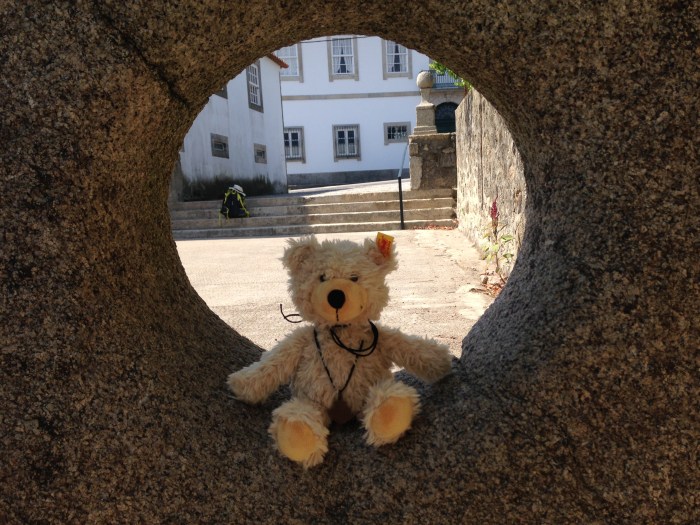
This is the alternative blog – based on messages home to my partner, Hazel. Carlos, by the way, is a small Steiff bear she gave me before I set off on the Camino Frances last year. He sits, usually with his head out, in a small side pocket of my rucksack.
Wednesday 31st August:
Eating a very good octopus and bean stew after a stroll round the very lively streets of Porto. One girl belting out an Eric Clapton blues. Marvellous evening views of the river from the cathedral, the port houses of the likes of Cockburn and Sandeman still lining the shore. Hotel OK. I’ve bunk beds in the room as well as double bed – should I need them!!!
Thursday 1st September:
I’m sending a photo of Carlos (now on his second Camino!) taking in the view (the Atlantic, lost in the heat haze) just before we finished our walk. We (he and I!) are staying at the monastery in Vairao – beautiful location. Countryside surprisingly green, given the hot weather. Walked 17 miles in the hot sun.
Started 10.30, after exploring Porto by daylight, especially the cathedral – I loved the cloisters. Slept well and walked well. Only problem might be a plantar fasciitis recurrence – felt sore even before of started walking. Not bad, doesn’t really hurt… Staying in the high 80s here. I think I like it! Carlos thinks Portugal is …cool!
Friday 2nd September:
18 miles in 88 degree heat. Yes I did wear my sun hat! Shade always came to my rescue. Eucalyptus woods have a sweet smell! Two great cafes en route – they love peregrinos and make you feel like a celebrity. Barcelos is delightful – somewhere for you and I to visit when we do our northern Portugal trip!! (Did you know about that?) Tomorrow – 20 miles and no cooler – I’ll probably do 12 miles [I didn’t – I did 21] and stop off at an earlier albergue. Ponte de Lima does sound special.
There’s a spiritual quality in all this, somewhere, must remember that, and too much mega hot sun doesn’t help! Don’t worry – I will be sensible.
Saturday 3rd September:
Today probably the toughest of any Camino day – close on 21 miles in 90 degree heat. Took a longish lunch break, mega amounts of water – camels have a good plan, and did the last three hours down to Ponte de Lima in stages – 15 mins then water, then shade. Think feet OK, but they’re sore, and a blister needs watching! Wonderful rolling wooded country, maize and vines in abundance, but too little shade. Carlos complains he’s getting a tan! …Tuesday forecasting 40 degrees here – over 100F. Won’t walk after 10 – will begin at 6 maybe and make it a short day! [That at least was the plan!]
Ponte de Lima beautiful and bridge medieval, long and narrow, for pilgrims and horses, but the whole place is touristy. Currently sitting outside after a shower (communal!) and drinking a local craft beer….
Sunday 4th September:
Got to Rubiaes about midday after five hours walking – and that is enough! Sheltering in the albergue, as is everyone, no-one daft enough to be out there walking! Wonderful walk from the Lima valley – a high pass only 1400ft but rugged and the sun already hot. They’re collecting pine resin from the trees – plastic bags attached to capture – so a sweet smell. And big views. Hot tomorrow again – aiming for the Spanish border…[News that Strictly Come Dancing has started already]… God help us all! They’d all die dancing in this heat… Planning a 6.30 start – not too early – Roman bridges don’t look special in the dark!… Flip-flops a big success. Sore left foot no longer sore! But sore spot on right foot. Such is life!
Monday 5th September:
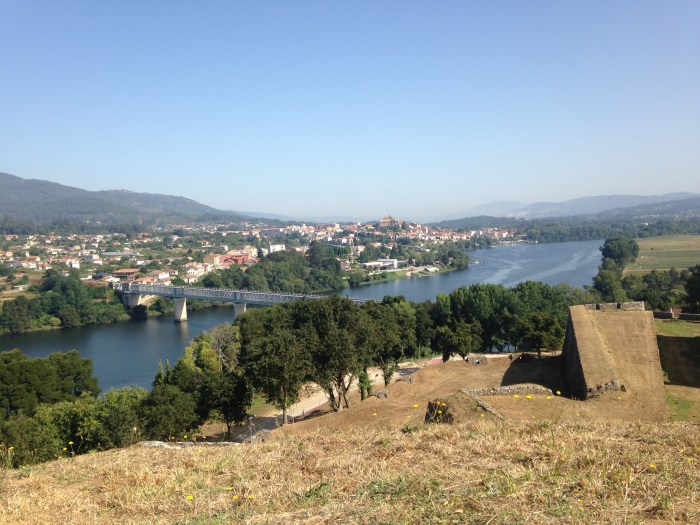
Having a coffee in Valenca, fortress above the Minho – view upriver takes some beating! Left at 6.10, arrived 11.30. Off to Spain in a few minutes – just 2km to Tui….
Now well-settled in Tui. Mixed dorms but we’re spared mixed showers! Breakfast with eccentric ex-postman from Wigan and chatted to Polish guy who has his own travel magazine, takes own photos and hates smartphone cameras! Otherwise I’ve been swinging along through beautiful country, Roman bridges – it was once a Roman road, wooded paths, a few red-barked cork oaks, and singing, and happily lost in thought – walking as the good Lord meant it to be. Heat building, but OK. Tomorrow is the mega heat day – should I leave at maybe 4.30? Could be 2 hrs walking in the dark… Time now an hour ahead – funny gaining an hour going north. Mega hot out there – can it really be that tomorrow will be 6 or 7 degrees hotter still?
Tuesday 6th September:
Our international party, Polish photographer, Antonio, Czech student, Michaela, and me, walked 22 miles from Tui to Redondela, leaving at 5.40 and arriving 2.10, in 97 degree heat. Feet done in but otherwise beginning to recover, aided by beer, water, bread and cheese. We kept talking and and helped push each other along. On my own – would I have made it? Other people on the Camino today included – more Poles, a group of Spanish scouts, and a Mexican couple. No Brits save me!… [Tomorrow] heading for Pontevedra. Easy walk, I think. Assuming I can walk! Feet in rebellion!…
[Message from home: ‘No Brit would be mad enough to walk in that heat.’] Are you suggesting I’m not British?! I’m not one of your lily-livered Brexiters! Antonio called out a moment ago – ‘How is Brexit?’ (meaning me) ‘Do not call me Brexit!’ I shouted back. Such are the burdens we old-school Eurobrits have to bear!
Talking of bears, Carlos got some serious attention today – he’s feeling better about things. Brave bear – coping with the heat. And I’m doing the walking for him, of course.
Wednesday 7th September:
Arrived Pontevedra 12.45, having left at 7.40 – last person out of the albergue. Most are gone by 6, but sunrise 8.10 here, and I want to see where I’m walking! Easy day, two healthy climbs, but sun came out late and I had my favourite breakfast – fresh orange juice, croissant and café con leche. Bounced along after that. Lesson for and from today – think of nothing, just take it all in! Staying in a cheap hotel – Hotel Virgin del Camino – better than vergin’ – it’s actually on the Camino! Now off to eat and sight-see.
Carlos’s fur trapped in zip but I think he’s OK…[‘Might Carlos like his head out of the rucksack, so he can enjoy the views…’] Carlos does have his head out of the rucksack, all the time. Only the rain would keep him in. Sometimes he stretches out a paw and waves as well!… I loved Pontevedra but wandered around too long, and my feet are very sore…
Thursday 8th September:
Arrived Caldas de Reis at 12.15 – walked non-stop from Pontevedra, not far short of 4 miles/hr pace. Too many slow Spanish walking groups and I needed to get well away from them! They talk! Beautiful gentle country, bright sun, and temperature high 60s. That makes two happy bears – Carlos tambien! Wondering whether to call him Carlito – little Carlos. Ibuprofen and blister plasters helping – feet doing better than I expected. Now enjoying bread and tapas lunch!… Amazingly I’m now halfway through this jaunt!
Friday 9th September:
Arrived Padron 12.30. Enjoying a very good menu de dia in a local restaurant! …very modern albergue – bunk beds with curtains! Big plus – they’ve done all my laundry! Shortish but beautiful walk – oak, pine, chestnut, under a deep blue sky. Chilly first thing. Bumped into Martin, who I’d met in Tui, and we did a short tour – walking up the hillside to where St James [doesn’t sound right if you’re a peregrino – has to be Santiago!] is reputed to have first preached the Christian message in what must have been about 40AD. Martin an Irish Catholic so a good companion for this! House/museum of a legendary Galician poet – Rosalia de Castro – up the road so I trekked off for a visit. Early start tomorrow – will be tight to get there in time for midday mass.
Saturday 10th September:
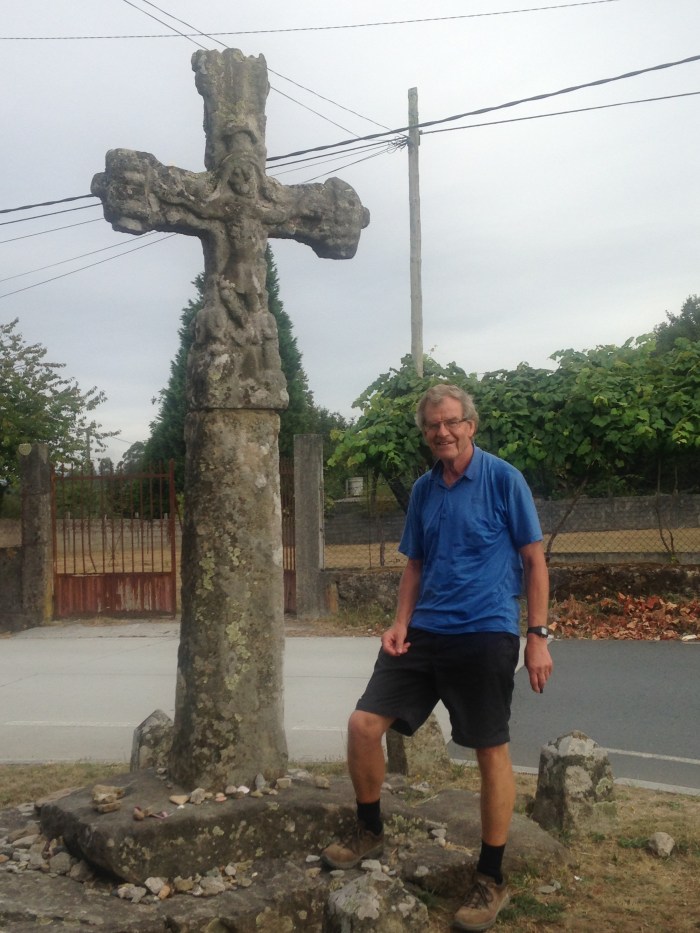
Photo [sent home, to Hazel, and to my son and daughter] taken a moment ago, 10.30, local time, 8 miles out from Santiago [I’m looking remarkably sprightly, all considered!] …
Arrived to music and carnival an hour ago. A mere 16 miles this morning and I chose to explore the longer way in – being a glutton for punishment (and I knew I’d missed the mass). Once I start moving I do walk fast – all that running and marathons and the like. Wonderful place to be – on the steps above the Praza do Obradoiro. Met my Czech friend, Michaela, from our big walk from Tui. Big shout of – Chris! Antonio around somewhere. And others I recognise – we’ve all walked a long way!
Sunday 11th September:
Mist down low over Finisterre [I took a bus, and did feel a bit of a cheat], there’s a little overhead sun but wherever I walk I won’t see much. Maybe it will add to be mystery, and there’s a lot out there….
The mystery is now the view, on a perfect evening! The mist cleared over the last hour. This is where you would, in classical times, pass over the horizon, to the other side, to the spirit world. No-one is closer than I am at this moment. Back in the now – you’d love it here – sun, sea and waves breaking gently. And warmth…. a wonderful day, in the end. I’d set out for the cape about 4pm and walked and scrambled and stopped and pondered and took photos till about 8.30. Magic, all a big surprise. No idea what I’ll do tomorrow. Just got back to the port (the cape is 2½km away) and I’ve a plate of salad, and a jug of wine, in front of me….
View from Cape Finisterre
Monday 12th September:
Damp, cloud down, forecast dreadful, no point walking 17 miles to Muxia [there will be, has to be, another time!], left Finisterre on an early bus, back to Santiago, thought I’d go to midday mass, but refused admission – my rucksack too big! Must have been by a centimetre! Maybe I look dissolute. [Tonight in a cheap hotel] tomorrow back at my favourite, the Balalada. So far a bit of a damp squib of a day!… Bought a shirt, so feel less scruffy, had a snooze, and a coffee with Martin … wonderful evening mass, felt inspired. A bit of a downer of a day early on but you can’t have the ups without the downs! Tomorrow it will rain, but I will smile!
View from my bedroom window over Santiago
Tuesday 13th September:
Sitting on the steps of the Praza do Quintana, near the Holy Door specially opened this year for Pope Francis’s Year of Mercy. But it seems to be just another entrance for the usual tourists – the message lost. Pilgrim mass in English this morning, lots of Irish, and an Irish priest officiating. We all introduced ourselves, said where we’d walked from – which was nice. Then I toured the monastery of St Martin, hard by the cathedral – full of altars and choir stalls which put San Millan to shame – but nothing quite to compare with the sculptures of Santo Domingo de los Silos. Galician (!) hamburger for lunch, with Stones tracks in the background. Sun now, after rain, but a chilly wind. Latest invasion of pilgrims has arrived – they’re everywhere! Each day they invade – proud to have been one of them. Funny to think – back home tomorrow night.
Wednesday 14th September:
Wrote a Santiago blog late on yesterday – still work in progress. But now fired up to get out and see things again! Funny being on your own – you can go anywhere, anytime you choose, yet you want to share it, and share coffees, and chat, as we did back in May [Pamplona, Roncesvalles, Castrojeriz…].
[Two big events, not mentioned in messages home – searching out the statue in the Alameda park of Rosalia de Castro, who is already my hero, and then the Museum of Sacred Art, with paintings and statues and much more on the Camino and on pilgrimages worldwide – few people there, and yet it’s one of the best museums I’ve seen anywhere.]
For cool damp weather, come to Santiago… Now queuing to board my flight…Bus to the airport took me via the last stages of the Camino Frances route into Santiago. Everyone wearing ponchos, and the rain then got harder. Lots of sun for them on the way – shame that Santiago lets them down now. But if they don’t know already – they’ll soon discover it’s one of the most remarkable places on earth!
[Carlos, sensibly, has stayed all the while inside his pocket!]
Reading Seamus Heaney’s Glanmore Sonnets, sitting beneath a tamarisk tree on the north Cornish coast.
…hankering after stone
That connived with the chisel, as if the grain
Remembered what the mallet tapped to know.
That ties in well with the landscape all about me, which has memories of many millennia stored within its rocks, ancient tracks, stone-hedged fields and sand dunes.
I love its blooms like saucers brimmed with meal,
Its berries a swart caviar of shot,
A buoyant spawn, a light bruised out of purple
Might that change the way you look upon the elderflower forever, or might it just be, depending on your mood, overwritten and overblown?
The tamarisk was planted long ago, when houses were cottages, and the land was ploughed, and the season was the farmer’s all year round, and not just the holiday-maker’s summer months. The wind scurries the fronds, a Cornish blue beyond and above, but they’re so fine that their susurrations lose out to the ash tree, which with the freshness of youth is a sounding-board for the breeze.
The tamarisk branches move uneasily, they creak, and the ash sways. The ash is all deep shade, the tamarisk a light touch of sun. A gull squawks, and when the wind falls low, there’s the distant sound of a combine harvester, for fields still do run away inland, when you climb beyond the pitched roofs and white facades of the holiday homes.




 zenpolitics.me