After Paris

France, in President Hollande’s words, is now at war with IS. And that’s the way I think most of us in the UK feel as well.

War challenges us, challenges our humanity.

As I’ve often made clear in this blog, I aspire to time for quiet and reflection, for a life made more simple, where there’s time for close observation on the one hand, and time to rest in the sweep of the days and seasons on the other. It could be open country, or Kew Gardens, where we wandered recently amid cacti and orchids, or music …. in the way Autumn Leaves and its gentle melancholy accompanied me along the Camino.

How to combine a more reflective life with a political engagement, and with all the issues of everyday life, that’s the challenge I set myself.

When I returned from the Camino and read up on all the events of the month I’d been away I was grateful for the fact that nothing untoward had happened. Crises continuing, but nothing like the events of last Friday.

That shattered all calm. Anger and grief, and a desire for retribution, took over. But the enemy is elusive. It will take wisdom and detachment to find solutions. And also understanding other points of view – not the IS standpoint, which is beyond ordinary understanding, but the causes that lie behind their rise and their ability to recruit.

How to avoid giving IS a victory and closing national borders?  Remember – they are already in our midst and terrorists will funds ways of circumventing closed borders. IS has recruited readily among local populations in the UK, France, Belgium and elsewhere, where there’s unemployment, a lack of opportunity, alienation, exacerbated by anti-Islamic sentiment. Integrating those populations into wider society has to be a high priority, and it will be achieved by providing opportunities (no mean challenge, I accept), not by further cutting benefits.

Improved security along the EU’s external border is vital, not least shared databases. But closing that border, separating Europe off from the Arab and wider Islamic world – leaving them to fight their own wars – misses the point that they are our wars too. Populations intermix, resources and manufactures are traded and shared, and given our long involvement exploiting and influencing the region we have a moral responsibility too. More than that – the Arab world is not homogeneous – the difference between the before 2010 relatively mild and secular version of Islam practised in Syria and the Wahhabi variant in Saudi Arabia is vast. Iran despite the ayatollahs has a strong secular and western-focused culture, especially among the younger generations, and in the cities. The enmity between Sunni and Shia, between Saudi Arabia and Iran, is another matter: nonetheless populations have lived adjacent to one another in Syria and Iraq since the seventh century.

But when a central authority is taken out, and ideologues and hotheads find space to operate, chaos and civil war ensues, as happened in the Balkans twenty years ago, post Tito, and in Iraq after 2003. Scrapping both army and police in Iraq was a tragic mistake, so too, and more controversially, imagining that a Western-inspired democratic revolution could transform a region with little tradition of genuine democracy.

The law of unintended consequences worked to brutal effect.

I’m also well aware that under the Damascus and Baghdad caliphates, and in medieval Spain, Islam inspired a remarkable civilization, intellectual and artistic – and tolerant, with Muslims, Jews and Christian living side by side for many centuries.

First and foremost now we have to act decisively to take out IS, with the West and Russia combining, not just in military action, but in a solution which will involve huge compromises but can lead, I believe, to an end to hostilities between Assad’s forces and the original western-backed rebel forces. Sykes and Picot drew the original Syrian border in 1916. The USA, Russia, France, the UK, and others, will have to decide how Syria divides and is governed as part of a post-war settlement. There may be multiple authorities, and that may be all that can be achieved in the short and medium term.

The refugee crisis requires safe havens financially supported by all the countries of Europe within the countries of entry, and plans to facilitate and finance repatriation at the earliest opportunity. Some Syrians may want to stay in Germany, but Syria has been and can be – will be – again a remarkable country. So much of our civilisation and our values, our culture and our morality, comes from that part of the world, and their people could one day rise again to the heights their forebears achieved. That has to be their aim – and our aim.

(I’m adding here a quote from Barrack Obama, which I read after I’d uploaded this blog, and with which I wholeheartedly agree: ‘It is very important that we do not close our hearts and start equating the issue of refugees with terrorism.’)

No-one in the West can easily conjure solutions to the enmity between Iran and Saudi Arabia, Shia and Sunni. But take out IS in Syria and Iraq as a warzone, and destroy that sense of invincibility IS have enjoyed, then potential recruits to other battlegrounds in Yemen, Somalia, Egypt and elsewhere may think twice, and local populations left to live again side by side, as they have for centuries.

Likewise if IS is destroyed, its triumphalism punctured, and its followers in France, Britain and other countries of western Europe realise that violence and martyrdom are a fool’s game, then we can focus again on what we’ve failed to deal with over the last thirty and more years – the growing alienation of many young people in the Muslim communities in our midst.

It’s another area where skill and understanding will be required, and where closed minds and bigotry must be opposed at every turn.

We are all one people.

Down river – a week in politics

‘One log cannot support two bears.’ Sergei Shoigu, Putin’s defence minister, would, according to a one-time Kremlin adviser, have been unwise to challenge Putin for the Russian leadership. Be that as it may, it’s the idea of two bears on one log, and what they might be doing there in the first place, that intrigued me.

As for three bears… but I’m getting off the subject.

Who might we not want to share a log with? Boris Johnson, for one. It would be far too unstable. And he’s my villain of the week, for his crass comments on supporters of a trade ban on produce from the Israeli-occupied West Bank. ‘Corduroy-jacketed, snaggle-toothed, lefty academics,’ were his words. They need no comment from me.

Where else has my attention wandered this week? Let’s try Texas.

I’d also be loathe to share a log with anyone from the American gun lobby.  ‘Campus carry’ is a big issue in Texas, the eighth state to adopt legislation allowing guns to be carried on campus. Arkansas apparently permits ’only faculty’’’ to bear arms’ (Quote from the Economist). To universities, faculty and students, anywhere else in the world, this beggars belief. Encourage gun ownership, feign shock when shootings happen, in schools, on campuses, and elsewhere, and use that as a pretext for further gun-carry laws. There’s something not just crazy but evil at the heart of this.

And where would my log end up? With David Cameron on board it would be pulled to the right by unwelcome currents, and there’s a chance we could end up on the wrong shore – wrong for him, as closet European, and for me as an avowed one. Pronouncements that he has no attatchment to the institutions of Europe, on the one hand, and his averred willingness to fight heart and soul to stay in Europe if he gets the reforms he seeks rest uneasily together: it’s a scary log to ride.

One final thought on riding logs. Compare a long path stretching ahead as many times I encoutered on my recent walk. The wind may buffet, and the rain may drench you, but you know where you’re going. The river, especially the big rivers of Russia and Canada, where bears just might ride logs, can sweep all before them, currents can deceive, and you’ve no choice but to follow. The right wing in both the UK and USA want to claw back upriver, to a destination that isn’t there any more. They’ll still of course be swept downstream, but they won’t end up where they want – or expect – to be.

More on Europe another time. I’ve moored my log for now.

The eagle and the geese

Nan Shepherd has won many followers since Robert Macfarlane brought her to our attention. In The Living Mountain she writes in a remarkable way about the Cairngorm landscape, conveying both its grandeur and its subtlety. Written during WWII it reads as if written yesterday.  Light and shadow, rain and snow, the passage of the seasons, affect mountains, but time is slow time, geological time.

I’m comfortable with slow time

She’d be the subject, I’d decided, of a short blog. Later that day I was watching a TV programme on Alex Ferguson (retired Man United manager) and leadership. I saw a link between the two.

Nan Shepherd, walking on Ben a’Bhuird:

‘Once some grouse fled noiselessly away and we raised our heads quickly to look for a hunting eagle. And down the valley he came, sailing so low above our heads that we could see the separate feathers of the pinions against the sky, and the lovely lift of the wings when he steadied them ready to soar.’

A page of two lay she focuses down on to the almost infinite forms ice and snow can take, depending on the surface and the wind. There’s an extraordinary level of close observation, looking up, and looking down. I love to investigate in my own walking, to get close, to see the shape and form of things, though I couldn’t ever begin to describe it as Nan Shepherd does.

Alex Ferguson…. he’d look skyward at the Carrington training ground and point out to the players a V-shaped flight of geese overhead, how they fly together, and take it in turns to lead.

‘I’m going to tell you the story about the geese which fly 5,000 miles from Canada to France. They fly in V-formation but the second ones don’t fly. They’re the subs for the first ones. And then the second ones take over – so it’s teamwork.’

Shepherd and Ferguson have one thing in common here – they looked skyward, and looked closely. Shepherd drew no conclusions. The simple act of observation was personal, and enough. For Ferguson, it took players (and Ryder Cup golfers!) by surprise – and they never forgot image or insight.

Any message in all this – only that we can be too earthbound!

With Dante on the Camino

Back in June, my first week on the Camino, I met up with Daniel and Gabriel, 18 and 17-years-old, both strong walkers, one Czech, the other Italian. Daniel told me that his friend loved to talk about Dante, and they’d renamed him ‘Dante’.  I remember well a conversation with Dante in the main plaza in Pamplona when he explained as best he could, in English, the poet’s terza rima rhyme scheme – aba, bcb, cdc.  He the 17-year-old, me in my 60s. I resolved to read the Divine Comedy over the summer and before I resumed on the Camino in October – and I did.

A quote from Osip Mandelstam, sent to me by Graham Fawcett, has sent me back to the poet.

“Both the Inferno and, in particular, the Purgatorio, glorify the human gait, the measure and rhythm of walking, the footstep and its form. The step, linked with breathing and saturated with thought, Dante understood as the beginning of prosody. To indicate walking, he utilizes a multitude of varied and charming turns of phrase. In Dante, philosophy and poetry are constantly on the go, perpetually on their feet. Even a stop is but a variety of accumulated movement: a platform for conversations is created by Alpine conditions. The metrical foot is the inhalation and exhalation of the step”. (Osip Mandelstam, Conversation about Dante)

To which my first response was ‘wow!’ I read Graham’s note two days out from Santiago, too late for me to practise ‘the step, linked with breathing and saturated with thought’. Maybe just as well.

You do think about walking and all it entails when you’re walking over 500 miles.

I walked the Camino with mind empty, with mind and senses open to the landscape, sounds and smells, with mind and feet in meditative step with each other – and with mind ‘saturated’ with thought. I found rhythm in songs and hymns, and had I a better memory for poetry I’d have been speaking out loud more of my favourite verse, to the occasional consternation of fellow-walkers.

But I have yet to master linking my step with thought!

Frederic Gros in his book A Philosophy of Walking points out that for thinkers such as Nietzsche and Thoreau walking was key to their work. And in earlier times, when walking was the normal mode for getting from A to B, thinking your best thoughts while walking would have been normal practice.

What levels of thought and imagination were achieved by pilgrims to Santiago in the 11th,12th, 13th centuries? In an age when most couldn’t read or write. Our obsession with conveying our thoughts in written form, fed by this computer age of ours – and by blogs! – has downgraded walking as prime time for thinking. We are now overwhelmed with the thoughts of others.

In our city lives, too often when we walk we rush, and when we rush we don’t think. Gros has a better understanding: walking “is the best way to go more slowly than any other method that has ever been found”.

Time for a walk.

Just four weeks to Santiago ….

Forgive me, this blog is called ‘zenpolitics’, and there’s not too much that’s political about what follows (though if you read through to the very end…). But if you want a taste of what it’s like walking the Camino, then read on.

Up at 6.30, it’s early October, and sunrise isn’t till 8.45 (the clocks haven’t changed and Spain is one hour ahead of the UK), so even if you hang around a bit and have a croissant (standard Spanish breakfast) and tea and a glass of freshly-squeezed jumo de naranja, even if you delay your start, you’re still out on the path by 8 at the latest.2014-07-30 10.35.34
Most mornings, happily, the sky is clear, and there’s a pre-dawn glow behind you. Always behind you. One feature of the Camino is that you’re always going west… There can be a gentle pinkish glow in the west mirroring the burgeoning glow behind you but it’s as nothing compared to the deep reds that run along the eastern horizon, silhouetting the mountains you’ve left behind on previous days.

Early October, and we have a remarkable morning sky: a last-quarter moon, receding to a crescent, and one morning no longer there (full moon by the time I reach Santiago almost three weeks later), and Venus as a morning star, and Jupiter, all together, within a degree or two of each other. Venus so bright that it only finally disappears with the first rays of the sun.

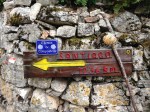
The way is marked, all the way to Santiago, by yellow arrows. At 8am you need your head torch to light your path, and you’re sometimes searching hard for that arrow, and taking the wrong route – and finding others are following you….  Like sheep we follow!

An hour passes, and you’re lost in an empty mind, or lost in thought, or simply measuring your footsteps, or listening to the first birds calling, or listening to silence. You’re singing a favourite song – for me it’s Autumn Leaves this time, as sung by Eva Cassidy, and much earlier by Nat King Cole. Appropriate, and a touch melancholic, but gentle and reflective, and so timely as weeks later I shuffle up the leaves walking through the wonderful oak and chestnut woodlands of Galicia.

Or try a hymn… a Methodist upbringing works wonder. One line, ‘the king of glory passes on his way’, stayed in my mind. God normally stays in one place, but maybe he’s a pilgrim too. That’s good for a few minutes speculation!

Another hour, and it’s a stop for a café con leche, and a cake of some sort. Or if you’ve missed out earlier, for breakfast. (Some albergues, the overnight hostels that put us up in bunk beds for 10 euros or less per night, don’t do breakfast and there may be nowhere else, so you walk on an empty stomach.) That’s a beautiful time. You’ve maybe six, seven or eight kilometres behind you, maybe already one-third of your day’s journey, and you chill out, savour the moment, feel good about yourself, maybe catch up with friends, have your first laugh of the morning.

Then it’s the toughest time of your day. Putting in some real distance. And the sun will be climbing higher, and if you’re back east, it’s still the early stages, and the summer’s not letting go just yet, then you’re hot, and your shirt is sticking to your back, and the straps of your rucksack which weren’t troubling you earlier are troubling you now.

The meseta, that high and wondrous plateau land beyond Burgos, is mysterious in the early light, under the moon, but in the heat of the day it’s a brown and long-ago harvested expanse of stubbled or ploughed (despite all the stones, some ‘sacred’, why, I’ve yet to discover!) and horizon-stretching field, without break of hedge or wall, undulating vast distances. It’s almost hypnotic, and when, as it was for me, it’s blowing a mighty gale into your face (Caribbean hurricanes even stretch their lower limbs into northern Spain) you’ve a battle on your hands. Clouds build and race in the wind across the sky. All you can hear is the wind in your ears. Try and pick up the sound of the wind in the long grass and thistles and thorns along the side of the path, but no way. Tumbleweed, sharp and looking rather lethal, comes careering past me.

Further west, you’re up at 3000 feet and there’s a ground frost, and equipped for a late Spanish summer you’re wearing every last item of clothing. But only for an hour or so, you warm up, and the sky is a pure blue, and the sun does get to work and warms you. But beware, after 5 in the evening, it may still be shining, but it’s lost its warmth, and the chill over the land seeps into you, and those clothes you left optimistically to dry in the sun on the albergue’s washing line stay resolutely wet.

*

Mornings are chill but beautiful. But not always. And one afternoon is memorably dreich. Climbing up  to O’Cebreiro, at 4000ft, into the rain and mist and wind, it’s a wild and surreal version of winter up there. I decide I’ll take a room in a small and very cheap hotel. The sheets are damp, and it’s back to my sleeping bag. Night comes early, but a few yards up the road there a glow of light: the door is open, and there’s a Pilgrim Mass, and the church is warm and full, and a cocoon of wisdom and good feeling in a chill landscape. It dates back to the 10th century, and that makes more than a thousand years as a place of refuge.

The following morning is a nightmare, a slippery five-hour descent in the heavy rain. I dry out, just, and the following day, down in my river valley, the sun breaks through at 9.30, and then it’s four days of magic and bright-sky walking through the green and hidden landscapes of Galicia, cattle and corn cobs and big views, and every half-kilometre a way-marker telling me that I’m half a kilometre closer to Santiago.

Santiago now only a morning’s walk away… There’s a change in the weather, but the rain has stopped and I walk avoiding drips (they catch the head torch beam) from the chestnuts and eucalyptus above me through a dark dark wood until I exit into a faltering dawn. There’s an old church, with its open tower and two bells and locked door, and the path diverts round the airport, past the TV headquarters, and endless roads frustrate, and there’s rising excitement, but it keeps being dashed as you turn into yet another road. Then finally, into the old city, and I trek round to the Plaza  Obradeiro… only to find scaffolding hiding the Portico de Gloria, every pilgrim’s ultimate destination for 800 years, and a loud political, anti-government demonstration underway. Much drumming, and chanting ‘un pueblo unido jamas sera vencido’ (‘one people united will never be defeated). I almost join in: we chanted that in the 1970s. But it wasn’t quiet, and it wasn’t holy, and it wasn’t spiritual.

Later, later, I told myself, and with a thousand pilgrims alongside me and the singing nun leading us in the Jubilate Deo at the Saturday evening mass, and again at the Pilgrim Mass Sunday lunchtime, I knew I’d arrived – heart and soul as well as feet. And the great censer, the thurible, the botafumeiro, began its long arcing swing as the Sunday service ended, a pendulum to end all pendulums. I’m told it was intended originally to defumigate newly-arrived pilgrims. I can’t speak for our clothes, but all the albergues have showers, and we all make a beeline for them on our arrival. So we’re a pretty clean lot in the externals.

We’ve also cleaned out a lot of mental and emotional junk by the time we arrive.

The rest of the day we’re all of us meeting old friends and saying our goodbyes. The rain has relented and the sun, briefly, is brilliant, and Santiago is every bit as inspirational as I anticipated. If not a little bit more so.

Some head off to the coast, and Finisterre, finis terrae, the end of the world. For me it’s a plane home. The end of the world will have to wait.

(I said no politics, but as I left the old city I looked back and there was a walker struggling his last steps into the city, as I’d done two days before, and on the back of his shirt three words – END AUSTERITY NOW.)

Why walk the Camino?

Walking for five minutes or five hours, there’s one recurring question we ask each other. Why are you walking the Camino? Usually in life, maybe standing by a bus stop, there aren’t any easy ways into conversation, and most of us, en route to work maybe, are too lost in our own thoughts or anxieties to want to talk. But on the Camino you’re a big exception if you don’t acknowledge someone with at least a ‘buen camino’, and you may well walk together a little while, and that question will always come up, in one guise or another.

And the answer? Spiritual, religious or personal? Maybe it’s simply the challenge, a bit like walking the three peaks in the UK (Ben Nevis, Scafell Pike and Snowdon) for the hell of it, often against the clock.

The spiritual and religious blur into one another. This blog is inspired by Zen, but also firmly rooted in the Christian tradition. Walking the Camino with an open mind, and finding peace and serenity, and rejoicing each morning as the dawn turns into day – that experience is the same, whether your Christian, or Buddhist, or simply ‘spiritual’, in the best sense of that all-encompassing term.

When asked why I was walking the Camino I’d say my reasons were personal, spiritual – and historical. I love the tradition, that sense of others walking before me for the last 1200 years.

In medieval times you’d be looking for the church (the Catholic church) to grant you absolution from your sins, and the pilgrimage to Santiago was a uniquely powerful way of achieving that. The journey mattered as much as the destination, as a pathway to merit. You couldn’t take a plane to Santiago, or walk the last five days from Sarria, and receive a certificate, as you can now. Wonderful churches, on a scale which would have left pilgrims agog with wonder, grew up along the route, and the hospitals, hostelries, provided care and shelter. This was the Christian gospel in action, in a marvellous way, and even if our faith is not as theirs was, we can pick up on something of their experience, and be inspired by it.

In the movie The Way James Nesbitt plays Jack, an Irish travel writer who, reacting against his upbringing, refuses to enter churches, but come Santiago, he’s there, in the cathedral. Religion as it should be is both celebration and sanctuary, and the pure Romanesque of churches at Torres del Rio, Villalcazar and Fromista, to quote just three examples, reminds us of that. Maybe it influenced Jack (OK, I know he’s fictional!) as it influenced me.

Walking over 500 miles you find your prejudices challenged. All your petty grumbles and bigotries in time come to seem rather absurd. So too with the church, and I’m thinking of all denominations. Too often in ordinary life it mirrors our own human failings, even encourages them. On the Camino it rises above them in a very literal sense – the churches, the great cathedrals, and a path a millennium old, often climbing up ahead of us, as it does onto the meseta, beyond Burgos.

For me, Santiago, Jesus, the Virgin Mary, they’d been companions and support and inspirations for pilgrims a thousand years ago, and they were for me this October. I’m not suggesting they had a literal presence for me. But I walked with an open mind, and set myself to connect with how pilgrims from another very different age must have experienced the Camino.

An open mind requires stillness and, walking in the pre-dawn with the crescent moon behind and stars ahead, you are walking into the stillness, and it takes you over.

‘Be still, and know that I am God.’

The pilgrim and the refugee

Four weeks walking on the Camino, from Logrono to Santiago in northern Spain. (I walked from St Jean Pied de Port to Logrono back in June.) An average of seventeen miles a day, across high plains and mountains, rain and shine, legendary cities such as Burgos and Leon, and villages just hanging on in the modern world. Hard on the feet. But I had a path to follow which others before me had followed for 1200 years, and I had a fabled destination, and I could remind myself that the journey was as much the destination as Santiago itself. And there were new friends to make along the way.

Others have been walking longer distances this summer and autumn, with only a vague destination, somewhere north, maybe Germany, a path with no history (following a route usually taken by road, not on foot), where the destination is everything, and the mode of transport a cruel and hard footslog. Whereas on the Camino you’re welcomed by so many, and you’re a little bit of a hero when you arrive in Santiago, on this other journey there’s often hostility, and while for many there’s been a welcome at the end there’s always been the likelihood that borders will be slammed shut.

If you’re walking the Camino you’ve a home to return to, and maybe a minor hero’s welcome there as well. On the other journey, there’s no home to return to. At best it was a camp, and squalor, and at worst home has been destroyed, and family and friends may have been killed.

On the Camino you can absorb the history of 1200 years, you’re following in the footsteps of countless other pilgrims, there’s a physical challenge to drive you along, and an uplift of spirit and a closeness to creation, and to God if we will, as we walk, and St James, Santiago, to welcome us at the cathedral’s Portico de Gloria when we arrive.

For walkers further east, they’re travelling up through the Balkans to find fences at borders and stations closed, and motorways open so that you can exit a country more quickly – on foot. There is no triumph of the spirit (though there is a triumph of the will), and God’s creation in the heat and the rain is hardly benign.

So little in common between the two paths, the two caminos. The one born of personal challenge, the other of desperation. But the comparison is important, and telling.

We Camino walkers need to remember our good fortune.

But there’s one thing the two journeys do have in common. Refugees heading north across Eastern Europe may meet all sorts of hostility, but they’ve also been met with love and warm welcomes by so many, especially in Germany. We’ve seen a triumph of the human spirit, of all that’s best in us. There’s no better way of demonstrating compassion one for another than finding someone a home.

The refugee issue is the hardest issue of our times, reflecting current crises and long-term population issues. But our starting-point at all times has to be compassion. Political solutions are for the medium and longer term. For now, if we lose sight of compassion we lose sight of our basic humanity.

All the news I haven’t heard….

Returning from walking the Camino, and returning to the world of 24-hour news, which I’ve avoided for four weeks, I’m struck by the intensity, the ranting, that accompanies  so much political discourse. That’s hardly surprising. One reason for being away so long was to point up that contrast between the every day, as we experience it, and the ordinary day – the day that we might enjoy if only we learnt to stand still awhile, take in the dawn and the passage of the sun and the clouds across the sky, to take in a deep breath, and keep breathing.

The ordinary  day as I describe it would for many be an extraordinary day. ‘Life isn’t like that.’ But it is the real life of all history. It is we who are fooled.

I’ve long experience of working with children and schools, as a parent, a school governor and, a little while back (and hugely enjoyably) as a cricket coach. Positive messages, focus on opportunity, on working together, on compassion for others and understanding of our natural environment, that’s what we try and inculcate, along with the hard facts and great ideas and practical skills….

And yet beyond the school gate there’s the TV news and the newspapers, ranting, focusing on personalities and often irrelevant detail, resorting to preconceptions and prejudice at the earliest opportunity. If school is about the getting of wisdom, everyday life for kids is an all-too-rapid getting of unwisdom. As parents, the press and people everyday are perceived to behave – so the world tells them should they, our children, and there’s little that the finest teacher can do about what happens beyond the school gate.

(I’m not overlooking all the negative impacts of politically-driven expectations on schools, children and teachers. But schools remain remarkable places, and teachers, so many of them, no less remarkable.)

Walking the Camino I’m aware how many young people have held on to that wisdom of childhood, and built on it. I walk with optimism. Returning, I’m reminded of realities.

But I’ve not lost my optimism. This blog isn’t will never be a tabloid-style retreat and rant against the world. It is about engagement and purpose, focusing on the simple things, and doing them well.

The small private acts of life

I mentioned Mobi Ho’s introduction to his translation of Thich Nhat Hanh’s The Miracle of Mindfulness in my last blog.

Thich Nhat Han suggested to Mobi that he do the translation slowly and steadily, in order to maintain mindfulness. And he translated just two pages a day. Translating a text such as this is of course rather different from typical daily life. But it is a reminder to give our full focus, our full mind, to each task, however trivial.

It would be good advice for writing a blog.

But what of life on a public – on a world – stage, the other side of life? There could hardly be a greater contrast than that between the conflict in Syria and the focused and private attention given to a translation – or any private activity.

I’m reminded again of that building in Syria used down the centuries as both a church and a mosque.

What we’ve lost in Syria is a way of life which held Christian and Muslim together. It may be a decade, or decades, before we can bring them together again, in a way where they can share again the small (and all-important) private acts of life.

We must hope it will not be forever. History tells us it so easily could be.

Compassion and conflict

This is a longer blog than I would wish. But the subject doesn’t allow of anything else.

I’ve been reading the early pages of Richard Flanagan’s novel, The Narrow Road to the Deep North, about the brutal skirmishes between British and Vichy France troops in 1941, with Palmyra and Tripoli both figuring in the conflict. It brings home again how key down the centuries Syria has been, as a pivotal territory in the battles between countries and empires. And how, until recently, Aleppo and Palmyra had survived.

The Australian troops who came out of Syria alive then found themselves Japanese POWs after the fall of Singapore, suffering a different and sadistic brutality – the main theme of course of the novel.

On another tack …back in the 1960s Thich Nhat Hanh founded the School of Youth for Social Service in South Vietnam. It ‘drew young people deeply committed to acting in a spirit of compassion’.  They refused to support either side in the Vietnamese conflict and ‘believed that… the true enemies were not people but ideology, hatred and ignorance’. Several were kidnapped and murdered. (Quotes from Mobi Ho’s introduction to Thich Nhat Hanh’s The Miracle of Mindfulness.)

The juxtaposition of these two conflicts in not intended to draw out any comparisons. In Vietnam the School was at least able to function, at a sometimes terrible cost. Syria in 1941 and today is a different and terrible kind of all-out conflict.

But compassion – is there any room for compassion in conflict? The battle in Syria is a battle for a way of life, against a perverted ideology. The practice of compassion is such circumstances is a mighty challenge. But compassion, and specifically the saving of life, must come before any desire or insistence on retribution or punishment. If in this case there is scope for working with the Assad regime – not an easy case to argue – and by extension with Iran, and also with Russia, then we should do so.

The PM in the House of Commons today spoke of Assad ‘butchering his own people’. Even so, treating with the Assad regime, and bringing to an end one conflict, may be the only way in which we can focus on IS and Al-Qaeda, with whom we can never treat. I’m sure this is already being discussed behind the scenes: it will take extraordinary diplomacy to achieve.

We should not delay. I read today that an Al-Qaeda-related group has seized a strategic airfield in Syria near Idlib. The momentum is still moving in the wrong direction.