The Hay Book Festival 2017 

It’s May 2017. The Hay Book Festival surprises yet again. You know it will, one of the great joys is turning up to talks you may have booked in advance – but you never quite know what to expect.

And what you can do of course is not book in advance, head for the box office, see what’s still available, which is most talks, if you’re early enough, and simply take pot luck. Serendipity can have big surprises in store, and rarely disappoints.

Hazel and I took in some talks together, for others we split up and compared notes afterwards.

For anyone interested in getting a flavour of Hay Festival, and not averse to reading something of the ideas and arguments, and the sheer variety of subjects, and the passionate advocacy of many of the speakers – please do read on!

*

Wednesday 31st May

11.30. I began with Cambridge historian John Guy on the subject of Thomas More. He traced the remarkable history of More’s ‘Utopia’, its influence worldwide, and disabused us of the notion that More was a serial torturer. John Foxe in his Book of Martyrs, hagiography of the Protestant reformers who suffered in Catholic hands, had a vested interest in accusing More. Hilary Mantel in Wolf Hall follows Foxe, but Guy holds back from criticising her too harshly. Like all of us he’s in a little in awe of her ability to brings characters to life. Guy is also an admirer of Paul Scofield in ‘A Man for all Seasons’, but he stressed that More as a man with an individual conscience that he could not deny (Robert Bolt’s spin on More in his play) is a misrepresentation. More belonged in a 1500 year old Catholic tradition, and his conscience was formed within the church’s teaching.

Why did More write ‘Utopia’? A radical democrat? The reverse is closer to the truth.  He was an elitist, who feared the demos, just as Plato had done, and saw a guardian class as the natural protectors and rulers of the land.

Hazel skipped Thomas More and took in Artemis Cooper (biographer of Patrick Leigh Fermor) on Elizabeth Jane Howard, author The Cazalet Chronicle, the wife of naturalist Peter Scott (when she was still a teenager) and Kingsley Amis, and lover of Arthur Koestler and Laurie Lee. Sounds like someone it would have been interesting to know….

*

1pm. We followed with Alistair Sawday, famous for his Special Places travel guides. What struck me above all is Sawday’s ability to talk in a relaxed conversational way, and I could imagine him talking to hotel and inn owners all over Europe, charming, enthusiastic, interested. Pulping 25,000 copies of an early travel guide almost brought the company down early on. He’s an enthusiast for earth closets. He fears that special places, which aren’t smartened up and denuded of character, are getting fewer. But they survive. Telling a wider world where to find them is a double-edged sword – great for the hotels, helping them survive, but a wider awareness and clientele can damage that sense of places apart.

*

2.30. My day’s highlight was Cambridge lecturer (in public policy), Finbarr Livesey, in conversation with Andy Fryers. ‘From Global to Local.’ Is globalisation the only paradigm, is hyper-globalisation inevitable?

Livesey puts up powerful counter-arguments, well summed up in one comment: ‘As countries commit to harder, binding targets for emissions reductions, the ideas of reuse, remanufacturing, circularity [as opposed to the linear nature of globalisation, long lines of travel across the ocean] and zero waste will all gain more currency and increase the uptake of these ideas across industry.’ In the light of Trump’s withdrawal from the Paris Agreement (yesterday, 2nd June), Livesey’s comment finds an even sharper focus. Industry around the world, we must hope.

Hazel took in Mary Aiken on The Cyber Effect, on how human behaviour changes online, taking in the impact on the developing child to teen sexting. Quoting the Hay programme: ‘She examines the acceleration of compulsive and addictive online behaviours (gaming, shopping, pornography) and the escalation of cyberchondria (self-diagnosis online), cyberstalking and organised crime on the Deep Web.’

Hazel was impressed – wished I’d been there. An example of how you can’t be everywhere at Hay!

*

4pm. We ended our afternoon with Hazel listening to Roy Hattersley talking too fast and quietly about his new book in The Catholics, ‘history from the Reformation to the present day’ – and I took in (Thomas More enough for me for one day!) Jeanette Littlemore, professor at Birmingham University, with a talk entitled The Way You Tell It. Her subject being non-literal expression, in this case metaphor, metonymy, irony and hyperbole, in everyday life. College students who don’t have English as their first language can radically misinterpret metaphor. Parents can enjoy themselves on touchline shouting encouragement to their children – but do their children understand? Advertisers have thought it through rather more – one example was a wonderful Boddingtons ad from the 70 with the head (appalling froth to the modern ale drinker!) combed into a quiff, with a comb nearby.

She brought in a wide range of research findings, could have been too many, but she was mistress of her subject, and handled questions brilliantly. Makes you all the more aware of the way we use language.

**

Thursday 1st June

We stayed down in the Usk valley, amid pasture and woodlands, with a trip in bright morning sunshine through the Black Mountains back to the Wye valley and Hay. Valley to valley…

11.30. We began our day with an inspiring talk by doctor and pyschiatrist Lynne Jones on her work with her work in disaster zones from Bosnia, to Indonesia, to Haiti, to the Jungle in Calais. The title of her talk (wait for it!): Outside the Asylum: a Memoir of War, Disaster and Humanitarian Psychiatry. PTSD and counselling is what a lot of funding goes into, but Jones provided ample evidence that listening, patient listening, is what’s required more than anything else. She recalled how a Bosnian man apparently objected to her taking photographs – it turned out he wanted his photograph taken, in front of the ruined house where his mother had been killed. He wanted someone with whom to share the experience. Where there are real and serious psychiatric problems it’s above all medication that’s needed.

Jones has a history as a passionate activist, doctor, psychiatrist. She was probably the highpoint of our Hay visit. She is only happy when involved, when engaged, and she puts politicians who rejoice in a narrow homeland focus to shame.

*

1pm. Jeremy Bowen talking about his many years as BBC Middle East Editor was next. Title: Our Man in the Middle East. He’s informed, wide-ranging, tolerant, a natural talker, and I’m sure a listener, and one of the wisest voices on the BBC. That came over strongly. I’ve been critical of (sometimes angry at) the BBC’s coverage of the Middle East over the years – too much focused on immediate calamities and picking up the latest Western government line, which has often been too much focused on the horror of it all, and apportioning blame, at the expense of hard and difficult talk about solutions. Talking to a Hay audience Bowen allows himself a broader understanding, the Saudis in Yemen and Assad in Syria both perpetrators of appalling violence – taking sides and demanding retribution something he avoided. Bowen has to practise his trade in a world of instant news which sometimes runs counter to a proper understanding of the issues – and he copes with this probably as well if not better than anyone else. In short – he’s a good guy.

*

4pm. Hugh Warwick, on Linescapes: Remapping and Reconnecting Britain’s Fragmented Wildlife, was our next port of call. Passionate and amusing, he’s probably our greatest expert on the hedgehog which for him is an emblematic animal, which has suffered more than most from our practice of dividing the land by way of roads, canals and railways. Hedges, walks, ditches and dykes are a man-made but natural landscape in which wildlife flourished. Take out a hedge and build a fence and wall – and don’t expect to find hedgehogs in your garden. Warwick is passionate about raising awareness, and optimist about solutions such as the wild areas left by motorways along which wildlife can travel, and green areas left on the margins of cropped fields in which plants and habitats can flourish. He argues passionately against the fracturing of ‘wildlife habitats into ever smaller and increasingly unviable habitats’.

*

5.30. At the end of the day Hazel headed for ‘Countryfile star and visionary farmer’, and all-round good guy, Adam Henson, on the subject of his Cotswold farm park, set up by his father (‘Like Father, Like Son.‘) And I went for something TOTALLY DIFFERENT! Physicist Roger Penrose talking to Marcus du Sautoy about string theory, which posits too many extra dimensions to be convincing for Penrose, though he’s a fan of the theory, as a theory… about quantum mechanics and Newtonian physics and their incompatibility when it comes ‘reasonably massive objects’, and the predilection among many scientists that it must be Newtonian physics that ultimately must adjust (must they be compatible?)… and about cosmology, and the origins of the universe, and his own theory that mass may ultimately simply fade away, with only photons surviving, and at that point the universe returns to a singularity, out of which a new universe is born, and that process is beyond either birth or death of the universe… I don’t claim reliability or accuracy for my summary!! Roger Penrose is like Stephen Hawking a marvellous example of mental acuity remaining as sharp as ever with advancing age. And good to see Marcus du Sautoy, who took over as Oxford’s professor for the public understanding of science from Richard Dawkins, and whom I’d not come across in person before.

**

Saturday 3rd June. We decided two days were not enough. So on a brilliant sunny morning we took the road to Hay in time for a coffee and then three more talks.

10am. We began with Nick Crane and a talk based around his new book, The Making of the British Landscape. We’re back post Ice age, after the Younger Dryas period, 9,600BC and a time of rapid warming, then almost 4,000 years in the blink of an eye to the major inundation (possibly the result of giant landslides which saw 180 miles of Norwegian coastal shelf slip into the North Sea) which finally put the Dogger Bank under water, and turned us into an island. An island of only 12,000 people, on one estimate, no towns, so Roman towns were a radical landscape change. I’ll have to read the book to discover how he thinks villages changed the landscape, and to compare with WG Hoskins’ The Making of the English Landscape, which has always been my bible in the subject. One question I tried to ask – but you have to be aggressive waving your hand! – was whether he thinks the proposal to make the Lake District a World Heritage Site is a good thing. George Monbiot in a powerful and I think misguided piece in the Guardian argued against. Monbiot fears stasis, and would like to ‘re-wild’.

Crane, intentionally he said, didn’t mention either the Bronze Age or Iron Age. He put his reason in the context of politicians misrepresenting history. I should have asked a question – I am of course with him all the way. I’m assuming the issue for him is too-easy and misleading labelling.

*

11.30: Hazel checked out a hero of hers, Noel Fitzpatrick, Channel 4’s Supervet, on the subject of ‘Global Health in Man and Animal’. He’s arguing passionately for ‘a single shared medicine linking human and animal health’. Cancer in a dog is almost identical to cancer in a human. Medicine would be shared between species, not one species exploiting another for its own gain. How this might work in practice I don’t know – again, wish I could have been there.

Instead I chose almost on a whim to head off to hear the Turkish novelist Elif Shafak talking about her new novel, Three Daughters of Eve. It was an inspired choice. She talked brilliantly about Turkey, about the language (modern Turkish has been pared back to exclude Persian and Arabic words, to its great detriment), about liberals and academics operating in a hostile world where loss of job or imprisonment could follow any kind of mis-step. (Turkey she pointed out has long had a sense of being threatened by hostile countries on all sides, which puts recent events in an interesting context.) English is a third language, and yet she writes her novels in English – writing in a foreign language heightens your awareness – translating, from my very limited experience, does likewise. But Shafik is operating at a whole other level.

Her novel has three Turkish girls, brought up in Istanbul, studying in Oxford. She describes,a seminar where the lecturer tries to separate the pursuit of an understanding of God from religion. Without success. I’d have asked her about the Sufi tradition in Turkey had I had the chance – how it links with the current resurgence of Sunni Islam. Shafik had earlier brought the 12th century poet and mystic Ibn el Arabi into her talk.

If you think that all this suggests she lives in a rarefied world, you’d be wrong. She’s a powerful advocate of feminist and minority including LGBT rights. A long queue formed for her book signing: when we returned to the bookshop 1 ½ hours later she was still signing – and still talking.

*

1pm, positively our last talk! QC and human rights lawyer Dexter Dias talking about his new book, The Ten Types of Human. Trying to illustrate some of the ten types in response to questions from an interviewer initially made it hard going. What Dias has done is use the structure of the ten types, all the product of human evolution, to produce a 800 page book passionately arguing for our engagement – the engagement of all of us – with human rights. The case he took up for the mother of a 15-year-old boy who died in custody, the victim of prison officer violence, was his starting -point for both his advocacy of human rights, and for the book.

I found this summary online of his work, and it’s very helpful as background to a remarkable man: ‘As Queen’s Counsel, he has been involved in some of the biggest cases of recent years involving human rights, murder, terrorism, crimes against humanity and genocide. He chaired and co-wrote the influential Bar Human Rights report to the Parliamentary Inquiry into FGM, has briefed and written reports for the UN around gender-based violence, and works pro bono internationally with survivors of modern day slavery, human trafficking and Violence Against Women and Girls.’

It’s encountering people such as this, and being inspired by them, that’s one of the glories of Hay.

**

And that’s it. Another Hay, another year. If you’ve stayed with me this far, thank you – and well done. If you not a Hay habitue, then do head off there, one year, some time soon.

Hay’s slogan this year is Hay 30: Imagine the World. Hay is thirty years old this year. But Hay does more than encourage us to imagine – it inspires us to change it. Advocates of the status quo, or turning inward, of identity politics and self-interest, would get short shrift.

Out on to the Silk Road …

The new Silk Road – will the direction of traffic be primarily east to west, west to east, or both – and who will control the flow?

I’ve posted recently on the subject of history, and how we abuse it. But sometimes we do need the big picture, and I’m thinking here of China President Xi’s $900 million Belt and Road initiative to build a modern-day Silk Road.

History provides a vital context, and a warning.

Forty-six nations attended a gathering in Beijing last weekend. Heads of state from Rusia and Turkey were there, though not from Europe. The EU held back from endorsing a final statement because it didn’t stress ‘transparency and co-ownership’. India argued the scheme is ‘little more than a colonial enterprise [that would leave] debt and broken communities in its wake’.

Philip Hammond attended (not our high-risk foreign secretary, I note), relishing the opportunity for trade deals. In his speech to delegates he argued Britain was a ‘natural partner’ for China. ‘China and the UK have a long and rich trading history…’  Others have commented that the Chinese, remembering the 19th century Opium Wars, and the great British imperial enterprise, might see this ‘natural partnership’ in  different way.

There’s something telling in this sycophancy. Sycophancy comes out of weakness, not strength. The EU holds back, argues from a position of strength. India is rebarbative, confrontational, overstates it – yet there’s truth lurking there. Circumspection has its merits.

Britain in the 16th century set up its own maritime Silk Road, along with the Dutch, Portuguese and (less successfully) the French. The Belt and Road initiative is the land route reasserting itself. The old oceanic skills of Empire will no longer help us. We are one of many, supplicants, out on a western European limb.

There will be many camel trains along the new road, if it develops the way the Chinese wish. We might just be a little lonely. On a camel train, as out on the ocean, there is strength in numbers.


Brexit and the abuse of history

History is our best and only guide to our future. In the last analysis we rely on evidence (which itself is always open to challenge). Doctrine, dogma, ideology, big ideas – they all escape evidence all too easily.

I thought it time to look at a few examples of the way history is abused by supporters of Brexit. In an attempt to change the way that history is framed. As with scientists and climate change the assumption is that historians are engaged in some kind of conspiracy. The Govean disparaging of expertise opens up the field. Interpretation becomes a free-for-all. Bias is owned lightly, he (and it seems it’s mainly he) who corners the airwaves calls the tune.

It’s insidious. Even the mild-mannered Giles Fraser, one time Canon of St Paul’s, is caught up in it. Reference his review in the current Prospect of Eamon Duffy’s Reformation Divided. There’s the argument that Rome (papal Rome) and Brussels are somehow synonymous.. Fraser refers to Thomas More ‘fighting a rearguard action against a 16th century Brexit. Substitute the Bishop of Rome for the Treaty of Rome and it appears we have been fighting over Brexit for centuries.’

There’s a harsher more vituperative tone to David Starkey, an example of an historian who has sacrificed academic credentials for a new career of opinion and disputation. Starkey unashamedly links the the 16th and 21st centuries. Brexit is our second Reformation, escaping a continental behemoth. Suffice it to say that sovereignty means something radically different today from the 16th century. A restrictive theocratic establishment bears no comparison whatever to a institution dedicated to opening not closing borders.

The German sociologist, Max Weber, whose book on the Protestant work ethic was published in 1905, is also brought into the argument. Turned by some today into an attack on southern and Catholic Europe, seen as having a malign influence on the EU – so we are best out of it. David Starkey for one is no friend of Catholics. And yet – France of course is as close to a secular nation as you can get, and southern Germany is largely Catholic… Italy and Spain have a remarkable industrial record. The old Catholic Church was a heavy restraint – but most of western Europe long ago put aside such restraints.

Then there’s Nick Timothy, Theresa May’s right-hand man, claiming Joseph Chamberlain, social reformer and advocate of economic power based on ‘Greater Britain’, as an inspiration. Chamberlain as a social radical turned Tory was an altogether bigger beast than Theresa May, operating in a radically different political context, and in an age of empire. Timothy’s comparisons are convenient, and spurious.

In a similar vein we have the Anglosphere beloved of Daniel Hannan and Michael Gove, and a good few others – the notion that there is some wide English-speaking identity, tradition and loyalty which can form the basis of future trading patterns, and which has to date been restricted by our trading relations with our near European neighbours. The Empire lives on, and other countries will come somehow to doff their caps to their one-time British overlords. Old loyalties will trump self-interest, overlooking the fact that trade is a brutal game.

For my part, I’m intrigued by these arguments. History is a broad church and thrives on interpretation and counter interpretation. It’s always pushing back boundaries, bringing to bear new research, widening our understanding. And yet – it is a poor guide to our futures. Linking the Reformation, Henry VIII, the Protestant work ethic and European economic dominance is a highly questionable activity.

What we can be quite certain of is that the consequences of Brexit will not be what any of us expect – whether we’re yea or nay sayers.

**

There’s also this quote (source Wikipedia) from a 2003 New York Times article in which the historian Niall Ferguson pointed out that data from the OECD seems to confirm that ‘the experience of Western Europe in the past quarter-century offers an unexpected confirmation of the Protestant ethic. To put it bluntly, we are witnessing the decline and fall of the Protestant work ethic in Europe. This represents the stunning triumph of secularisation in Western Europe—the simultaneous decline of both Protestantism and its unique work ethic.’

A highly questionable thesis in the first place. And Western Europe too easily becomes synonymous with the EU, Brexit a brave new world which will see the revival of both the work ethic and our economic prosperity.

And maybe the old British Empire as well…

Walking in the Lake District with Mrs May

Father, son and daughter in the Lake District. No talk of politics, just much sharing of music, all our of favourites, from fifty years back in my case, back to Grace Slick belting out White Rabbit – where did such amazing music come from when all had been doldrums only ten years before. Not quite so far back for Ben and Rozi, but they have good taste, and are slowly convincing me that I should love You can be heroes...wrong… We can be heroes… wrong again, just Heroes, and maybe come round to David Bowie after all these years. Now that he’s gone.

We try and avoid politics, though father and daughter are political animals. Whoops of delight when I see that all the election posters in Coniston are for the LibDem candidate. What, I wonder, does Theresa May talk about with her husband, and passing strangers, when out walking? And what if I met her out walking? A cheery good morning?

Bagehot in the Economist has a piece on Theresa May, under the heading Tory of Tories. Her Britain he writes is ‘the Britain of the Tory heartlands, a Britain of solid values and rooted certainties, hard work and upward mobility, a Britain where people try to get ahead but also have time for the less fortunate’. That made me wonder. What’s to disagree? Well, let’s get started…

Rooted certainties – that of course has never been England, or the UK. It’s our ability to change, to move quickly, to adapt, to draw on skills from around the world (here in the Lake District the Coniston mines and Millom tannery are two local examples) that has made us what we are. Not clinging to rooted certainties. ‘Solid values’ – a euphemism too often for closing ranks against the world. ‘Hard work’ – it’s inspiration, and we’ve drawn over centuries much inspiration, and wisdom, from Europe, we need as well. ‘Upward mobility’ – and what of those left behind? Not the JAMs, the just about managing, an invented concept if ever there was one, but those whose disadvantages of birth and position deny any opportunity of upward progress. The Tory world is too often a world where the barriers comes down, and the shutters.

There’s another free-trading Tory as well, a different breed, and they have a curious co-existence with the heartland Tory. Not Mrs May’s world at all, nor it seems that of her ‘guru’, Nick Timothy,  who likes to quote Joseph Chamberlain as a hero, claiming him as a people’s champion against … free trade. Falling into the old trap of quoting history out of context, one that seems to be everywhere in these post Brexit days.

All a frightful muddle.

And if we’d met her out walking? A cheery hello, as I manage with most walkers, that would have to suffice. Puzzling over the contradictions of Mrs May would be for another time, and the certainties.

Walking is about the next horizon, and the one after that, and horizons open up as you travel to take in the whole world…


Gloucester, Easter Sunday morning

Easter Sunday, and a forecast of dullness belied by brilliant sun, and a blue sky which set off the white stone of Gloucester Cathedral. 8pm, early morning communion in the choir, before the high altar. Above us the great 14th century window reputedly commemorating the battle of Crecy. About thirty people at communion, come 11pm the cathedral will be packed, chairs await them in every corner of nave and aisle. After communion I waited awhile, and stood at the back of the nave, looking toward organ and altar, and all was (for a few minutes) empty, not a soul, just the great Norman columns in stately procession toward the transept, and the simple vaulted ceiling, in sharp contrast to the wonderful fan vaulting of the choir.

(Should anyone wonder why a blog with zen in its title should be comfortable with early communion… There’s a silence, a time for contemplation, in the early morning. I’ll say no more than that.)

In the cathedral precinct there’s major landscaping, and fences everywhere, but lift your eyes to the cathedral walls, the tower and the sky, and there is all the space, and all the serenity you could wish for in the world.

Ivor Gurney has a close association with the cathedral.  The son of a Gloucester tailor, he was composer, writer of songs, poet, and a celebrant of the Gloucestershire landscape, in his poems from the front, and in his letters. Windows in the Lady Chapel commemorate him, and I always pay a visit when I come to the cathedral – but not today. The Lady Chapel is fenced off, major renovations until the autumn. They will make for easier access, and maybe more people will find sanctuary there, and take in the wonderful stained glass (by Tom Denny) of the Gurney memorial. He survived the first war, but his mind didn’t, incarcerated in a mental home in Kent he longed for his home county, and the Severn vale, where he’d walked countless times…

One place he walked was Cranham, whose woods he celebrated, and where I am now. Reached via the Portway, down and up which I drove an hour or two ago. Gurney would have walked, and he’d have seen that amphitheatre of woodland and meadow opening up ahead, farms either side, and a vast sky above. He was obsessed with the idea of beauty, above all the beauty of his home county. It gave him comfort in France. He recalls in a letter home how the tower of the church of Merville reminds him of Gloucester’s tower. Both churches rise above the landscape, are landmarks, and inspirations.

Walking back to my car, I passed along pedestrianised streets, stained, a little ragged, forlorn, and empty on an Easter Sunday morning. Only Macdonalds and Burger King open, and they only just. How would Gurney have responded to the decay of his old city? To the contrast between shops, and cathedral and precinct, an absolute contrast. How I wondered as I walked back could the city be revived, made vibrant and colourful as a city centre should be – and keep all the while the quiet and sanctity and celebration of the cathedral and its surrounds.

One of many questions this Easter, an Easter where questions seem to crowd in on all sides – so many questions where there are no obvious answers.

The day after…

So we’re the day after. Theresa May has invoked Article 50, officially received by Donald Tusk. From a Brit to a Pole, a document that’s tantamount to a surrender of our status in the world. Ironic, remembering 1939, when we went to war for Poland.

I’ve often thought post referendum that this blog belonged to another age. Might a Zen approach to politics, bringing wisdom and compassion, as understood in Buddhist terms, to bear, no longer be of its time?

Engagement, street-corner politics, arguing, rallying, taking sides, contrasting opposites – we may seek to hold to the truth but when the other side embellishes or distorts then we have to counter – and the language of attack and counter-attack isn’t always sweet. I tried the counter-attack last year. But that’s for another blog. For now, a simple statement, from the Buddha, no less:

How wonderful, how miraculous that all beings are endowed with the wisdom of the Tathagata [someone who has achieved enlightenment]. Only sadly human beings because of their attachments are not aware of it.

The ultimate attachment is to ‘I’, which is out there all the time asserting its identity, in a state of more or less insecurity, seeking reassurance, arguing, shoring up its position.

24-hour news is part of this. Listening every few hours, even every hour. Always engaged with the minutiae, and responding yea or nay to each news item – agreeing, disagreeing. Encouraged, depressed. Even if we’ve escaped the high and lows we’re always in there with the buzz of it all.

As a contrast, take a simple image, water in a glass vessel, conforming to its size and shape. We want to change the moment, or change the world. We pour the water out, find another vessel.

But imagine the universe as a vessel, and the laws which govern it – the laws of the tao (see the Tao Te Ching), the Buddha wisdom, the Christian gospel message of love, which is universal – as the water within.

The day-to-day is about change. That is what life is, change and becoming. But chucking out the water, changing the vessel, endless agitation, that can never be the way forward. The way of wisdom moves more slowly, wisdom lies in silence and in a quieter, more measured understanding.

And that is not the mood or way of our times!

The sleep of reason (2) – Goya

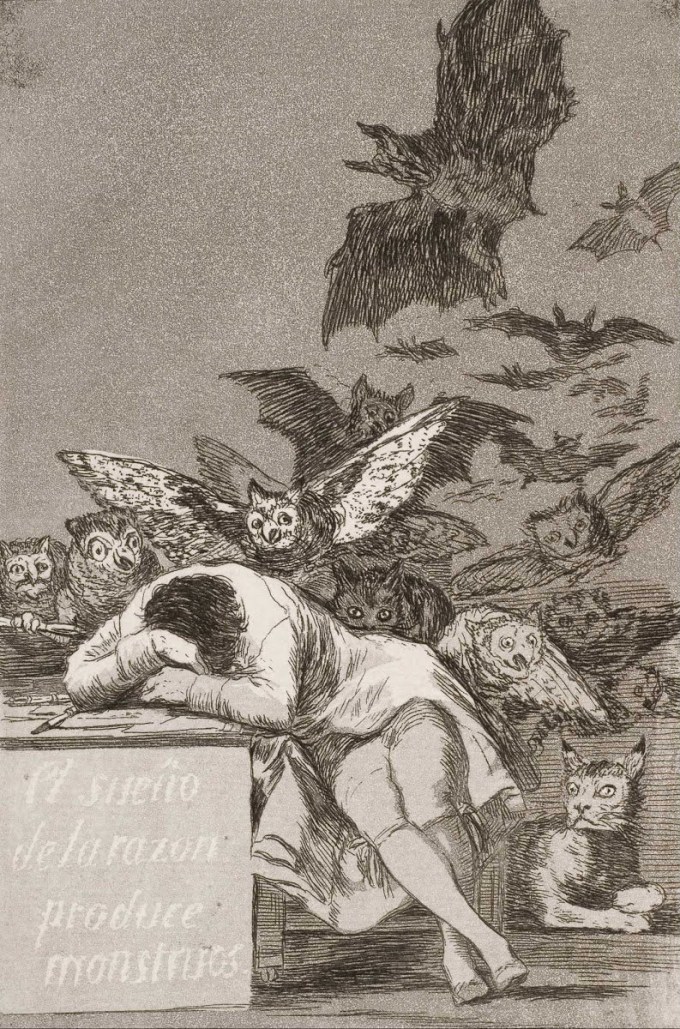
I mentioned ‘the sleep of reason’ in my last post. I had in mind Goya’s Los Caprichos print series, and specifically plate 43, ‘the sleep of reason produces monsters’. Owls gather above the sleeping artist’s head, no owlish wisdom here, just confusion, compounded by bats swarming behind – the owls lit, the bats unlit, and below two cat-like creatures look out, lynxes maybe, one directly at us, black and ominous, drawing us in.

By 1799 when Goya published Los Caprichos the high hopes of the Enlightenment had faded – his time maybe not too similar to our own.

Sleep of reason

Goya is clear that we cannot live by reason alone. ‘Imagination abandoned by reason produces impossible monsters; united with her, she is the mother of the arts and source of their wonders.’

We have in recent times been short-changed on both. Imagination looking back not forward, reason pilloried as ‘expertise’. And for many us, for the first time in our lives, we feel the tide of human improvement, I won’t say progress, is running against us.

Can music help? Leonard Cohen’s words from his song, Anthem, have helped me. (I love singing it!) Simply the idea that there’s a crack, however formidable the surface textures might seem just now, there is a crack. A crack in everything.

Rings the bells that still can ring/Forget your perfect offering/There is a crack in everything/That’s how the light gets in.

Applies to the whole Brexit edifice. And the Trumpian. We haven’t come so far that we could now go back. Surely not.

I see that the artist Sarah Gillespie has made ‘the crack in everything’ the title of a painting. Maybe I’ll make it the title of a poem.

And another artist, Turner Prize-winner Wolfgang Tillmans, quoted in the RA Magazine: ‘ …this amorphous, right-wing, nationalist sentiment … has become the central issue of world politics …how, as a sort of avant-garde artist, do you engage with the number one political subject?’

How does an artist respond? Or a writer? A musician?

Propaganda has its place, but propaganda and art are not easy bedfellows. Caricature if it points up absurdity, gross behaviour and the like has a powerful role to play. But not if it only appeals to the already converted. In the hands of Hogarth, Rowlandson and Gilray caricature becomes an artform in itself. But we must tread carefully.

What we can’t do, in our anger or frustration, is allow ourselves to abandon reason, to let reason sleep awhile.

‘Imagination abandoned by reason produces impossible monsters; united with her, she is the mother of the arts and source of their wonders.’

A puzzling innocence

Back in January I wrote a poem which touched on a nightmare which I trusted with the bright and clear skies, and warmth, of June would evaporate. It didn’t, of course.

There is a foolish innocence abroad in the land. I thought back in January that we could all handle it with gentle irony. Now it’s for real – and the irony, still gentle, has a sharper focus. Irony better than anger? I’m not sure!

*

A puzzling innocence
at home on English shores

Is it a puzzling innocence, that we should wish
to shake ourselves free of all the sand and salt,
a dog out of the waves,

more than sand and salt –
we would be somewhere else, another beach –

the same waves, the same wrack and kelp,
but the sea would be somehow different,

the tide driven by another moon and
under that new moon we’d trade our goods

beyond our shores unfettered, be more English –
the moon an English moon –

ours would be
a calculated innocence, a glorious future,
an imagination of a past when we rode oceans –

grew rich on other lands – unshackled, the sea
we’d command would stretch no more than

a few miles off our shores, yet we would
still be lords –  you say,

                         it’s bright-eyed innocence
to see only the benign, the old navy afloat,
a few new tugboats on calm and peaceful waters –

but who needs containers in this grand design –

where once we traded pounds we’d trade in pence
and who are you to say, that’s not a better way

(c) Chris Collier, January 2016

All Hallows

Yesterday was All Hallows’ Eve, which makes today All Saints’ Day. Yesterday was also in warm and brilliant sunshine the last day of autumn (by my calculations anyway!) – the autumn colours burnt in the sun as I’ve rarely seen them, a multitude of shades, with their own luminescence – as if they didn’t need the sun to make them glow. Today is the first day of winter – the cloud is down on the hills, there’s a chill, the fire must be lit soon, and the leaves are thick on the ground. I raked them in the sunshine yesterday, but they’ve returned, and if I rake again, this time in the damp and gloom, they will return again, until the last one has fallen and I can put the rake away.

Yes, there’s an elegiac quality to all this. I listened to the adagio from the Elgar violin concerto driving back along the A419 heading toward the Cotswolds yesterday. That caught the mood. I knew this was the last day, the last of autumn, and there were not two hours till sunset.

The day before I’d listened to David Mellor on Classic FM, playing music from the Philharmonia under Otto Klemperer. A recording of Mahler’s Resurrection symphony when the great conductor was already in his 80s. He took it slowly. About the same time the recording was made I was, I remember, at a party at Professor Gombrich’s house. Ernst Gombrich was my professor at the Warburg Institute. Frau Gombrich mentioned they were going to hear Otto the following day. Otto being Klemperer. All with Viennese Jewish backgrounds, and the connections were still strong.

Klemperer had been recommended sixty  years before by Gustav Mahler (also that Jewish connection) to an orchestral position, and I felt my own connection listening to the final ecstatic bars of the symphony to Klemperer and Mahler. Almost a laying on of hands. Ridiculous in its way, but the music took me to another level. Triumphant – but also elegiac, and intensely moving.

Mahler died young, and two world wars had to work themselves out before Klemperer stood before the Philharmonia in the late 1960s.

I’ve felt betrayed by events this year – my values betrayed, values by which I’ve conducted by life over almost seventy years. The autumn leaves, the music, a sense of loss I wouldn’t ordinarily indulge. But I did this time, this once, just this once.

Back to Brexit ….

A brief note – in the end not quite as brief as I intended! My reason for this post – to explain why I am not one of those who voted Remain but is now prepared to accept Brexit, to accommodate – accept that the vote has happened, argue we should make the best of it and get on with life.

A few reasons, in no particular order, as they say on Strictly Come Dancing, as follows….

The vote was won on a basis of a false prospectus and false promises. Even now – press headlines pick up James Dyson and Lord Bamford, two of the rare industrialists who supported Brexit.

We are a parliamentary, representative democracy, and we should live and die by that. Not be ruled by plebiscites, which are the first and last resort of populists and demagogues. (We currently have an unelected government, governing to its own and not the 2015 Tory manifesto, and which anticipates pushing Brexit through using the royal prerogative without, if it can help it, reference to parliamentary discussion or vote.)

The European Union is a remarkable institution. Unwieldy, bureaucratic, fractious, but it is the extraordinary coming together of 28 different nations, each passionate about its own interest, but likewise seeing the benefits, after two thousand years of conflict, of coming together. Our efforts should be concentrated on reform not withdrawal. (The EU has been pilloried for its poor handling of the refugee crisis, but I wonder how it could have been handled well, given all the fear and anxieties felt by 28 countries with very different histories. Had here been no EU, how would the crisis have been handled? With any less agony, any less suffering?)

A war which tore Europe and then the world apart ended only seventy years ago, a year before I was born. Before that another war, arguably even more terrible. We’ve had seventy years of peace, unprecedented peace. The EU symbolises and acts out that peace.

As an economic union, despite all the talk it’s a significant success. No serious economist would argue otherwise. Run a business which trades with other European countries, which I’ve done, and you’re aware of all the benefits. The danger is you take them for granted – assume they’d have happened anyway. There are also extraordinary levels of scientific, environmental and cultural collaboration, for which the EU has provided both the mechanism and inspiration.

The EU isn’t restrictive – unless you’re opposed to workplace and environmental rights. And we’re not going to do without the regulations by asserting our independence – if we want to trade with Europe, the regulations are the terms.

Where there is unnecessary red tape we need to be in there, ensuring it’s removed, instead of being passive observers. We are sacrificing engagement, and influence. We’ve used that influence well over the years.

Immigration is a perceived threat – where immigrant numbers are highest we had the highest Remain votes, where they were low the highest Leave votes. A perceived threat – nowhere near the actual threat that much of the press played up. Likewise no evidence that immigration has held wages down. Yes, pressure on schools and housing in certain areas – and the last government singularly failed to recognise that immigration, and other changes in our working lives, must be reflected in improved infrastructure. (Levels of immigration in recent years have been too high – I’m not arguing otherwise – and politically they’re unsustainable at this level. How you handle this while preserving freedom of movement is a mighty challenge, but not remotely a sufficient reason for Brexit.)

Behind immigration lies the identity politics, aligned with nation and race and social group, which we should be fighting every step of the way. Espouse patriotism not separatism. Patriotism based upon British values of openness, tolerance, free speech – and a tradition of welcoming strangers, bringing them into the fold, and letting them benefit our life and culture – blending in as countless immigrants have done before. Likewise refugees – there are limits of course, but our first instinct must be to welcome.

Related to this, the argument that British, the U.K., England, isn’t the country it used to be. The old generational cri de coeur. True, the pace is faster, and the landscape much impaired. But there have been many radical improvements, too easily discounted. As for the negatives –  the EU takes the rap. I may personally be in the old codger bracket, but I’m with the younger, pro-EU generation.

There’s a mood out there, encouraged by the right-wing press, and played along with by the BBC, that somehow it will all work out. In Philip Hammond’s words, there will be bumps in the road. There’s another much more likely scenario where we find ourselves out on a limb, with an agreement which is dictated to us, and which we accept out of necessity. The economic auguries are not good. Put simply, a crisis awaits us.

There is so much else that matters out there in the world which we were just about facing up to, and they’re now on the back burner in terms of government and public attention. Global challenges, new technologies, fundamental changes in our working lives. At home, infrastructure, the NHS – requiring focus and funding when attention is elsewhere.

We have a hugely inflated view of our presence and reputation in the world. We embody as a nation tolerance, free speech, we pioneered modern representative democracy, the world plays many major sports by rules we laid down. But this is Britain as was. Our current behaviour simply alienates.

To end, two further points –

I’ve mentioned openness above. We have always been open to the world, and the danger now is that we shut ourselves off. Look to the past. Seek one-off deals when others work together. Openness is state of mind, and in an atmosphere of fear and apprehension, in great part built up by the media, it is now challenged as never before in my lifetime.

In direct contradiction to Theresa May’s comments, whether we like it or not we are citizens of the world, citizens, along with all our neighbours, of Europe, and citizens of the U.K. My patriotism is undiminished, I’m British to my last breath, but I also share a common humanity  with every man and woman on the planet.

And finally – never imagine that the change you wish for works out as you anticipate.  It will not, and never has. Gut instinct will never provide. A wing and a prayer will never suffice.

I remember one egregiously daft piece imagining a post-Brexit Britain in 2025 by Daniel Hannan in the Telegraph. It was the stuff of dreams, and typified the dream world in which Brexiters exist.

Now isn’t the time to buckle under.