Finisterre – a few hours at the end of summer

Finisterre (Fisterra), Sunday 11th September. There’s a story in the photos below.

Mist down all day, clears to my surprise at 4 o’clock, initially only over the Finisterre peninsula, and even then it’s always present, as if only the slightest movement of air will cause it to re-form. There’s a radiance, an iridescence in and about the air. Should we sail out now into the ocean, to a spirit world, or paradise, beyond, the seas will be calm. There’s a white trail on the water: might that be the route we take?

I clamber down, below and beyond the crowds. I have the far southern tip of Finisterre to myself. People have of course been here before me. Once upon a time pilgrims burnt their no-longer-needed and odiferous walking clothes here, but that practice has been banned. But not to be defeated several people have built a frame of poles and branches and strung their old unwanted clothes from it. They hang limply now. Come the next strong wind they will be shredded.

All the while the cloud is building from the north-west, as the photos show. How stormy the weather will be who is to say, but a long hot summer is slipping away.

The surf is gentle, breaking in concentric patters round untroubled rock. The clouds are wondrous, curtains of cirrus, swags of dappled white looped lightly across the sky, and the ocean almost impercetibly darkened beneath. The sky as it might be in paradise, and all the more a thing of magic because it might just disappear in an instant.

Sure enough the following morning breaks grey and damp, with the cloud down to rooftop level. It will not clear today, and rain will follow. And in England – the hottest September day on record. Cold winds slip down to the west of Ireland, leaving England marooned, cocooned and over-heated.


Finisterre – end of the known world…

Last year walking the Camino across Spain I put all thoughts of politics out of my mind. I posted a blog when I returned, entitled ‘On being a European’. I had confidence a European and international outlook would win out in the end, whatever the short-term travails. The Brexit vote hit that confidence hard, but walking the Camino Portuguese, and the passing of the weeks, has helped bring calm and perspective. And a shrug of the shoulders – can we really be so daft?

At Cabo Fisterra, Cape Finisterre, where I ventured after Santiago, I clambered down the rocky slope below the lighthouse, and looked out west, over a stretch of ocean which to the Romans would have been at the very edge of the known world – finis terrae. The ocean as the Styx, and somewhere out there would have been Charon, with his boat, ferrying souls.

High cloud patterned the sky but didn’t reduce the sun’s intensity. Mist held to the coast behind me, but not out to sea.

In medieval times, likewise, this was the end of the world, and pilgrims would continue beyond Santiago to Finisterre. In the voyage of St Brendan he sails out west from Ireland and passes over into paradise.

I’ve this fantasy of May, Davis, Fox and Johnson, sitting in a restaurant, at the end of the world (borrowing from Douglas Adams!), having a last meal before they cut ties with Europe and venture off into the unknown. The ocean is peaceful just now but the autumn and winter storms will be mighty.

On another tack, but still in Spain, there’s a quote I like from Gerald Brenan’s classic book, The Face of Spain, about Spain, but more applicable to the UK just now: ‘I do not know where we are going, but I do know this – that wherever it is we shall lose our way.’

And China…. thinking walls, not oceans…. I’ve a sense that the Emperor Shih Huang Ti’s behaviour, as recorded in Richard Flanagan’s novel, The Sound of One Hand Clapping, might just have relevance to our own times: he ‘ordered the construction of the Great Wall and the destruction of all books preceding his reign, so that history would henceforth begin with him and his wall.’

In this post-expertise age, we are in a not dissimilar place. We might just finding ourselves using a new, unknown and very friable building material, not stone, not brick – but brexit. On one side of the wall, the old Europe, and on the other, the ocean.

Messages home from the Camino Portugues

or …… Travels with a very small bear

This is the alternative blog – based on messages home to my partner, Hazel. Carlos, by the way, is a small Steiff bear she gave me before I set off on the Camino Frances last year. He sits, usually with his head out, in a small side pocket of my rucksack.

Wednesday 31st August:

Eating a very good octopus and bean stew after a stroll round the very lively streets of Porto. One girl belting out an Eric Clapton blues. Marvellous evening views of the river from the cathedral, the port houses of the likes of Cockburn and Sandeman still lining the shore. Hotel OK. I’ve bunk beds in the room as well as double bed – should I need them!!!

Thursday 1st September:

I’m sending a photo of Carlos (now on his second Camino!) taking in the view (the Atlantic, lost in the heat haze) just before we finished our walk. We (he and I!) are staying at the monastery in Vairao – beautiful location. Countryside surprisingly green, given the hot weather. Walked 17 miles in the hot sun.

image

Started 10.30, after exploring Porto by daylight, especially the cathedral – I loved the cloisters. Slept well and walked well. Only problem might be a plantar fasciitis recurrence – felt sore even before of started walking. Not bad, doesn’t really hurt… Staying in the high 80s here. I think I like it! Carlos thinks Portugal is …cool!

image

Friday 2nd September:

18 miles in 88 degree heat. Yes I did wear my sun hat! Shade always came to my rescue. Eucalyptus woods have a sweet smell! Two great cafes en route – they love peregrinos and make you feel like a celebrity. Barcelos is delightful – somewhere for you and I to visit when we do our northern Portugal trip!! (Did you know about that?) Tomorrow – 20 miles and no cooler – I’ll probably do 12 miles [I didn’t – I did 21] and stop off at an earlier albergue. Ponte de Lima does sound special.

There’s a spiritual quality in all this, somewhere, must remember that, and too much mega hot sun doesn’t help! Don’t worry – I will be sensible.

Saturday 3rd September:

Today probably the toughest of any Camino day – close on 21 miles in 90 degree heat. Took a longish lunch break, mega amounts of water – camels have a good plan, and did the last three hours down to Ponte de Lima in stages – 15 mins then water, then shade. Think feet OK, but they’re sore, and a blister needs watching! Wonderful rolling wooded country, maize and vines in abundance, but too little shade. Carlos complains he’s getting a tan! …Tuesday forecasting 40 degrees here – over 100F. Won’t walk after 10 – will begin at 6 maybe and make it a short day! [That at least was the plan!]

image

Ponte de Lima beautiful and bridge medieval, long and narrow, for pilgrims and horses, but the whole place is touristy. Currently sitting outside after a shower (communal!) and drinking a local craft beer….

Sunday 4th September:

Got to Rubiaes about midday after five hours walking – and that is enough! Sheltering in the albergue, as is everyone, no-one daft enough to be out there walking! Wonderful walk from the Lima valley – a high pass only 1400ft but rugged and the sun already hot. They’re collecting pine resin from the trees – plastic bags attached to capture – so a sweet smell. And big views. Hot tomorrow again – aiming for the Spanish border…[News that Strictly Come Dancing has started already]… God help us all! They’d all die dancing in this heat… Planning a 6.30 start – not too early – Roman bridges don’t look special in the dark!… Flip-flops a big success. Sore left foot no longer sore! But sore spot on right foot. Such is life!

image

Monday 5th September:

Having a coffee in Valenca, fortress above the Minho – view upriver takes some beating! Left at 6.10, arrived 11.30. Off to Spain in a few minutes – just 2km to Tui….

image

Now well-settled in Tui. Mixed dorms but we’re spared mixed showers! Breakfast with eccentric ex-postman from Wigan and chatted to Polish guy who has his own travel magazine, takes own photos and hates smartphone cameras! Otherwise I’ve been swinging along through beautiful country, Roman bridges – it was once a Roman road, wooded paths, a few red-barked cork oaks, and singing, and happily lost in thought – walking as the good Lord meant it to be. Heat building, but OK. Tomorrow is the mega heat day – should I leave at maybe 4.30? Could be 2 hrs walking in the dark… Time now an hour ahead – funny gaining an hour going north. Mega hot out there – can it really be that tomorrow will be 6 or 7 degrees hotter still?

Tuesday 6th September:

Our international party, Polish photographer, Antonio, Czech student, Michaela, and me, walked 22 miles from Tui to Redondela, leaving at 5.40 and arriving 2.10, in 97 degree heat. Feet done in but otherwise beginning to recover, aided by beer, water, bread and cheese. We kept talking and and helped push each other along. On my own – would I have made it? Other people on the Camino today included – more Poles, a group of Spanish scouts, and a Mexican couple. No Brits save me!… [Tomorrow] heading for Pontevedra. Easy walk, I think. Assuming I can walk! Feet in rebellion!…

[Message from home: ‘No Brit would be mad enough to walk in that heat.’] Are you suggesting I’m not British?! I’m not one of your lily-livered Brexiters! Antonio called out a moment ago – ‘How is Brexit?’ (meaning me) ‘Do not call me Brexit!’ I shouted back. Such are the burdens we old-school Eurobrits have to bear!

Talking of bears, Carlos got some serious attention today – he’s feeling better about things. Brave bear – coping with the heat. And I’m doing the walking for him, of course.

Wednesday 7th September:

Arrived Pontevedra 12.45, having left at 7.40 – last person out of the albergue. Most are gone by 6, but sunrise 8.10 here, and I want to see where I’m walking! Easy day, two healthy climbs, but sun came out late and I had my favourite breakfast – fresh orange juice, croissant and café con leche. Bounced along after that. Lesson for and from today – think of nothing, just take it all in! Staying in a cheap hotel – Hotel Virgin del Camino – better than vergin’ – it’s actually on the Camino! Now off to eat and sight-see.

image

Carlos’s fur trapped in zip but I think he’s OK…[‘Might Carlos like his head out of the rucksack, so he can enjoy the views…’] Carlos does have his head out of the rucksack, all the time. Only the rain would keep him in. Sometimes he stretches out a paw and waves as well!… I loved Pontevedra but wandered around too long, and my feet are very sore…

Thursday 8th September:

Arrived Caldas de Reis at 12.15 – walked non-stop from Pontevedra, not far short of 4 miles/hr pace. Too many slow Spanish walking groups and I needed to get well away from them! They talk! Beautiful gentle country, bright sun, and temperature high 60s. That makes two happy bears – Carlos tambien! Wondering whether to call him Carlito – little Carlos. Ibuprofen and blister plasters helping – feet doing better than I expected. Now enjoying bread and tapas lunch!… Amazingly I’m now halfway through this jaunt!

Friday 9th September:

Arrived Padron 12.30. Enjoying a very good menu de dia in a local restaurant! …very modern albergue – bunk beds with curtains! Big plus – they’ve done all my laundry! Shortish but beautiful walk – oak, pine, chestnut, under a deep blue sky. Chilly first thing. Bumped into Martin, who I’d met in Tui, and we did a short tour – walking up the hillside to where St James [doesn’t sound right if you’re a peregrino – has to be Santiago!] is reputed to have first preached the Christian message in what must have been about 40AD. Martin an Irish Catholic so a good companion for this! House/museum of a legendary Galician poet – Rosalia de Castro – up the road so I trekked off for a visit. Early start tomorrow – will be tight to get there in time for midday mass.

Saturday 10th September:

Photo [sent home, to Hazel, and to my son and daughter] taken a moment ago, 10.30, local time, 8 miles out from Santiago [I’m looking remarkably sprightly, all considered!] …

image

Arrived to music and carnival an hour ago. A mere 16 miles this morning and I chose to explore the longer way in – being a glutton for punishment (and I knew I’d missed the mass). Once I start moving I do walk fast – all that running and marathons and the like. Wonderful place to be – on the steps above the Praza do Obradoiro. Met my Czech friend, Michaela, from our big walk from Tui. Big shout of – Chris! Antonio around somewhere. And others I recognise – we’ve all walked a long way!

image

Sunday 11th September:

Mist down low over Finisterre [I took a bus, and did feel a bit of a cheat], there’s a little overhead sun but wherever I walk I won’t see much. Maybe it will add to be mystery, and there’s a lot out there….

The mystery is now the view, on a perfect evening! The mist cleared over the last hour. This is where you would, in classical times, pass over the horizon, to the other side, to the spirit world. No-one is closer than I am at this moment. Back in the now – you’d love it here – sun, sea and waves breaking gently. And warmth….  a wonderful day, in the end. I’d set out for the cape  about 4pm and walked and scrambled and stopped and pondered and took photos till about 8.30. Magic, all a big surprise. No idea what I’ll do tomorrow. Just got back to the port (the cape is 2½km away) and I’ve a plate of salad, and a jug of wine, in front of me….

image
View from Cape Finisterre

Monday 12th September:

Damp, cloud down, forecast dreadful, no point walking 17 miles to Muxia [there will be, has to be, another time!], left Finisterre on an early bus, back to Santiago, thought I’d go to midday mass, but refused admission – my rucksack too big! Must have been by a centimetre! Maybe I look dissolute. [Tonight in a cheap hotel] tomorrow back at my favourite, the Balalada. So far a bit of a damp squib of a day!… Bought a shirt, so feel less scruffy, had a snooze, and a coffee with Martin … wonderful evening mass, felt inspired. A bit of a downer of a day early on but you can’t have the ups without the downs! Tomorrow it will rain, but I will smile!

image
View from my bedroom window over Santiago

Tuesday 13th September:

Sitting on the steps of the Praza do Quintana, near the Holy Door specially opened this year for Pope Francis’s Year of Mercy. But it seems to be just another entrance for the usual tourists – the message lost. Pilgrim mass in English this morning, lots of Irish, and an Irish priest officiating. We all introduced ourselves, said where we’d walked from – which was nice. Then I toured the monastery of St Martin, hard by the cathedral – full of altars and choir stalls which put San Millan to shame – but nothing quite to compare with the sculptures of Santo Domingo de los Silos. Galician (!) hamburger for lunch, with Stones tracks in the background. Sun now, after rain, but a chilly wind. Latest invasion of pilgrims has arrived – they’re everywhere! Each day they invade – proud to have been one of them. Funny to think – back home tomorrow night.

Wednesday 14th September:

Wrote a Santiago blog late on yesterday – still work in progress. But now fired up to get out and see things again! Funny being on your own – you can go anywhere, anytime you choose, yet you want to share it, and share coffees, and chat, as we did back in May [Pamplona, Roncesvalles, Castrojeriz…].

[Two big events, not mentioned in messages home – searching out the statue in the Alameda park of Rosalia de Castro, who is already my hero, and then the Museum of Sacred Art, with paintings and statues and much more on the Camino and on pilgrimages worldwide – few people there, and yet it’s one of the best museums I’ve seen anywhere.]

For cool damp weather, come to Santiago… Now queuing to board my flight…Bus to the airport took me via the last stages of the Camino Frances route into Santiago. Everyone wearing ponchos, and the rain then got harder. Lots of sun for them on the way – shame that Santiago lets them down now. But if they don’t know already – they’ll soon discover it’s one of the most remarkable places on earth!

[Carlos, sensibly, has stayed all the while inside his pocket!]

image.jpeg
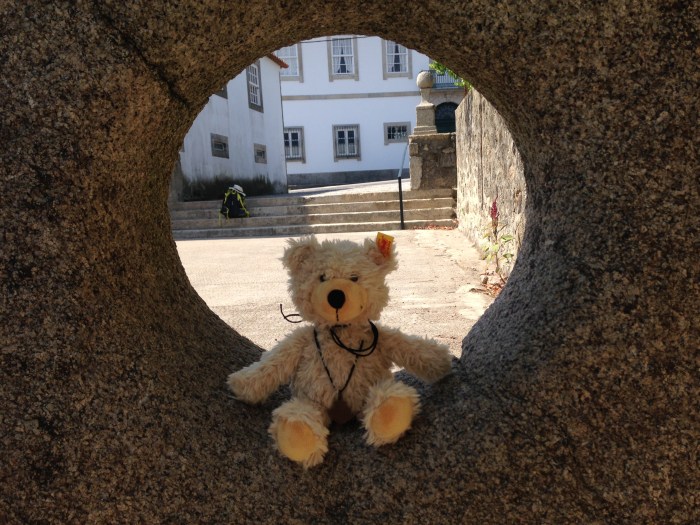
Carlos takes a break at Pedra Furada


It’s Thursday 1st September. Two weeks ago as I write. I’m starting from the Catedral Se in Porto after delaying awhile, with the heat building, in the wonderful cloister. A city built on hills, with the proud river Douro beneath, big vistas, and along its banks the old port warehouses of Cockburn, Sandeman and the like.

(Amazing in the twilight also – the previous, Wednesday, evening. Porto faces west, and silhouettes against against the sky. Street music I like: one memorable trio, with the girl belting out Eric Clapton’s ‘Before you accuse me’. If I want to sing blues and sing it seriously… I’ve a long way to go!)

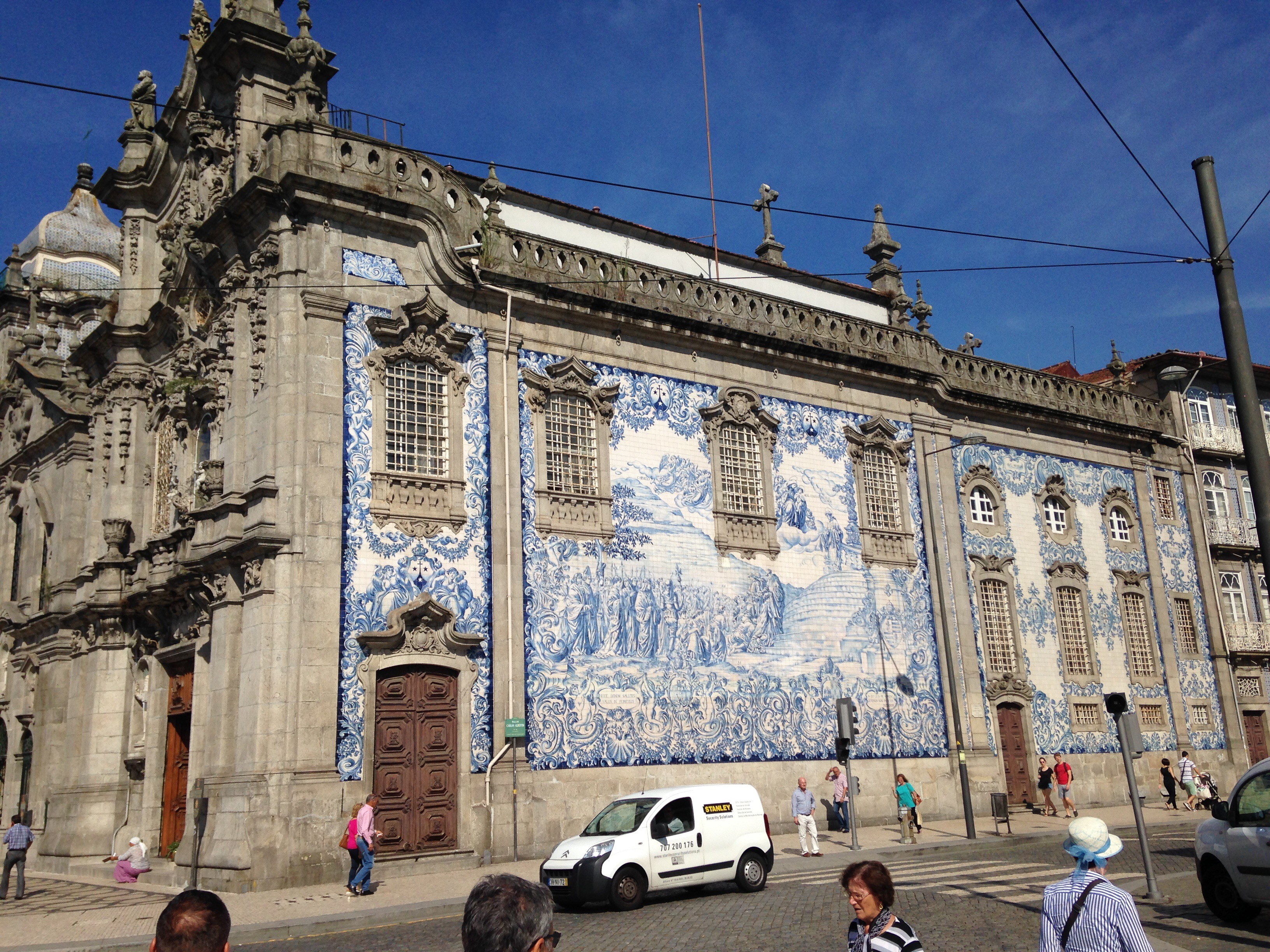
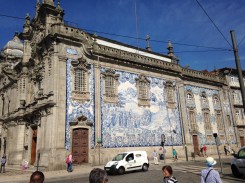
10am and sun already hot as I set off past the Carmelite church (the south side covered, and telling stories, in blue azulejos tiles), along the Rua da Cedofeita, which seems to contunue forever, and on through the suburbs. I haven’t gone far when I’m accosted by a stranger and invited to inspect a newly-opened albergue (Albergue Peregrinos Porto), which brings together under one roof all the best features that Oscar, the owner, has seen on his pilgrim travels. Next time I’ll stay there.
    img_9587-2

All the buildings, almost, have azulejos tiles, not least the station, and they tell stories, and the cathedral cloisters likewise, less so the outer suburbs. After maybe 12 miles of endless roads I’m into countryside, and a few miles beyond I’ve reached Vairao: staying in a monastery, beds not bunks, and it’s oh so wonderfully peaceful. No monks in sight, and there’s a single volunteer in charge – a Brazilian guy doing a two week stint. The meditation room I’m told is two flights of stairs up. No lights on the stone stairs: I stagger up in the total dark, and flick the light switch: Buddha and cushions but no sign of anything Christian! Yet this is a monastery. As a Dutch lady said to me a day or two later, she loves it all, but compared to the Camino Frances it’s not spiritual in the same way. Being a Camino, that spirituality has to be rooted in Christianity. Churches on the route are closed too often, and I miss the pilgrim masses. And the Templars, and Cluny, never got to work down here and put money into anything like the great Romanesque temples I love on the Camino Frances.

All that said – still an amazing trail to be following. Comparisons maybe miss the point!

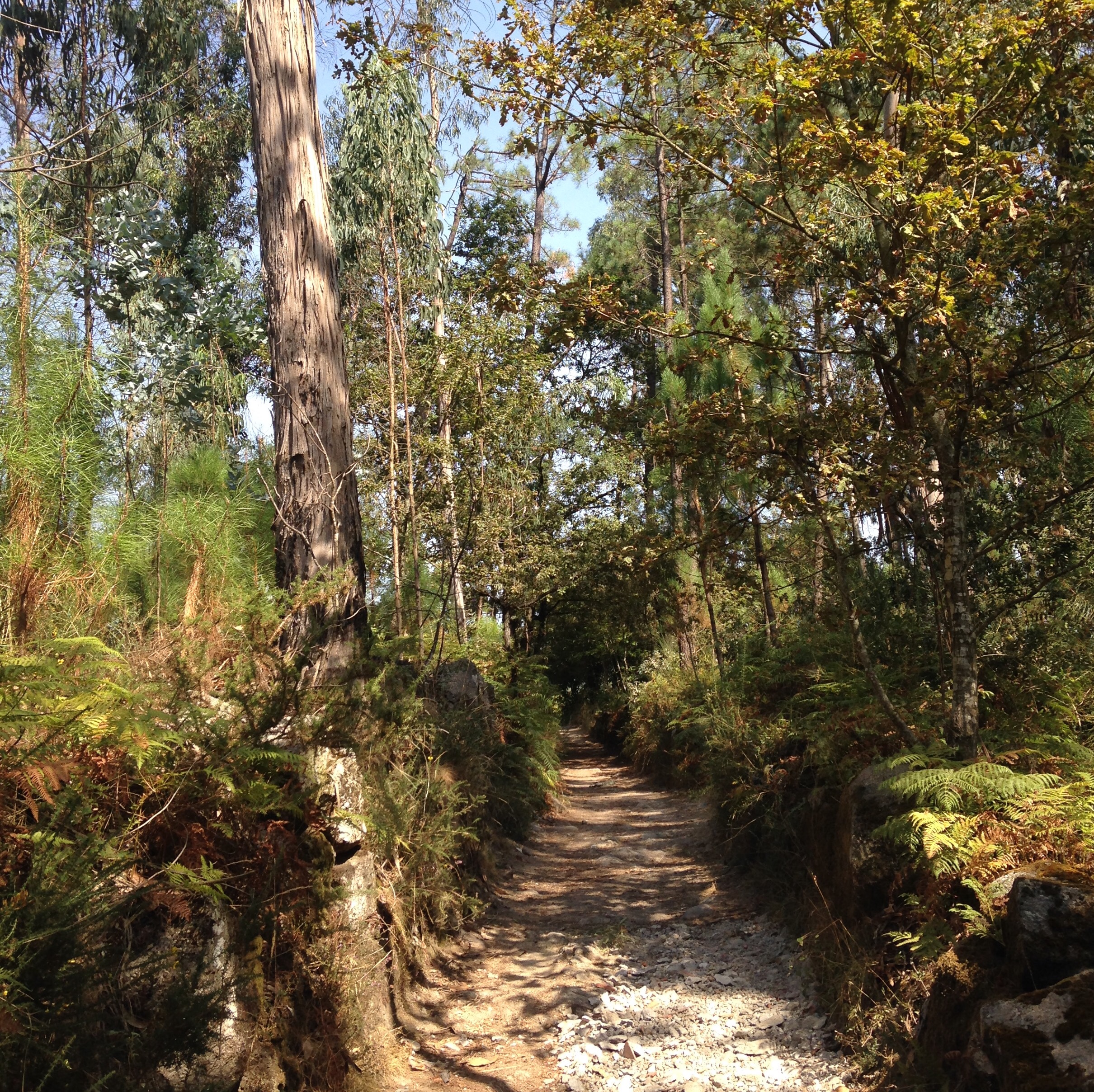
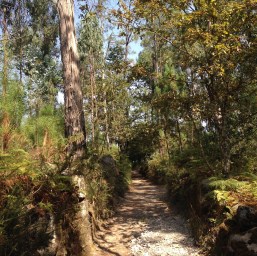
Friday 2nd. San Pedro de Rates, drinking water water water, and coffee, under an awning, the clock tower above, and the village square blasted white by the sun. The cafe owner (Cafe Macedo) loves pilgrims: big smile and handshake saw me on my way. Next – Dead Woman’s Peak – Alto da Mulher Morta. (Looked hard for Dead Man’s Gulch, but wrong continent.) Not enough shelter from the eucalyptus and pines as we gently climb. Pedra Furada – a megalithic disc, with a hole… stranded in a paved churchyard, but it still has mystery.
img_9690-1        img_9748-1

Barcelos, commanding the river, famous for its legend of the cock which crowed just in time (the victim was already hanging) to save an innocent pilgrim’s life. Now a garish cartoon cock, and he’s everywhere. One marvellous octagonal church, ornate decoration, and another severely Romanesque, the river directly below, with a mill by the bridge. Colourful umbrellas float above the main shopping street.  My albergue was in Barcelinhos, where checking in I’m greeted by the most beautiful girl in the world: dead on my feet and glasses coated with salt and sweat I walk into and rebound from a plate glass door. Impressing women is never easy. Also hurt my head!

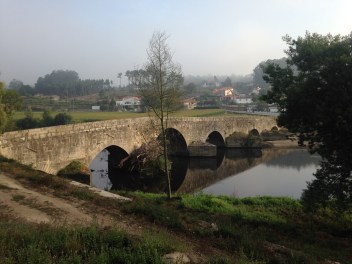
Saturday 3rd. Getting hotter by the day. Drink suspect water from a fuente, mild tummy upset – doesn’t help! Ponte da Tabuas, old bridge and river forms a lagoon, and someone’s swimming… Dirt tracks and cobbled roads (all minor roads are cobbled) take you through maize and vines, the vines forming a narrow screen next to the walls of cleverly laid, heavy, solid  granite stones. These are old landscapes, little changed, by the path side, but the fields are often big, and sprinklers throw their water far and wide, and are happy to dowse pilgrims.
 img_9619

A roadside chapel dedicated Our Lady of the Snows. You long for snow in summer, and you don’t have far to go to find it in winter. It’s a lovely evocative name, sounds even better in Spanish: Nuestra Senora de las Nieves. A pulpit sits outside the west door: this intrigued me – was a priest from back maybe in the 18th entity the radicalising Wesley or Whitfield figure of his time ? Preaching out rather than in. There’s a bandstand opposite – what does this signify, I wonder?

One big blister by the time I limp into Ponte de Lima. Wide river with long and spectacular medieval bridge. There’s a big kayak race – why kayaks? Whatever, it’s a big event!  They know how to party here and it’s Saturday night … Supper outside with a Canadian girl and a Italian guy: she works in England at Stevenage hospital, was born in Dubai, has lived in Canada since she was three, and her parents were originally from India, and her boyfriend who she came to England to be with is – Welsh. The multinational Camino represented in one person. She’s walking from Braga to Santiago, another variation on the Camino theme.

Not quite so many walk all the way from Lisbon. Places like Coimbra sound magical, and there’s Fatima, a pilgrimage in its own right. Someone, for much of the Portugues route, and beyond, has happily drawn blue arrows facing the opposite way, the Fatima way, wherever there’s a yellow Camino arrow.

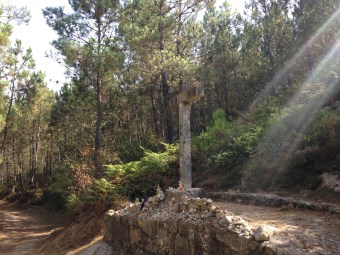
Sunday 4th. Sleep not too easy. Street noise right below the dorm window!  And everyone in my dorm is up at 5.30 – start early and beat the heat. No way can I sleep – so I’m off early to. By 10am climbing sharply, a rugged path to 1400 feet, big views back to the Lima valley, two evocative stone crosses with memorials and mementos, and pine trees with plastic bags attached: they’re collecting resin, and it’s thick and crystalline, and the smell is sweet.

Rubiaes, another municipal albergue. Down to basics – they pride themsleves on how minimalist they can get – as long as there are showers and bunks, they’re right, nothing else matters! And it’s 5 euros! Most of us there by 1pm. Late arrivals sleep on mattresses in corridors. Not much to do, the heat it seems exhausts more by doing nothing than by moving through it, save shower and wash clothes and read and talk and sleep and eat. This is not a metropolis.

Monday 5th. Checked out a Roman bridge in the half-light, we’re following for much of the way the Roman Antonine Itinerary XIX. A major route from the 1st to the 5th century. There are six-foot and bulky inscribed Roman milestones along the way. I love tracing out Caesar or Augustus with my finger. I reach the Spanish border by 11 – Valenca, Portuguese fortress, on a massive mscale, this is serious border country! Fortifications inspired by Louis XIV’s remarkable engineer, Vauban: they are on a vast multi-levelled scale. The Portuguese did not, and rightly did not, trust the Spanish!
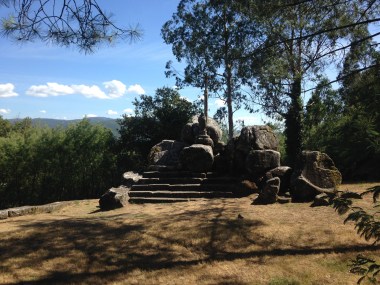
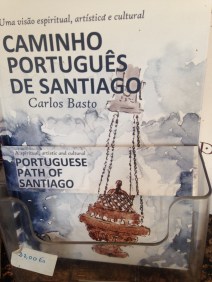
    img_9649

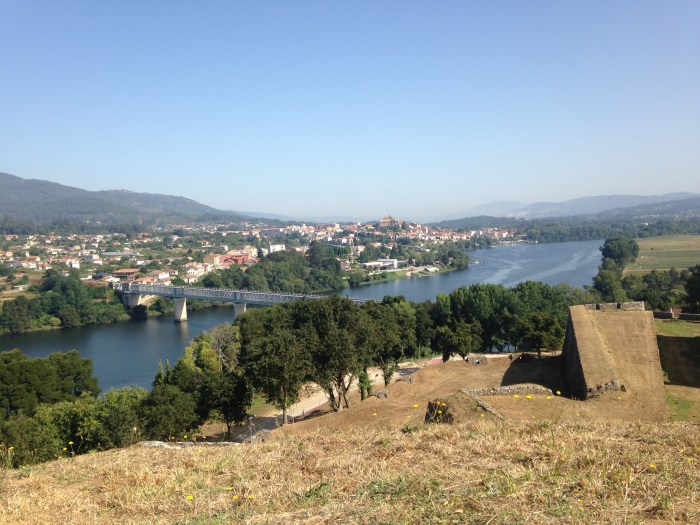
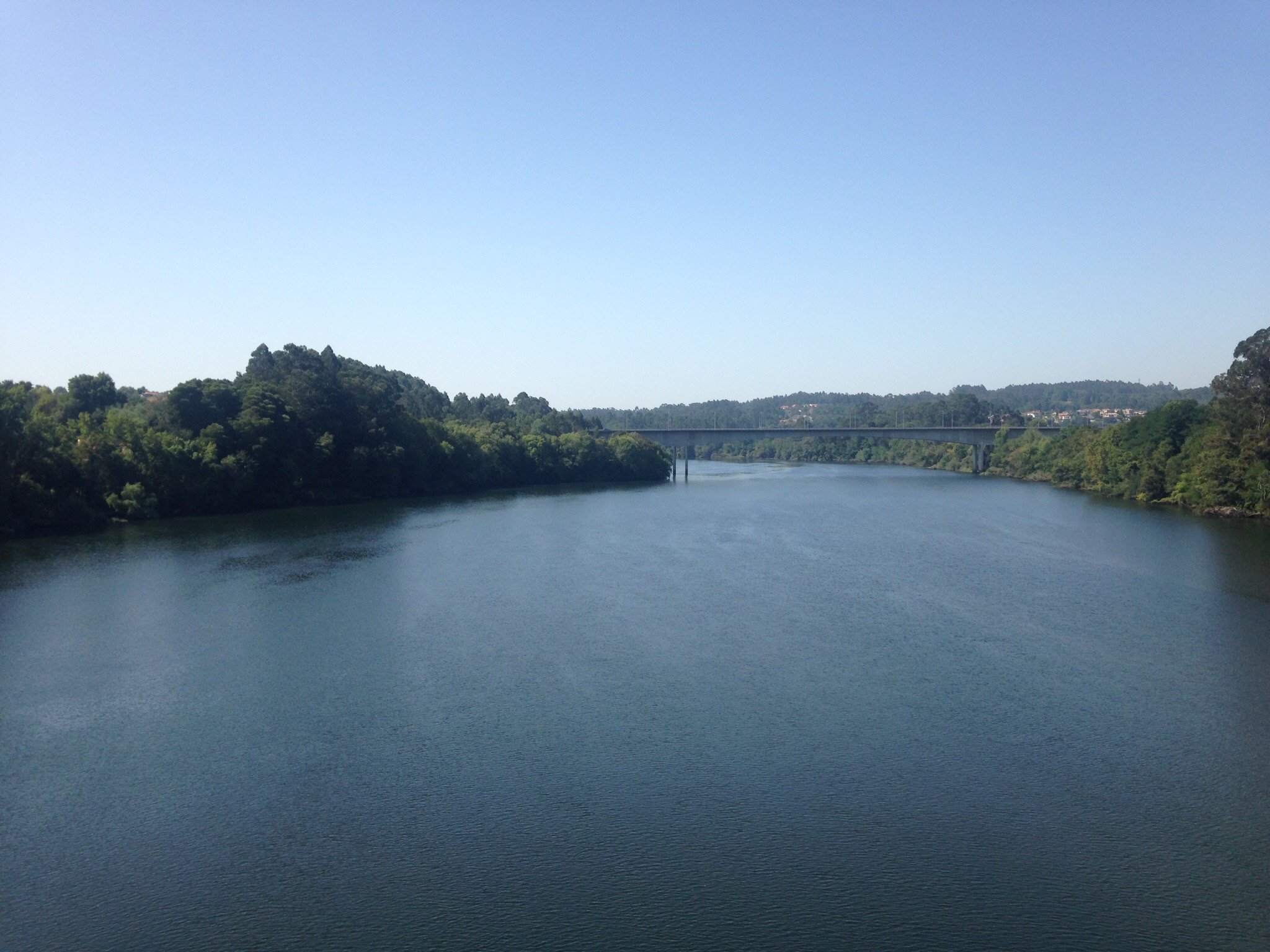
Views up and own the Minho river take your breath away. But most pilgrims head straight on, and tourists go for the nicknacks. Stop halfway across the bridge, straddling the border. River impressive – Ben (my son) and I went kayaking just below here ten years ago! Good memories.


Then on to Tui, Spanish border town, solid granite, cathedral a fortress, and cloisters the best place for cool! Carved portico inspired by the Portica da Gloria in Santiago. Dinner with Martin from Dublin (a retired engineer, he has a Camino tattoo on his upper arm) and Ken from Wigan. Broad Lancashire stalks the Camino..

Tuesday 6th. Big view from albergue up the Minho, first semblance of a breeze at 2, we’re all away by 5.30, 100 degree heat forecast. Stars bright, Orion already high, and Sirius just touching the horizon – winter stars, out of place in all this heat. We take the green route round Porrino, avoid the factories – three of us, a Polish photo-journalist, a Czech girl student, and a Brit. Pushing each other. After 22 miles we make Redondela, it’s getting close to 2pm. We get the last places in the dorm. Getting used again to mixed dorms – showers and loos separate. Male showers communal – back to school days! We’re close to a marvellous coastline, the Ria de Vigo: I follow the river and after a few 100 yards it opens out into a tidal creak – water flashing brilliant and enticing in the mega-sun.

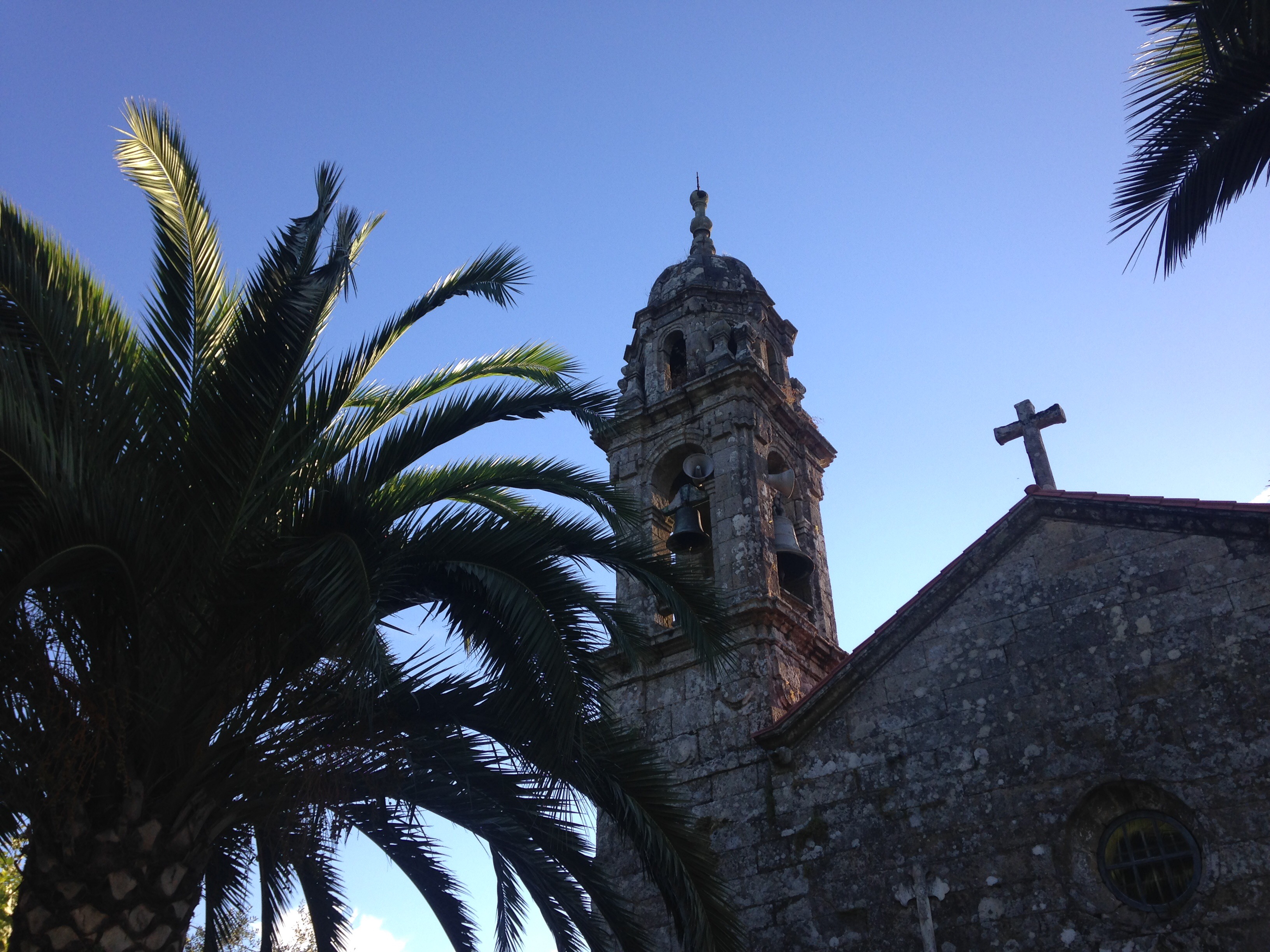
Most churches closed but their Romanesque bell towers stand out against the blue skies. I always detour to take a look, while others walk on. One way to find peace. I love the cruceiros, wayside crosses which can sometimes pack the full biblical cycle from the Fall to crucifixion into tableaux carved out of the granite. Everything, all the way from Porto, is granite. Not least the walls, and the narrow posts which would once upon a time have supported the vines that line the field edges.
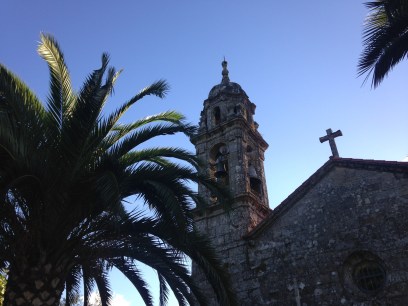
 

Wednesday 6th. A shorter walk, to Pontevedra, via the river route – alder and birch mixed in, we’re almost into English greenery. But it’s hotter, and the shade deeper. Santa Maria a remarkable Renaissance basilica – the life of Mary climbs and fills the western front. Sanctuaria de Peregrino  a perfect 18th century rotunda – ground plan shell-shaped. I take a breather – take a cheap hotel! The Asador Virgin del Camino, my oft-related joke being that it’s better than vergin’, it’s actually on the Camino.

St James is more and more entwined with the pilgrim route, the closer we get to Santiago.

Thursday 7th. But first Caldas de Reis. Chatted to Christine from Canada on the way, she’s running a leadership course near Lisbon, and all participants have to walk the last stages of the Camino Portugues. Young people, working in not-for-profit fields, from all over the world.

Caldas – thermal waters, baths and springs since Roman times. Bathed my feet: water seriously hot. Got a disapproving look from a local – no longer a cool thing to do! Ice cream in the Xardin Botanicas – that was a better highpoint. Too much time to kill. Down by the bridge over the rio Umia there’s a wonderful tree-shaded restaurant: if only I’d known!
img_0011-1    img_0021

Friday 8th. Padron – where St James landed, or at least where he is supposed to have landed. Let’s assume he did! Much more fun that way. The stone to which he tied his boat lies beneath the altar in the Igrexa de Santiago. The hill above the Carmelite convent, the Santiaguino, is where he preached. After his execution his disciples returned to Padron with his body. I bumped into my friend, Martin, from Tui and we walked and talked the hill and its story together. Helps that he’s Irish! Below, in front of the Carmelite monastery there’s a vast platform – a viewing platform, for taking in the landscape, and not half bad for preaching either.

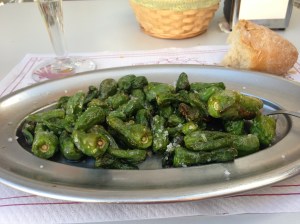
My albergue, all rather prosaic by comparison, is new, compact, and pristine clean – and the individual bunks had curtains. Also memorable: the menu de dia in a local restaurant, I’m now into main meals at lunchtime – do as the locals do. Not forgetting my evening pimientos de Padron, the local speciality.

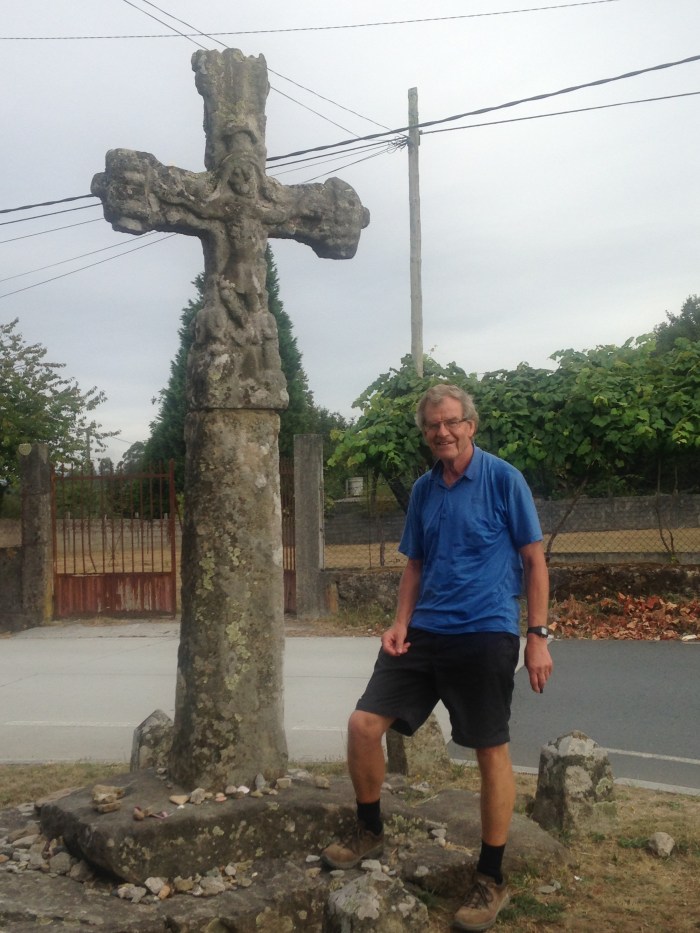
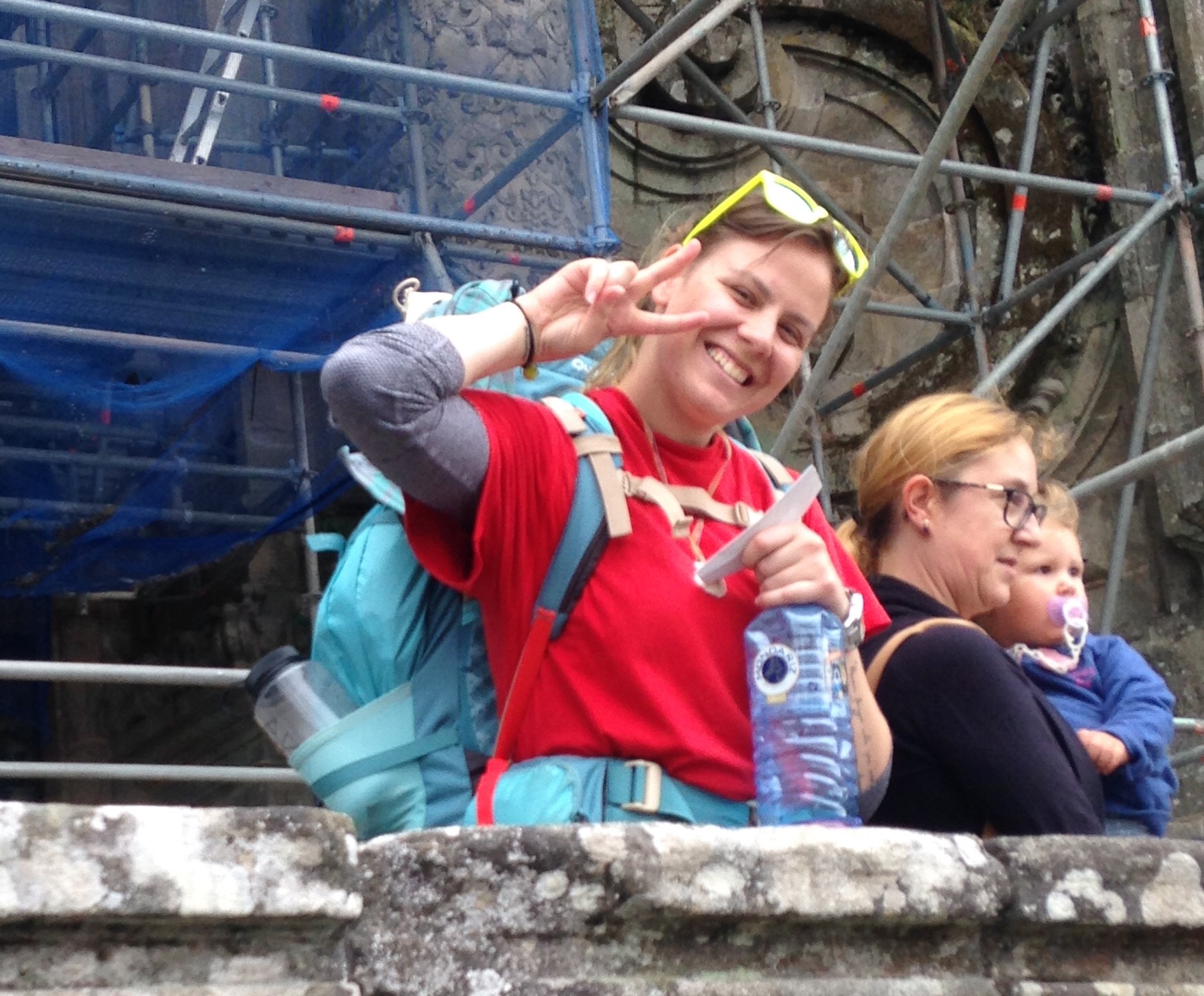
Saturday 9th. James’s disciples buried his body in Santiago. What route would they have taken? My trail ran past the ancient Iria Flavia basilica, sacked by Almanzor in 997AD (he snatched the Santiago cathedral bells in the same raid), through run-down villages , through eucalyptus and pine, following a delightful wooded river valley, past the oldest of all the cruceiros, 14th century (I had my photo taken there, appropriate for someone who loves all the old stuff, the churches, the religion, however unfashionable that might be), then across the valley, through villages …then one river left to cross, just to tease, and a curiously rural valley for somewhere so close to the centre, another bridge, and finally tired legs into the old town, where it’s Saturday, and I seek out the traditional Portuguese gate of entry, and the different areas of the city are progressing in fancy dress and marching bands, drums and pipes, into the Praza do Obradoiro.

Sadly, as last year, the west front and the Porta da Gloria are covered in scaffolding, and that means I will have to come again! It’s Saturday, as last year when I arrived, but where last time it was politics this time it’s carnival in the streets, colourful costumes,  Galician pipers, big drums echoing down the ruas, captioned horses barely under control, high-steping middle-aged ladies looking gorgeous and showing off their legs, all the Santiago communities dressed up for a big day, and the rain holds off – just. Everyone heading for the Praza do Obradeiro. I watch from the steps with my friend, Michaela, from our big walk from Tui. By mid-afternoon it’s wet.
image               

Behind me is the Portico da Gloria. Under wraps. Inside the cathedral, at the back, there’s plastic sheeting, and you can get down on your knees and peer underneath, and two girls are sitting on stools, under arc lights, chipping away the grime of ages. I think it’s the statue of Master Mateo himself one of the girls is working on. I’d love to have touched heads with him, as pilgrims used to do, in the hope that a little 12th century genius might transfer to the 21st. Outside, on the great western facade, it’s slow work there too, and there’s a lift that trundles incongruously up and down. Just how did they get their building material, and their craftsmen, up there in past times?

Santiago’s history and tradition is now embalmed – explained and served up for pilgrims and tourists. Pick almost any period in its past and the story would have been radically different. In the 13th century destruction followed on a riot in the Quintana, and rebuilding followed. 15th century, another riot, the cloister damaged and rebuilt. I’ve been unable to find the reasons or the consequences, but stories of riots do bring us, as they brought the city centuries ago, back done to earth. What were the conditions the masons and journeymen in the 10th, 13th, 17th and all centuries inbetween worked under? Master Mateo and Archbishop Xelmirez may have been hard taskmasters.

Inside the cathedral it’s evening, and the Pilgrim Mass draws to a close. The great organ strikes up, the botafumeiro is released and pours out holy smoke as it swings in its great arc across the transept. Not I’d have thought the best way to fumigate pilgrims: it may not take our sweat but it does take our breath away. There’s a pilgrim mass in English every morning, in the Chapel of Our Lady of Sorrows. The Irish well represented, including five men in orange T-shirts who are all cancer survivors, and cycling together. The priest is a jovial, over-weight 69-year-old Irishman. I too am 69. We all introduce ourselves, a marvellous diversity, though quite a few like me have come from Porto rather than St Jean. Along one wall a mitred medieval bishop rests, on his side, head on one hand and his other, upper hand clasping the good book to his thigh. He seemed so content, in the sleep of the Lord, death could not touch him.

So many sculptures, and I love getting in close and taking in their expressions. Adjacent to the Porto Sacra are prophets and fathers of the church, and bishops and popes, not psychological portraits, but the sculptors had their fun, making each one different. Calm faces, cool faces, classical faces, and some at the opposite bizarre, plum ugly end of the spectrum. All those empty stares. And noses don’t survive the centuries well.

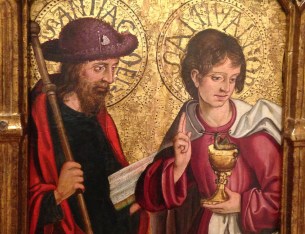
For paintings and sculptures if you want to see them not with a craned neck but close at hand, then check out the Museum of Sacred Art, a modern miracle of a museum housed within the old Mosteiro de San Paio on the Praza da Quintana. There’s the tabernacle in which St James is supposed to have been originally buried, and statues and paintings of Santiago and pilgrims from all over Europe. What did they wear in their feet, I wondered. Mostly sandals it seems, though one pilgrim had his feet wrapped round in what I assume was leather – almost a shoe!

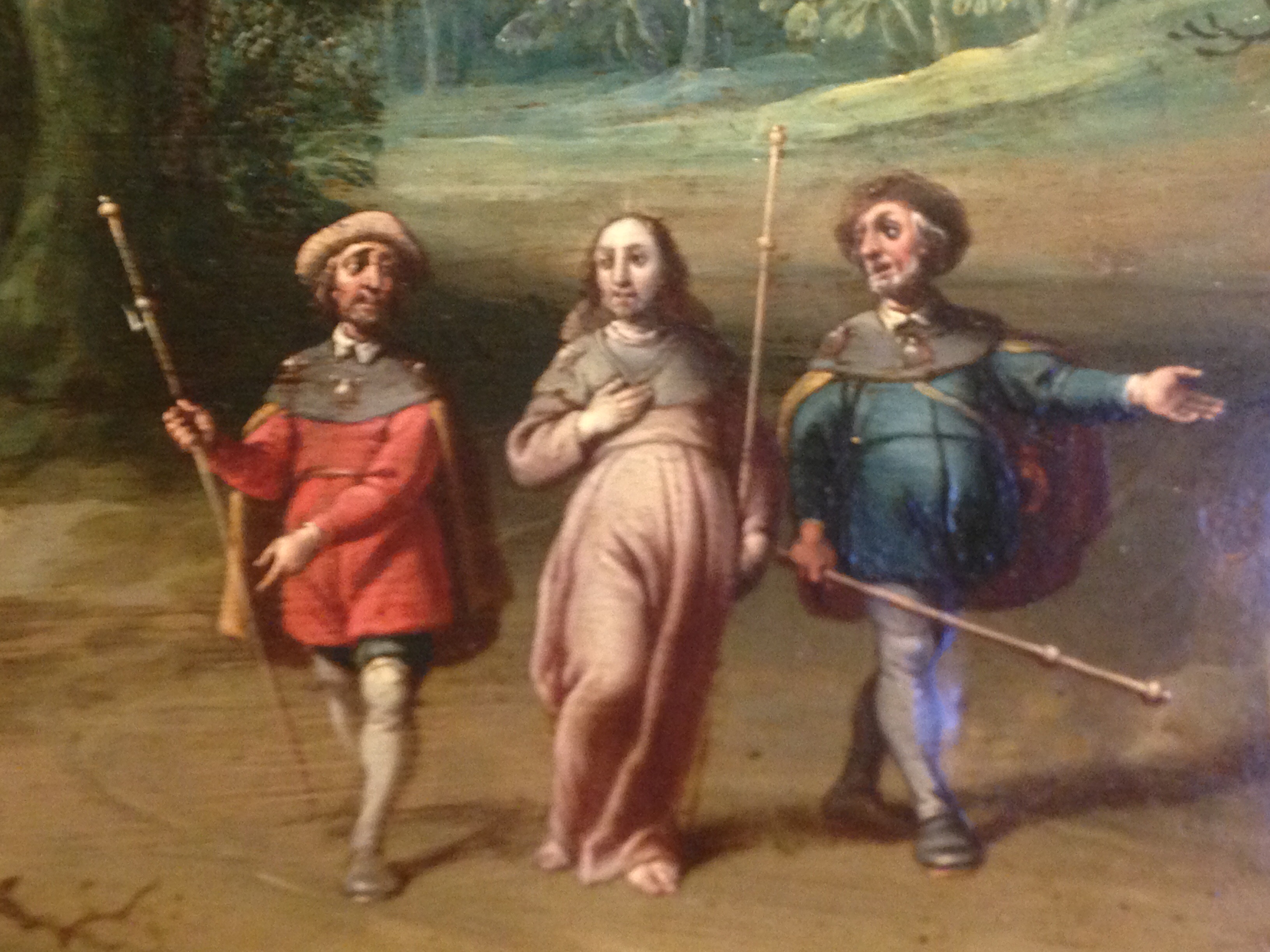
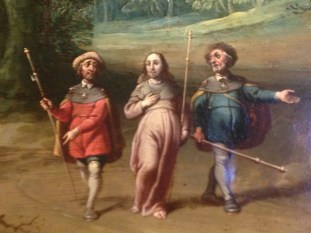
Pilgrimage is a broad concept. On a path, with a purpose. Once upon a time when we all walked we were all pilgrims… Jesus on the road to Emmaus was joined by two disciples who didn’t recognise him at first, and there’s a wonderful painting, 16th century, almost my favourite item in the whole of Santiago, of the three of them ambling along, talking animatedly beneath towering woodland. Small figures, and a big theme. Three modern pilgrims engaged in animated conversation wouldn’t look that different!
      

Jesus – lest we forget, the Pope decreed that that this should be a Holy Year of Mercy, and the Holy Door, the Porto Sacra, on to Quintana is open this year, as it would otherwise be only in those Holy Years when the saint’s day falls on a Sunday. But no mention of this in the cathedral: I saw a pile of unused leaflets, that’s all. And tourists were using the Holy Door as just another entrance. If you take confession, and mass, and are free not from sin as such but a disposition toward sin (wonderful semantics!) then you qualify for a plenary indulgence. I’m not a Catholic, and Luther railed against indulgences, but I love the idea of a Year of Mercy, and it’s a shame to see that’s it’s not impacting on the lives of tourists, and pilgrims, a little more.
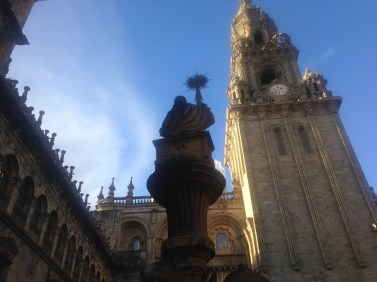
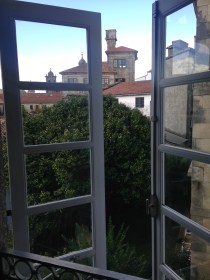
img_0229      

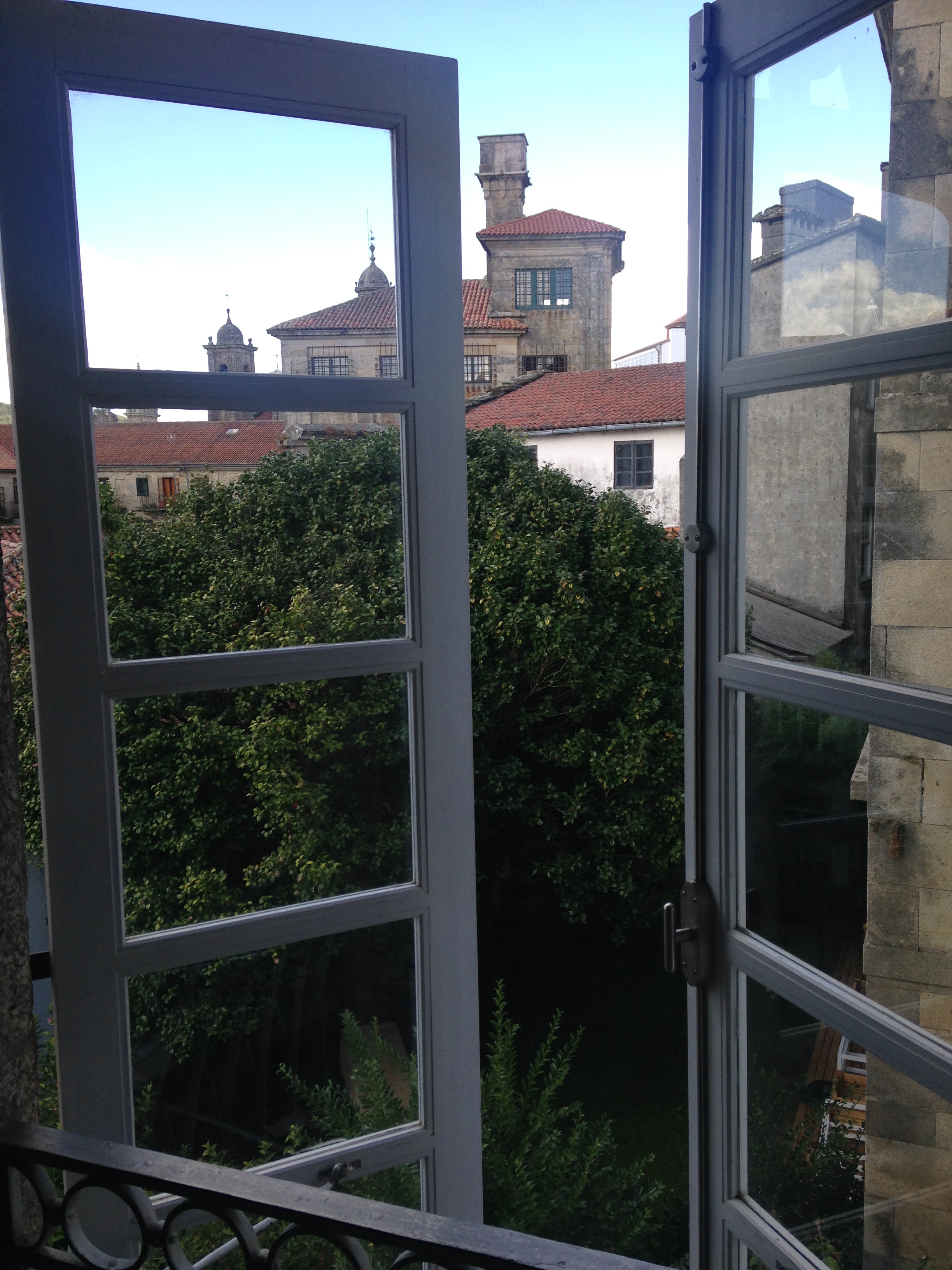
But Santiago works its magic anyway. My hotel, the Balalada, on the Rua da Xelmirez  (Xelmirez was archbishop in the early 12th century, and the driving force behind the building of the  cathedral), hides out in an old house, and my bedroom window looks over roofs and trees to one of the cathedral towers. There’s a bar four floors below my bedroom and on Saturday nights the party doesn’t stop until 5am, but if you’ve just walked 150, or 500 miles, you’re likely to sleep anyway, and next year – you can drink into the small hours, outside, in the cool of night.

Staying over two extra days I wandered the streets, explored churches, gazed up at high statues, spent time in cafes and restaurants and shops, but nothing quite beat my discovery of the Alamada park, which stretches away toward the sunset to the west of the city, endless green open spaces, trees and walkways, the church of Santa Susana in the middle, a perfect place on a hot day. If lived in the city I’d be retiring there to walk or to run, or with my book, or simply to find peace. And on the far side there’s a wonderful statue of Rosalia de Castro, Galician poet and national hero, whose house I visited in Padron. She has strong features, and a wise face, and I like her. No military celebration, or or pride or pomp, just humility, and wisdom, set on high, so we can look up to her. Below, carved into stone, are the titles of her books – poetry and prose. She had a melancholy cast of mind, there’s a sense of loss, and maybe that’s woven into the Galician sensibility. Not for me to say. But in this place of triumph for pilgrims I’ll end with a quote that’s just a little bit sad, but nonetheless evocative. Santiago is also a place for reflection.

I can only tell you that my songs/ rise in confusion from my soul/ like a sound from deep oak groves/ at daybreak,/ a sound which may be/ the wind’s tease,/ or the flower’s kiss,/ or the simple, but mysterious harmonies/ which, lost in this sad world,/ seek a way to heaven.


Taking time off from Brexit

I’ve written a lot about the referendum and Brexit in this blog. It is after all a blog with ‘politics’ in the title. But we’re all tired of reading analyses of one kind or another, about hard and soft Brexit, free trade and customs unions, the democratic deficit, immigration levels and the like.

And I want to get back to writing on other subjects, could be political, but just not Brexit, chill out, write poetry, seeking out high mountain or deep country retreats – or more prosaically, just get on with ordinary life.

That said, I’m not signing off without one last submission! With a focus on the action – the actions – we should be taking.

There’s a sense at the moment that events are running away from us. We’re anticipating dire consequences from the Brexit vote – but that means we’re looking out for those consequences – almost willing them – to prove ourselves right. And that’s no place to be.

A sense that more than ever in my lifetime we are headed in the wrong direction, and led by the wrong people – amateurs in a ruthless world. Rarely has hope – false hope – so triumphed over pragmatism.

Nor should we forget anger. Anger over the simple mendacity of many in the Leave campaign. But also over our own foolishness for not seeing it coming, for not realising the potential for a protest vote – and not understanding earlier why that protest vote might happen.

We now need to take action, to build up and sustain pressure – working with others, as part of campaigning groups, as supporter/members of the pressure groups, or pro-EU political parties – the Lib Dems, or an actively opposing opposition, as I hope Labour will become after the September leadership election. (It may be another kind of Labour, a breakaway or a reborn Labour, as it needs to be if it’s to regain support among the old blue-collar, working-class vote.)

‘Actions’ in italics.

All the while we have to keep that open and open-market, European, international, global perspective. International agreements by continent or wider are a much more effective, more reliable way forward than agreements at a single country level. (Which isn’t to say we should be immediately signing up to TTIP!) Europe is also an attitude of mind, relating back to how we connect with the world.

But – don’t so much shout in from the roof-tops, develop a wider, quieter strategy, but one that’s no less determined. There was too much shouting during the referendum campaign.

And too little awareness – now I hope radically changed for everyone on the Remain side – of economic and social and political realities, too little awareness of what life is really like beyond city borders – the sense of a government that doesn’t listen, the decline in prosperity and pride in traditional working-class areas, and the hostility and alienation felt even in prosperous Tory outer suburbia. If immigrants bring increasing wealth to the country, where is the infrastructure, the investment in the NHS and schools? If industries close down, where are not just the re-training packages but the industries, the services, the actual physical jobs to allow people to re-engage with society?

We may find we’ve common ground with Brexiters here – arguing for (sensible, nationwide – not HS2) infrastructure and investment.

Cameron and Osborne all but turned their backs on the problem. Inadequate re-training, and little sense of a wider industrial strategy. The irony is that it’s now the Brexiters, the old-style grumbling Tories of the shires who have to take action, when it’s just they who have been happy to turn their backs on run-down, de-industrialised areas in the past.

There are critical procedural considerations – how we can best secure votes in parliament before before Article 50 is invoked, and likewise on the results of negotiations, if we get that far. And how we can make certain we win those votes, should they happen. In the first instance – by supporting individual MPs, think tanks, pressure groups – and political parties, Labour I hope as well as the LibDems. 

God knows how the immigration debate will play out over time. Business and the NHS and social care depend on immigrants, and if the economy expands, and the NHS and social care improve their services, we will require continuing high levels of immigration. If we’re to stand a chance of retaining a sane immigration strategy it will need some radically re-thinking at an EU level – which we must argue for.

The sovereignty debate is one where opinion if it changes will only do so over time. It’s become confused with national identity, and too many people have argued that British and European identities are not compatible. The EU has to a great extent only itself to blame. It has now to show, and we have to argue hard for, a radically improved awareness of national concerns and susceptibilities. It will go to the wall, and one country after another will exit, if it doesn’t. Federalism must be put out to the very longest grass .

And that, for now, is it on the subject of Brexit!!

Woolly journalism

There is too much woolly talk and poor journalism on the subject of Brexit. Too many people asserting that one referendum vote is enough – enough to turn history on its head. One moment in time – and we have a paradigm shift.

An example was on Radio 4’s The Long View, with Jonathan Freedland, this morning (1st August). I missed much of it, so if I do it an injustice I apologise. One of the contributors recognised that the way the country is split is a big issue – with big Remain majorities among the young, the educated, and city dwellers.

But another suggested that academics (I think we’d consider them educated) were horrified because, whereas elections over the years had been squabbles between right and left, now their own personal interests were affected. The suggestion being that their opposition was self-interested and self-indulgent. But – they, the academics, know – and I know – and my friends know – and a few million others out there – we all know – that our concerns lie at a deeper level – about a way of looking at the world, with an open not a closed mind – about being European and internationalist – taking a positive rather than a cynical view of the world – looking to the future with optimism. (It’s there writ large in the comparison between all the enthusiasm and aspiration of the Democratic convention last week, and the negativity of the Republican convention the week before.)

The programme enlisted Diarmaid MacCulloch, Oxford historian, to make a ‘long view’ comparison between Henry VIII’s break with Rome and Brexit. It took a long time for the implications of that break to work through the country, to rework the fabric, to change irrevocably beliefs and practices – twenty years, forty – and longer. Could we be in for something similar this time – a slow, gradual, inexorable change to a different view of the world – to a different world?

To my mind the very notion that there’s a comparison is absurd. I’d agree that Henry’s decision was pretty arbitrary, a whim, the result of an obsession, influenced by a (un)favourable reforming wind from the continent, and an executor and manipulator in chief who knew how to execute (too literally) and manipulate – yes, maybe we can have fun drawing comparisons. But that there are any real searching comparisons with any relevance for our time – that’s a load of baloney.

A 52:48 vote in favour of an ill-thought through proposition based on misleading and sometimes mendacious arguments does not represent a paradigm shift.

As another example of bad journalism we have Ed Conway in The Times. (I’m relying here on a summary of his article in The Week).

The wider world is all too keen in Conway’s view to blame the world’s problems on the Brexit: ‘Britain’s great gift to the world: a giant pre-cooked excuse for absolutely everything.’ That’s nonsense, he says. We’d all agree. And it’s not of course what the wider world is saying. Brexit is, however, part of a big picture that the wider world does find worrying.

For Conway the problems in the world economy have been ‘baked into the system’ for some time. To be specific: unemployment rates, productivity, demand. But it’s been ‘easier to blame (problems) on Brexit’.

Arguing from one dubious proposition to another, he goes on to suggest that ‘if anything Brexit presents an opportunity’. ‘For years G20 members have been paralysed in the face of a global showdown. If Brexit provides an excuse for tackling this by spending more on infrastructure, tearing down regulations, printing more money, so much the better’.

An excuse to spend – to spend our way out of a crisis. Brexit it seems could be an excuse for throwing caution to the winds. More an argument I associate with the Corbynite left.

There are good arguments for increased spending on infrastructure, and there’s a debate about whether a further dose of QE would be helpful. But that debate should have nothing to do with Brexit. Unless it is – as this is how I’d construe Conway’s argument – we spend and print money out of desperation following a post-Brexit slump in economic performance and confidence.

I started with The Long View, and a massive non-sequitur – Henry VIII and Brexit. And I’m ending with another – Brexit and global economic reform.

The pre-referendum debate was characterised by wild assertions and woolly thinking. The post-referendum ‘debate’ is sadly no better.

On being a European

Stefan Zweig was an Austrian by birth, a European by instinct and vocation, an author and poet who became the most translated writer in Europe in the 1930s, a Jew, an exile, a refugee, who in spite of two world wars and exile continued to write and travel and argue – until in 1942 he and his wife took their own lives in Brazil.

He championed international cooperation, championed culture and the intellectual life – his aspiration that they might bring Europe together, and triumph over petty nationalisms.

In the World of Yesterday, ‘one of the canonical European testaments’, he tells the story of his life and times from school days to 1939. Curiously in the UK he never achieved the fame he found in Europe.

Maybe that should change.

*

On Europe…. 

‘It will be decades before that other (trusting) Europe can return to what it was before the First World War…….bitterness and distrust have lurked in the mutilated body of Europe.’

As more became known about Hitler and his ready resort to violence ‘the conscience of Europe’ chose not to take sides, because all violent acts were within Germany…. (my italics)

After the First World War, ‘The orderly German nation did not know what to do with its liberty, and was already looking for someone to take away it away again.’ (Today the guardians of that liberty hold sway, but the threat is always there, from neo-Nazis, and from political parties such as Alternative fur Deutchland.) 

In Austria in 1937, before the Anschluss, few at least publicly made the connections with 1914 – no-one wanted to. Zweig describes vividly a traditional Christmas in Vienna in 1937.

All the while a new power out there, aiming to seize government, ‘regarded all idea we valued as outmoded – peace, humanity, reconciliation…’

He compares the English with Austria, Germany, or France – they lived more quietly, more content, thought more about their gardens.

(We lose so much if we deny ourselves that European focus – if we imagine the values we hold sacred are specially English, or British. Reading Zweig reminds us what it was like living through that remarkable period from 1900 to 1940. We are part of Europe, our outlook and culture – and origins. The rest of the world sees us as European – we are foolish to think otherwise. )

On government – and the people …

In the run up to 1939 (and too often true today): ‘ … 10 or 20 people (in Downing Street, the Quai d’Orsay…), few of whom had ever shown any evidence of any particular intelligence or skill were talking and telephoning and coming to agreements which the rest of us knew nothing about.’

Zweig ‘knew that the vast majority always go to whichever side holds the balance of power at any given moment.’

On armchair revolutionaries… 

Zurich in 1916 – the Zurich of Dada – Zweig had never met such an impassioned and varied mixture of people and opinions. Since his death Zweig’s been accused of being a coward for not coming out more strongly against the war. His comment about ‘coffee house conspirators’ gives the answer – his disdain for ‘professional revolutionaries raised from personal insignificance merely by adopting a stance of opposition’.

(There were many such – and there were as I well recall in the 1970s when I was a trade unionist –Father of Chapel of the Penguin Books NUJ chapel, and they are still very much out there today – and will be in every generation. )

On the arts… 

The poet Rilke, a friend of Zweig’s – ‘Can there ever be such pure poets again…all they wanted was to link verse to verse perfectly in quiet yet passionate endeavour, every line singing with music…. can that kind of poetry exist in our new way of life… which chases out peace of mind like a forest fire?’

On being a refugee, in England…. 

‘I, the former cosmopolitan, keep feeling as if I had to offer special thanks for every breath of air that I take in a foreign country, thus depriving its own people of its benefit…’ Zweig had ‘trained his heart to beat as a citizen of the world for 50 years… On the day I lost my Austrian passport I discovered, at the age of 58, that when you lose your native land you are losing more than a patch of territory set within borders.’

On being Jewish….  

Jews used to have ‘an inviolable faith in their God’. But they were many peoples, multiple languages, now thrown together – what did they have in common? And they asked – ‘what is the reason for this pointless persecution.’

The questions asked by Job.  [‘Why did I not perish at birth, an die as I came from the womb?’  (3:11). ‘What strength do I have, that I should still hope? What prospects, that I should be patient?’ (6:11)]

After the Anschluss – his elderly mother enjoyed walking – but now ‘no Jew must sit on any public bench’. She no longer had a place to rest. And that was almost the least of the strictures which took down and took apart Jewish life in the city.

And at the last….

A confession- ‘I do not mourn for what I have lost – the art of saying goodbye to everything that was once our pride and joy..’

And yet – ‘But in the end every shadow is also the child of light, and only those who have known the light and the dark, have seen war and peace, rise and fall, have truly lived their lives.’

*

Zweig has many lessons for us, as a European, a Jew, a citizen of the world, a man of culture and intellect, with many flaws as have all of us – but just maybe someone to champion in our own times, when uncertainties are greater, and crises seem – and are – closer to hand, when there’s a sense that the post-war consensus might just break apart, and we need reminders, we need a champion or two.

Zenpolitics, and the world, six years on

It’s not a bad idea in these tortured times to remind myself why I began this blog. ‘What is zenpolitics,’ I asked. My answer? ‘Taking the trash and hyperbole out of politics and trying to look at people and issues in a way that’s detached from emotion and as they really are.’

Six years now since I wrote that, and it’s even harder now. The Brexit campaign has focused all the uncertainty in British politics but instead of providing resolution has brought animosity, and potential chaos. Politics should always be about gradual not sudden change – not a thought everyone shares, I appreciate – it’s a subject for another time, another post.

But now we have an elephant in the room, as someone said. We are all obsessed and divided and old-style political discussion has gone out of the window. A good thing?

Referenda do damage, they polarise, the original subject of debate gets lost in hyperbole, in distortions, it too readily becomes a protest vote. They’re prey to propaganda, to manipulation. Referenda were a distant and unlikely possibility six years ago. Now they are subverting the parliamentary democracy which gives a forum for rational – and emotional – debate, which falls prey to all sorts of issues and irregularities, but nonetheless gives a sane and measured and balanced way forward.

In the US it’s no better, and potentially worse. US presidential elections reflect a traditional divide, they have a slow almost two-year (if not a four-year!) build up, and they are multi-issue. But this time it’s a protest vote, whipped up on the one side by special interests with vast amounts of advertising spend at their disposal, now turned on its head by Donald Trump, and on the other side by an equally disillusioned younger and streetwise population – both sides equally out of step with Washington politics. In the US and the UK vast numbers of people no longer feel a part of the traditional democratic process.

Behind all this are the challenges of globalisation and new technologies – the decline of traditional industries, a switch from a unified and organised and socially cohesive labour force to a fragmented and lower-paid workforce engaged in lower-paid service industries, influenced and exacerbated by massive trade imbalances with China – resulting in a growing divide between those who benefit from these changes, usually educated and skilled, and those who do not.

And out of this we have alienation, discontent – and, given a forum, we have protest. And we have the blind (and Tory economic policy under Osborne has to fit under that heading) who fail to see the

impact of that alienation, and how it has to be directly addressed. And the manipulators, who turn it to their own purposes – anti-immigrant sentiment, or neo-liberal economic agendas.

Blind – we’ve all been blind. Back to my original zenpolitics aspiration – ‘trying to look at people and politics… the way they really are’. More than ever that has to be the aspiration. And it’s now, with so much emotion and obsession, that much harder.

All the while, the other big issues haven’t gone away – the refugee crisis, Syria, IS. Population movements in Africa, where the population explosion is hitting hardest. Russia and Ukraine. China and the South China Sea. And suddenly, almost but not quite out of the blue, we have Turkey, an attempted coup, and a profoundly foolish but populist regime which will lead Turkey further down the road to either chaos or autocracy.

And here in the UK – we now obsess with Brexit, where the very best outcome will be that we achieve something close to our existing economic performance, and the worst – better not to contemplate.

There are bigger issues, much bigger issues, out there, and we have turned foolishly inward.

I wanted with zenpolitics to take the emotional out of politics. But we need emotion at times to drive the engagement we need to have to put our own world, here in the UK, back on to a saner track.

But above all we need to, and I repeat, ‘see things as they really are’. In a world of fractured and misleading debate that is a mighty challenge.

The absurdities we’re living through…

Sometimes it’s hard to keep up. I’m about to head off walking the Cornish coast path… And not listening to Andrew Marr, or reading the …whatever it might be.

The world must go on.

But absurdities we’re living through still strike home.

The BBC’s James Robbins, on the subject of a meeting of European foreign ministers, with Boris Johnson present for the first time:’Today’s meetings are bound to be odd, when the man who compared the EU’s ambitions to create a super-state to those of Adolf Hitler, sits down with the 27 other ministers.’

I’ve been imagining Johnson meeting with John Kerry, more pertinently with Barrack Obama, more pertinently still with black African leaders. ‘Piccaninny’ has been a expression he’s used in the past.

Brexit Secretary David Davis: EU migrants who come to the UK as a departure date nears may not be given the right to stay… there might have to be a cut-off point if there were a ‘surge’ in new arrivals …

A comment calculated to disturb: hardly likely to give those already here any confidence. Or businesses who rely on immigrants for the EU, now or in the future.

Liam Fox looming over reports that Australia would like to sign a free-trade agreement with the U.K. As if we don’t have successful trade arrangements with the Australia already. Rejoicing it seems over starting all over again to get to the place we started from.

They are an unholy trio, and Theresa May has shown a perverse streak in promoting outsiders who Cameron wisely distrusted into the most public positions of all in her new government.

God help us all. Maybe Mrs May had that in mind on a recent Sunday at Sonning parish church.

Missing the tide

We had Boris quoting Julius Caesar. He might have tried another quote, this time Cassius to Brutus:

‘There is a tide in the affairs of men, Which taken at the flood, leads on to fortune. Omitted, all the voyage of their life is bound in shallows and in miseries. On such a full sea are we now afloat.’

Only we’re not. The European tide is turning in our direction, and what do we do – we hide in the sand dunes.

The politics of the Tory party mean that departing Europe (and, yes, I mean Europe, not just the EU) at precisely the wrong time. We’ve not been the only country drawing back from a federalist agenda. In Germany they’re having the same debate but not as yet with the same foolish consequences. Take Wolfgang Schauble, the German finance minister, as an example. ‘Originally a European federalist in favour of an ever-close union (he) has concluded that the referendum signifies that Europe will not stomach yet more centralisation.’ (The Economist.) In Schauble’s own words, ‘Now is not the time for visions.’

On the other side of the argument we have members of the German SPD, Angela Merkel’s coalition partners, who want to push harder for closer integration: the president of the European parliament, Martin Schulz, argues for ‘refounding Europe.’

The debate illustrates how much Germany is pivotal to the debates about Europe’s future. It would have been Merkel and Cameron, Germany and the U.K., pushing for a wiser, less hands-on, less intrusive Europe, and yet a Europe that took forward the European ideals of openness and cooperation.

Schauble would like to see Europe concentrate on a few problems, and solve them – good examples would be the refugee crisis, or a Europe-wide energy grid. And if the commission fails to act ‘we must take control and solve problems among our governments’, an inter-governmental not a supra-governmental approach’, moving power from the Commission to the Council of Ministers. (See The Economist’s Charlemagne column.)

This is the process we should have been a part of, working with Germany, putting federalist ambitions out to grass. Instead we have two characters, Fox and Davis, who’ve survived on the fringes of British politics for a few years, pushed into the limelight to negotiate an exit from an organisation that it’s transparently in our interests to be a part of.

The best outcome will be that we negotiate something pretty close to what we have now. But in the meantime we’ll have lost the opportunity to influence the EU, and we’re all the poorer for that.