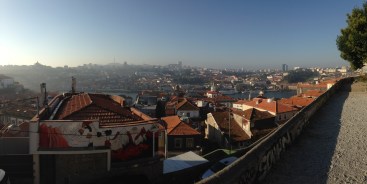
It’s Thursday 1st September. Two weeks ago as I write. I’m starting from the Catedral Se in Porto after delaying awhile, with the heat building, in the wonderful cloister. A city built on hills, with the proud river Douro beneath, big vistas, and along its banks the old port warehouses of Cockburn, Sandeman and the like.

(Amazing in the twilight also – the previous, Wednesday, evening. Porto faces west, and silhouettes against against the sky. Street music I like: one memorable trio, with the girl belting out Eric Clapton’s ‘Before you accuse me’. If I want to sing blues and sing it seriously… I’ve a long way to go!)

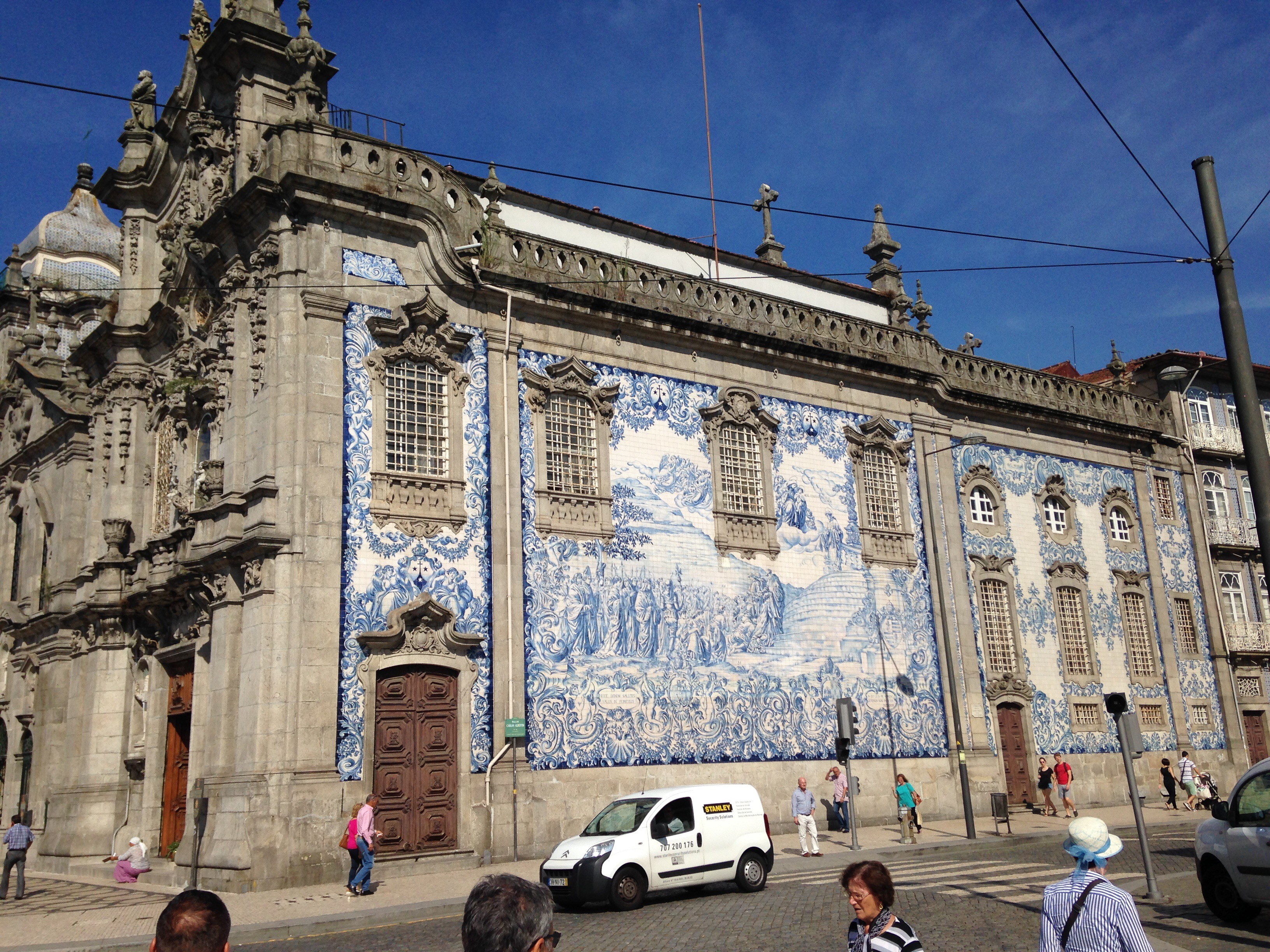
10am and sun already hot as I set off past the Carmelite church (the south side covered, and telling stories, in blue azulejos tiles), along the Rua da Cedofeita, which seems to contunue forever, and on through the suburbs. I haven’t gone far when I’m accosted by a stranger and invited to inspect a newly-opened albergue (Albergue Peregrinos Porto), which brings together under one roof all the best features that Oscar, the owner, has seen on his pilgrim travels. Next time I’ll stay there.
    img_9587-2

All the buildings, almost, have azulejos tiles, not least the station, and they tell stories, and the cathedral cloisters likewise, less so the outer suburbs. After maybe 12 miles of endless roads I’m into countryside, and a few miles beyond I’ve reached Vairao: staying in a monastery, beds not bunks, and it’s oh so wonderfully peaceful. No monks in sight, and there’s a single volunteer in charge – a Brazilian guy doing a two week stint. The meditation room I’m told is two flights of stairs up. No lights on the stone stairs: I stagger up in the total dark, and flick the light switch: Buddha and cushions but no sign of anything Christian! Yet this is a monastery. As a Dutch lady said to me a day or two later, she loves it all, but compared to the Camino Frances it’s not spiritual in the same way. Being a Camino, that spirituality has to be rooted in Christianity. Churches on the route are closed too often, and I miss the pilgrim masses. And the Templars, and Cluny, never got to work down here and put money into anything like the great Romanesque temples I love on the Camino Frances.

All that said – still an amazing trail to be following. Comparisons maybe miss the point!

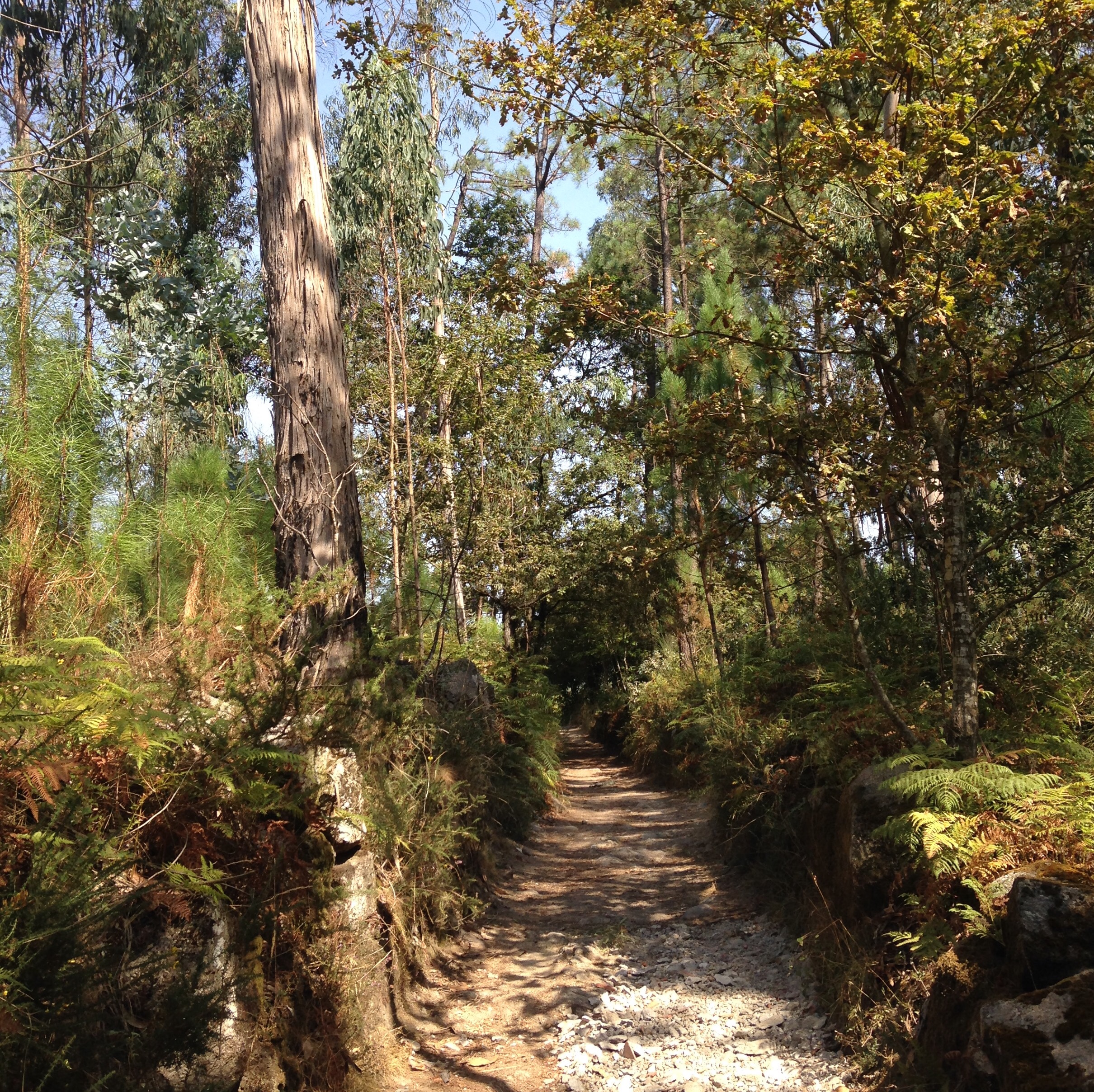
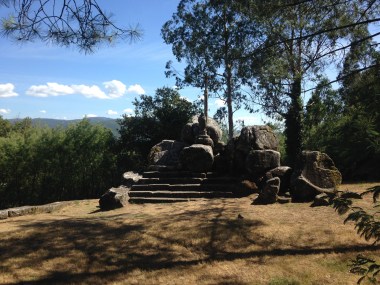
Friday 2nd. San Pedro de Rates, drinking water water water, and coffee, under an awning, the clock tower above, and the village square blasted white by the sun. The cafe owner (Cafe Macedo) loves pilgrims: big smile and handshake saw me on my way. Next – Dead Woman’s Peak – Alto da Mulher Morta. (Looked hard for Dead Man’s Gulch, but wrong continent.) Not enough shelter from the eucalyptus and pines as we gently climb. Pedra Furada – a megalithic disc, with a hole… stranded in a paved churchyard, but it still has mystery.
img_9690-1        img_9748-1

Barcelos, commanding the river, famous for its legend of the cock which crowed just in time (the victim was already hanging) to save an innocent pilgrim’s life. Now a garish cartoon cock, and he’s everywhere. One marvellous octagonal church, ornate decoration, and another severely Romanesque, the river directly below, with a mill by the bridge. Colourful umbrellas float above the main shopping street.  My albergue was in Barcelinhos, where checking in I’m greeted by the most beautiful girl in the world: dead on my feet and glasses coated with salt and sweat I walk into and rebound from a plate glass door. Impressing women is never easy. Also hurt my head!

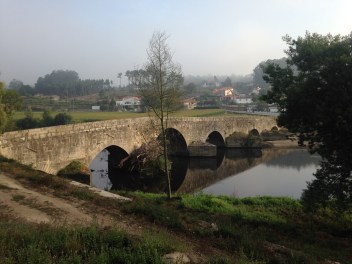
Saturday 3rd. Getting hotter by the day. Drink suspect water from a fuente, mild tummy upset – doesn’t help! Ponte da Tabuas, old bridge and river forms a lagoon, and someone’s swimming… Dirt tracks and cobbled roads (all minor roads are cobbled) take you through maize and vines, the vines forming a narrow screen next to the walls of cleverly laid, heavy, solid  granite stones. These are old landscapes, little changed, by the path side, but the fields are often big, and sprinklers throw their water far and wide, and are happy to dowse pilgrims.
 img_9619

A roadside chapel dedicated Our Lady of the Snows. You long for snow in summer, and you don’t have far to go to find it in winter. It’s a lovely evocative name, sounds even better in Spanish: Nuestra Senora de las Nieves. A pulpit sits outside the west door: this intrigued me – was a priest from back maybe in the 18th entity the radicalising Wesley or Whitfield figure of his time ? Preaching out rather than in. There’s a bandstand opposite – what does this signify, I wonder?

One big blister by the time I limp into Ponte de Lima. Wide river with long and spectacular medieval bridge. There’s a big kayak race – why kayaks? Whatever, it’s a big event!  They know how to party here and it’s Saturday night … Supper outside with a Canadian girl and a Italian guy: she works in England at Stevenage hospital, was born in Dubai, has lived in Canada since she was three, and her parents were originally from India, and her boyfriend who she came to England to be with is – Welsh. The multinational Camino represented in one person. She’s walking from Braga to Santiago, another variation on the Camino theme.

Not quite so many walk all the way from Lisbon. Places like Coimbra sound magical, and there’s Fatima, a pilgrimage in its own right. Someone, for much of the Portugues route, and beyond, has happily drawn blue arrows facing the opposite way, the Fatima way, wherever there’s a yellow Camino arrow.

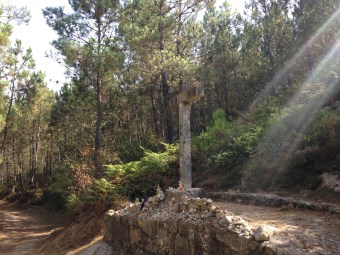
Sunday 4th. Sleep not too easy. Street noise right below the dorm window!  And everyone in my dorm is up at 5.30 – start early and beat the heat. No way can I sleep – so I’m off early to. By 10am climbing sharply, a rugged path to 1400 feet, big views back to the Lima valley, two evocative stone crosses with memorials and mementos, and pine trees with plastic bags attached: they’re collecting resin, and it’s thick and crystalline, and the smell is sweet.

Rubiaes, another municipal albergue. Down to basics – they pride themsleves on how minimalist they can get – as long as there are showers and bunks, they’re right, nothing else matters! And it’s 5 euros! Most of us there by 1pm. Late arrivals sleep on mattresses in corridors. Not much to do, the heat it seems exhausts more by doing nothing than by moving through it, save shower and wash clothes and read and talk and sleep and eat. This is not a metropolis.

Monday 5th. Checked out a Roman bridge in the half-light, we’re following for much of the way the Roman Antonine Itinerary XIX. A major route from the 1st to the 5th century. There are six-foot and bulky inscribed Roman milestones along the way. I love tracing out Caesar or Augustus with my finger. I reach the Spanish border by 11 – Valenca, Portuguese fortress, on a massive mscale, this is serious border country! Fortifications inspired by Louis XIV’s remarkable engineer, Vauban: they are on a vast multi-levelled scale. The Portuguese did not, and rightly did not, trust the Spanish!
    img_9649

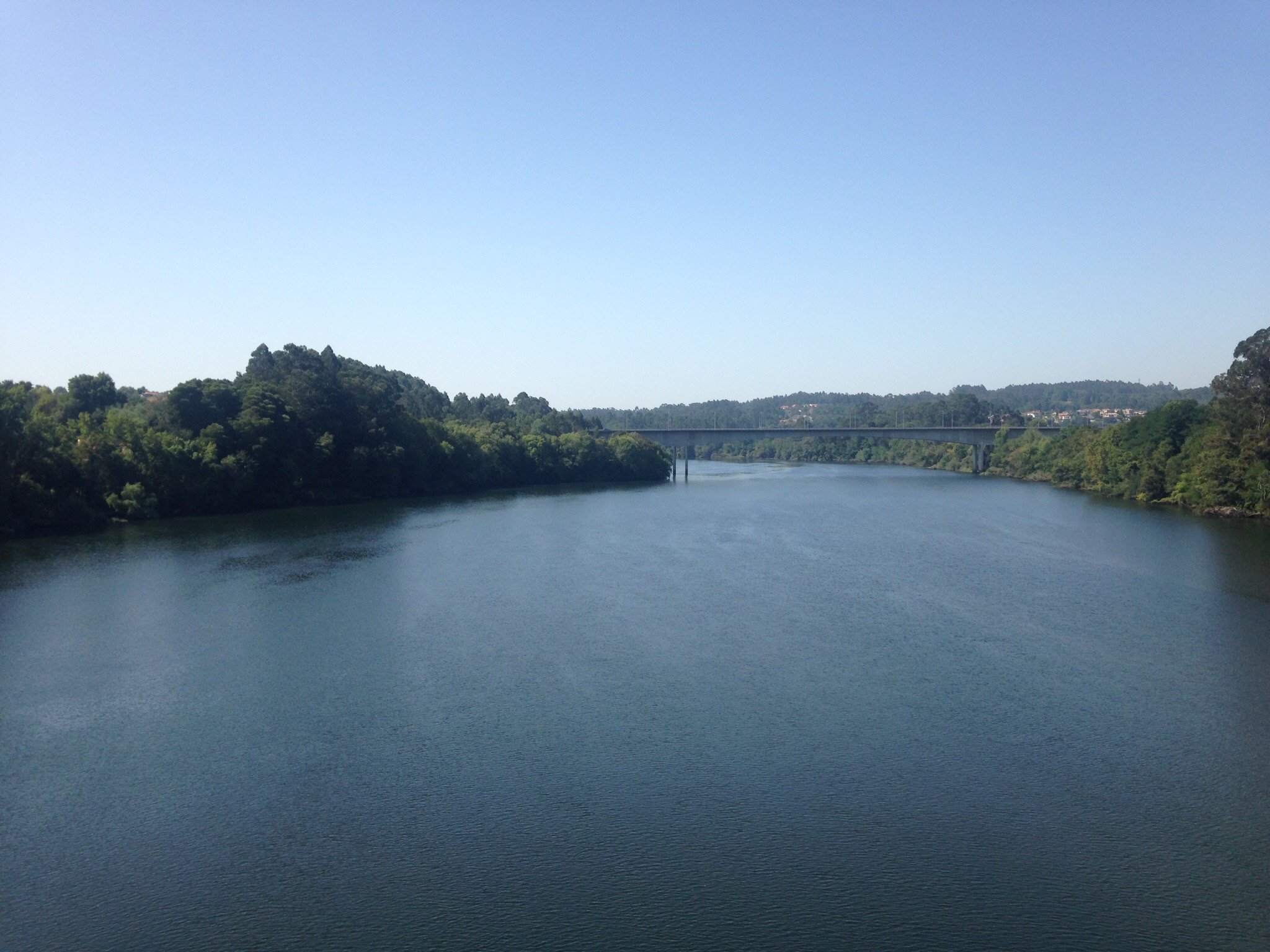
Views up and own the Minho river take your breath away. But most pilgrims head straight on, and tourists go for the nicknacks. Stop halfway across the bridge, straddling the border. River impressive – Ben (my son) and I went kayaking just below here ten years ago! Good memories.
  

Then on to Tui, Spanish border town, solid granite, cathedral a fortress, and cloisters the best place for cool! Carved portico inspired by the Portica da Gloria in Santiago. Dinner with Martin from Dublin (a retired engineer, he has a Camino tattoo on his upper arm) and Ken from Wigan. Broad Lancashire stalks the Camino..

Tuesday 6th. Big view from albergue up the Minho, first semblance of a breeze at 2, we’re all away by 5.30, 100 degree heat forecast. Stars bright, Orion already high, and Sirius just touching the horizon – winter stars, out of place in all this heat. We take the green route round Porrino, avoid the factories – three of us, a Polish photo-journalist, a Czech girl student, and a Brit. Pushing each other. After 22 miles we make Redondela, it’s getting close to 2pm. We get the last places in the dorm. Getting used again to mixed dorms – showers and loos separate. Male showers communal – back to school days! We’re close to a marvellous coastline, the Ria de Vigo: I follow the river and after a few 100 yards it opens out into a tidal creak – water flashing brilliant and enticing in the mega-sun.

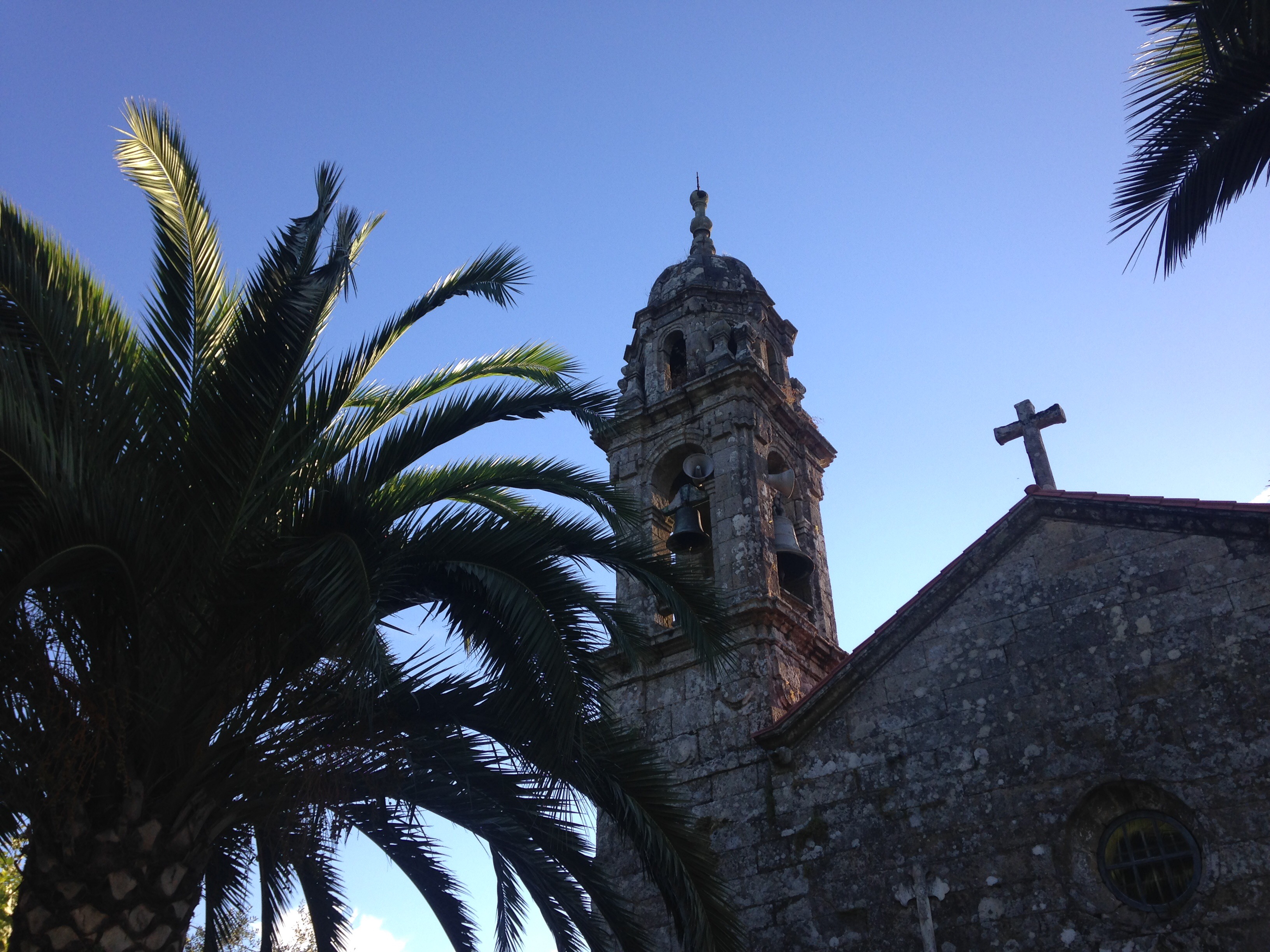
Most churches closed but their Romanesque bell towers stand out against the blue skies. I always detour to take a look, while others walk on. One way to find peace. I love the cruceiros, wayside crosses which can sometimes pack the full biblical cycle from the Fall to crucifixion into tableaux carved out of the granite. Everything, all the way from Porto, is granite. Not least the walls, and the narrow posts which would once upon a time have supported the vines that line the field edges.
 

Wednesday 6th. A shorter walk, to Pontevedra, via the river route – alder and birch mixed in, we’re almost into English greenery. But it’s hotter, and the shade deeper. Santa Maria a remarkable Renaissance basilica – the life of Mary climbs and fills the western front. Sanctuaria de Peregrino  a perfect 18th century rotunda – ground plan shell-shaped. I take a breather – take a cheap hotel! The Asador Virgin del Camino, my oft-related joke being that it’s better than vergin’, it’s actually on the Camino.

St James is more and more entwined with the pilgrim route, the closer we get to Santiago.

Thursday 7th. But first Caldas de Reis. Chatted to Christine from Canada on the way, she’s running a leadership course near Lisbon, and all participants have to walk the last stages of the Camino Portugues. Young people, working in not-for-profit fields, from all over the world.

Caldas – thermal waters, baths and springs since Roman times. Bathed my feet: water seriously hot. Got a disapproving look from a local – no longer a cool thing to do! Ice cream in the Xardin Botanicas – that was a better highpoint. Too much time to kill. Down by the bridge over the rio Umia there’s a wonderful tree-shaded restaurant: if only I’d known!
img_0011-1    img_0021

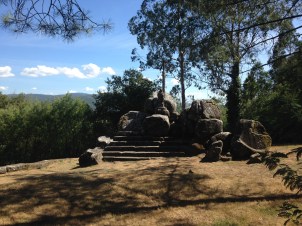
Friday 8th. Padron – where St James landed, or at least where he is supposed to have landed. Let’s assume he did! Much more fun that way. The stone to which he tied his boat lies beneath the altar in the Igrexa de Santiago. The hill above the Carmelite convent, the Santiaguino, is where he preached. After his execution his disciples returned to Padron with his body. I bumped into my friend, Martin, from Tui and we walked and talked the hill and its story together. Helps that he’s Irish! Below, in front of the Carmelite monastery there’s a vast platform – a viewing platform, for taking in the landscape, and not half bad for preaching either.

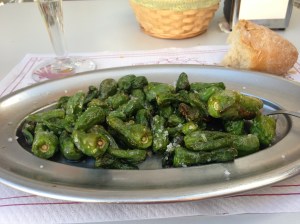
My albergue, all rather prosaic by comparison, is new, compact, and pristine clean – and the individual bunks had curtains. Also memorable: the menu de dia in a local restaurant, I’m now into main meals at lunchtime – do as the locals do. Not forgetting my evening pimientos de Padron, the local speciality.

Saturday 9th. James’s disciples buried his body in Santiago. What route would they have taken? My trail ran past the ancient Iria Flavia basilica, sacked by Almanzor in 997AD (he snatched the Santiago cathedral bells in the same raid), through run-down villages , through eucalyptus and pine, following a delightful wooded river valley, past the oldest of all the cruceiros, 14th century (I had my photo taken there, appropriate for someone who loves all the old stuff, the churches, the religion, however unfashionable that might be), then across the valley, through villages …then one river left to cross, just to tease, and a curiously rural valley for somewhere so close to the centre, another bridge, and finally tired legs into the old town, where it’s Saturday, and I seek out the traditional Portuguese gate of entry, and the different areas of the city are progressing in fancy dress and marching bands, drums and pipes, into the Praza do Obradoiro.

Sadly, as last year, the west front and the Porta da Gloria are covered in scaffolding, and that means I will have to come again! It’s Saturday, as last year when I arrived, but where last time it was politics this time it’s carnival in the streets, colourful costumes,  Galician pipers, big drums echoing down the ruas, captioned horses barely under control, high-steping middle-aged ladies looking gorgeous and showing off their legs, all the Santiago communities dressed up for a big day, and the rain holds off – just. Everyone heading for the Praza do Obradeiro. I watch from the steps with my friend, Michaela, from our big walk from Tui. By mid-afternoon it’s wet.
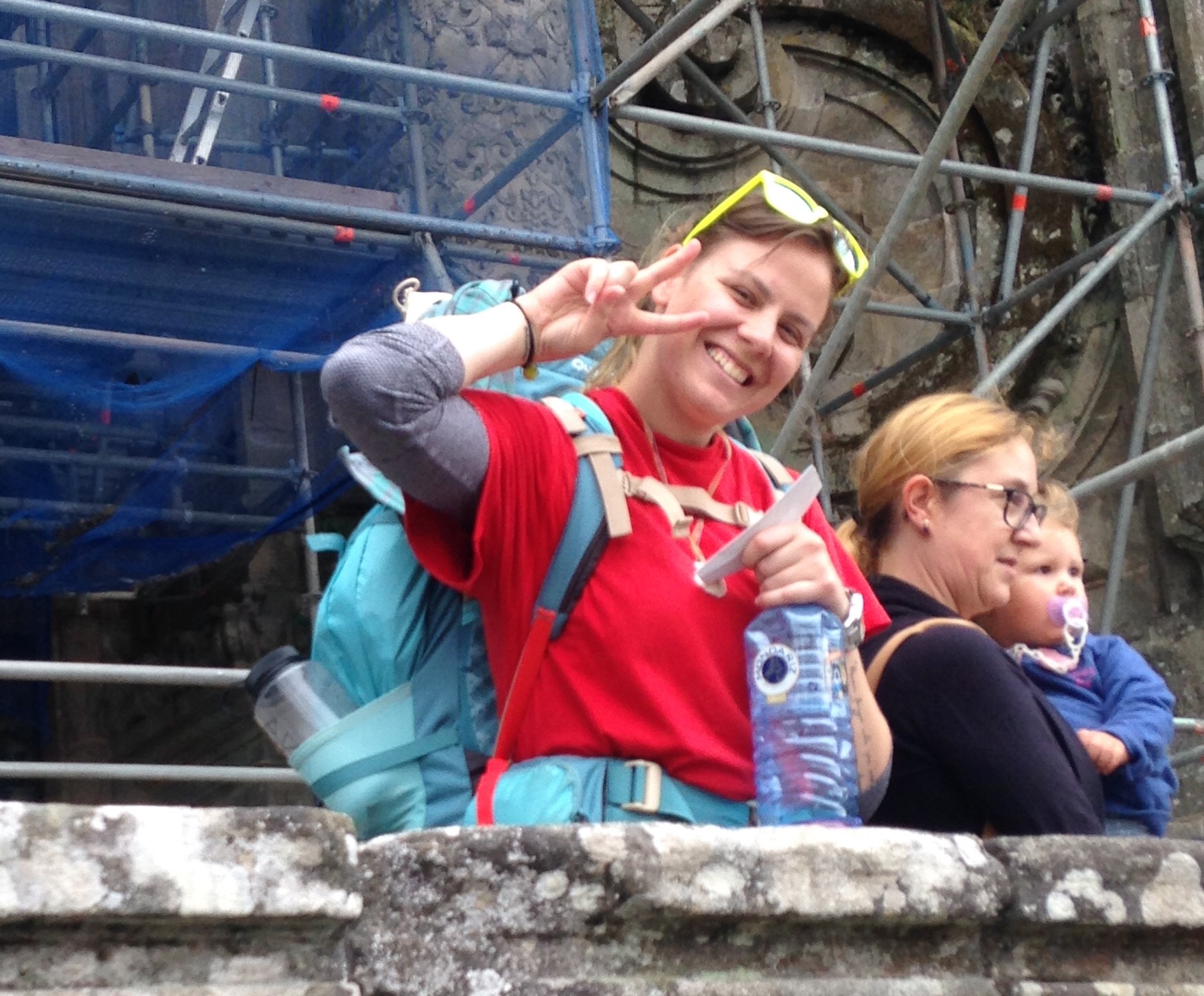
image               

Behind me is the Portico da Gloria. Under wraps. Inside the cathedral, at the back, there’s plastic sheeting, and you can get down on your knees and peer underneath, and two girls are sitting on stools, under arc lights, chipping away the grime of ages. I think it’s the statue of Master Mateo himself one of the girls is working on. I’d love to have touched heads with him, as pilgrims used to do, in the hope that a little 12th century genius might transfer to the 21st. Outside, on the great western facade, it’s slow work there too, and there’s a lift that trundles incongruously up and down. Just how did they get their building material, and their craftsmen, up there in past times?

Santiago’s history and tradition is now embalmed – explained and served up for pilgrims and tourists. Pick almost any period in its past and the story would have been radically different. In the 13th century destruction followed on a riot in the Quintana, and rebuilding followed. 15th century, another riot, the cloister damaged and rebuilt. I’ve been unable to find the reasons or the consequences, but stories of riots do bring us, as they brought the city centuries ago, back done to earth. What were the conditions the masons and journeymen in the 10th, 13th, 17th and all centuries inbetween worked under? Master Mateo and Archbishop Xelmirez may have been hard taskmasters.

Inside the cathedral it’s evening, and the Pilgrim Mass draws to a close. The great organ strikes up, the botafumeiro is released and pours out holy smoke as it swings in its great arc across the transept. Not I’d have thought the best way to fumigate pilgrims: it may not take our sweat but it does take our breath away. There’s a pilgrim mass in English every morning, in the Chapel of Our Lady of Sorrows. The Irish well represented, including five men in orange T-shirts who are all cancer survivors, and cycling together. The priest is a jovial, over-weight 69-year-old Irishman. I too am 69. We all introduce ourselves, a marvellous diversity, though quite a few like me have come from Porto rather than St Jean. Along one wall a mitred medieval bishop rests, on his side, head on one hand and his other, upper hand clasping the good book to his thigh. He seemed so content, in the sleep of the Lord, death could not touch him.

So many sculptures, and I love getting in close and taking in their expressions. Adjacent to the Porto Sacra are prophets and fathers of the church, and bishops and popes, not psychological portraits, but the sculptors had their fun, making each one different. Calm faces, cool faces, classical faces, and some at the opposite bizarre, plum ugly end of the spectrum. All those empty stares. And noses don’t survive the centuries well.

For paintings and sculptures if you want to see them not with a craned neck but close at hand, then check out the Museum of Sacred Art, a modern miracle of a museum housed within the old Mosteiro de San Paio on the Praza da Quintana. There’s the tabernacle in which St James is supposed to have been originally buried, and statues and paintings of Santiago and pilgrims from all over Europe. What did they wear in their feet, I wondered. Mostly sandals it seems, though one pilgrim had his feet wrapped round in what I assume was leather – almost a shoe!

Pilgrimage is a broad concept. On a path, with a purpose. Once upon a time when we all walked we were all pilgrims… Jesus on the road to Emmaus was joined by two disciples who didn’t recognise him at first, and there’s a wonderful painting, 16th century, almost my favourite item in the whole of Santiago, of the three of them ambling along, talking animatedly beneath towering woodland. Small figures, and a big theme. Three modern pilgrims engaged in animated conversation wouldn’t look that different!
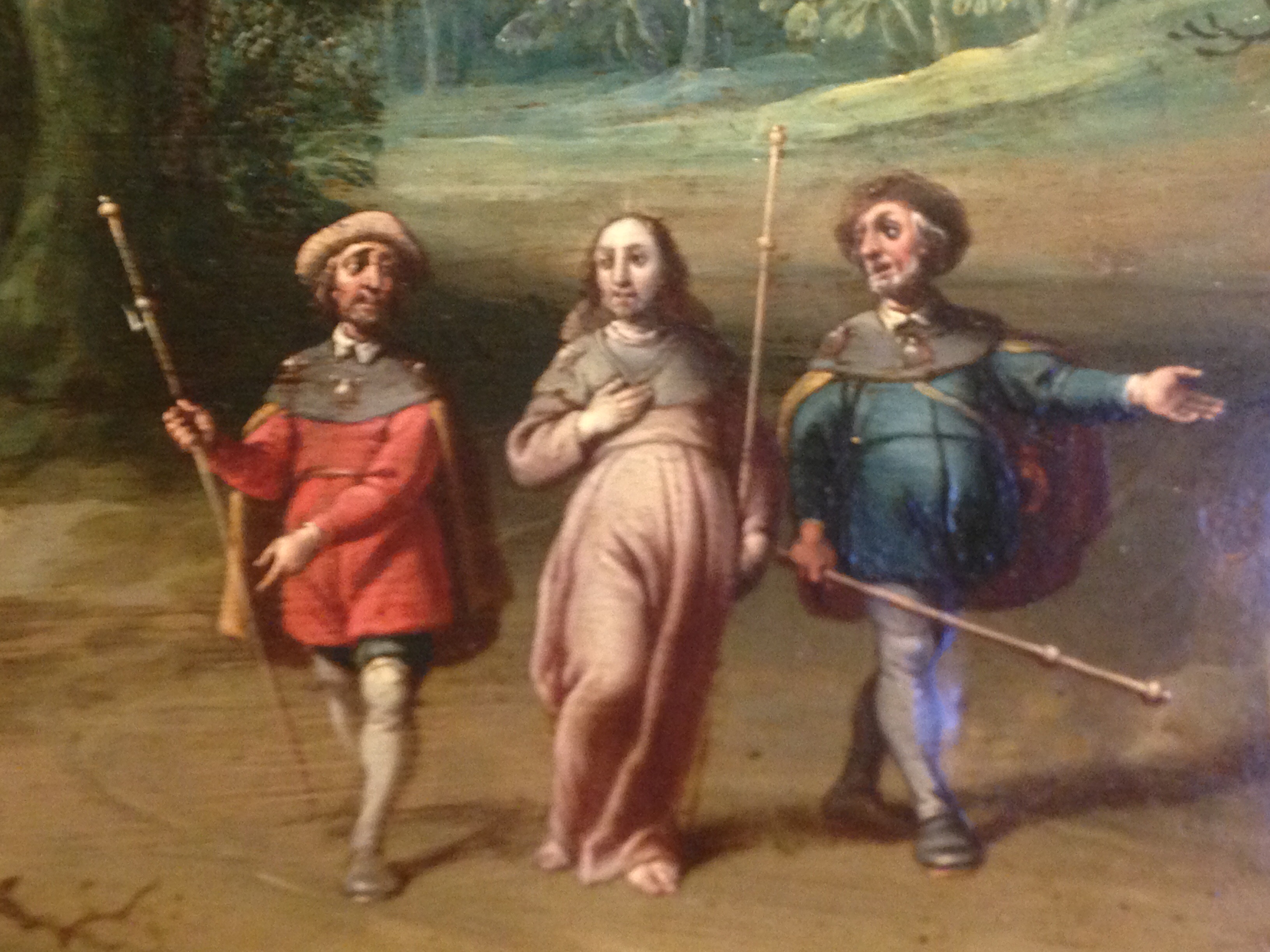
      

Jesus – lest we forget, the Pope decreed that that this should be a Holy Year of Mercy, and the Holy Door, the Porto Sacra, on to Quintana is open this year, as it would otherwise be only in those Holy Years when the saint’s day falls on a Sunday. But no mention of this in the cathedral: I saw a pile of unused leaflets, that’s all. And tourists were using the Holy Door as just another entrance. If you take confession, and mass, and are free not from sin as such but a disposition toward sin (wonderful semantics!) then you qualify for a plenary indulgence. I’m not a Catholic, and Luther railed against indulgences, but I love the idea of a Year of Mercy, and it’s a shame to see that’s it’s not impacting on the lives of tourists, and pilgrims, a little more.
img_0229      

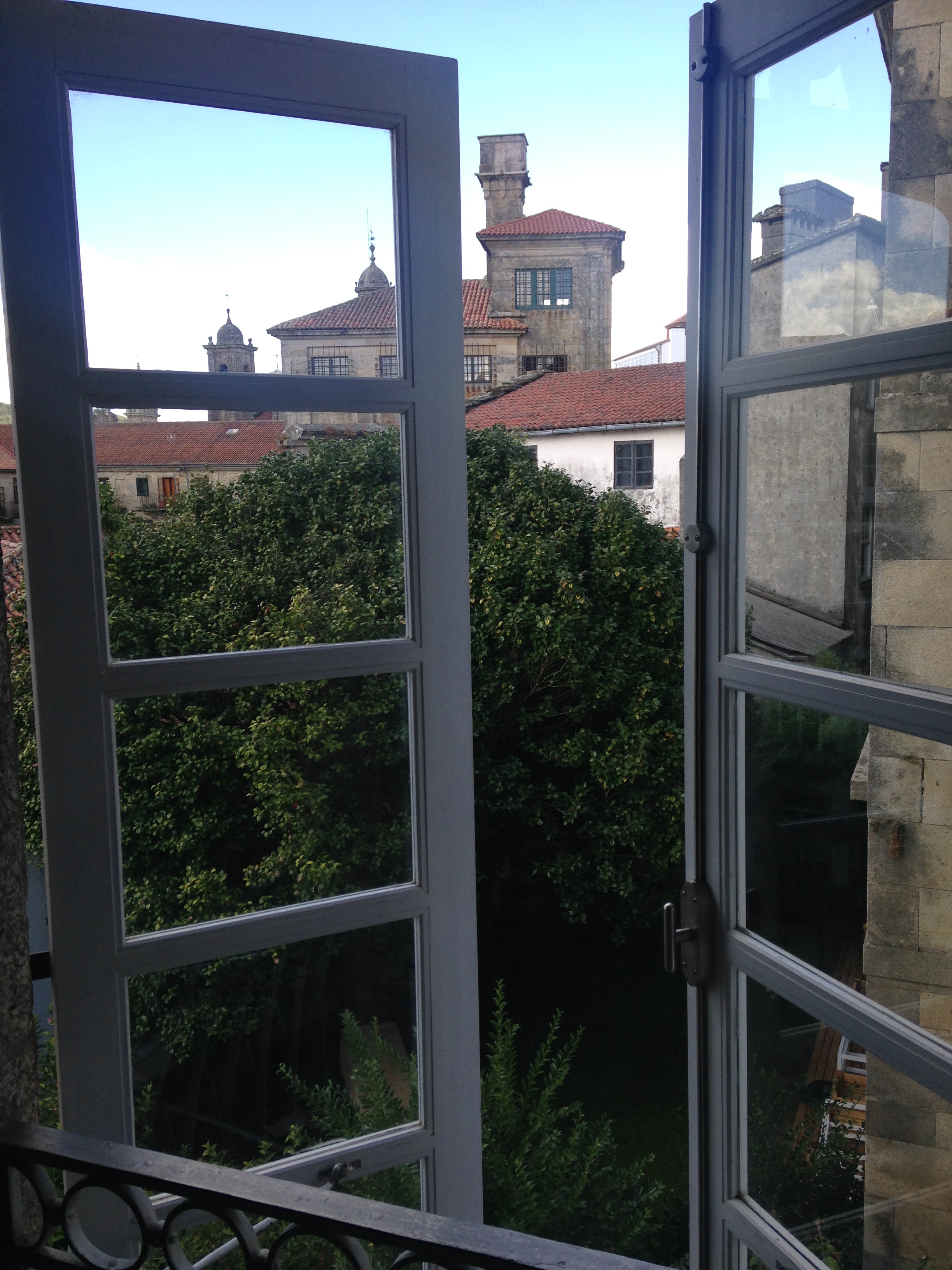
But Santiago works its magic anyway. My hotel, the Balalada, on the Rua da Xelmirez  (Xelmirez was archbishop in the early 12th century, and the driving force behind the building of the  cathedral), hides out in an old house, and my bedroom window looks over roofs and trees to one of the cathedral towers. There’s a bar four floors below my bedroom and on Saturday nights the party doesn’t stop until 5am, but if you’ve just walked 150, or 500 miles, you’re likely to sleep anyway, and next year – you can drink into the small hours, outside, in the cool of night.

Staying over two extra days I wandered the streets, explored churches, gazed up at high statues, spent time in cafes and restaurants and shops, but nothing quite beat my discovery of the Alamada park, which stretches away toward the sunset to the west of the city, endless green open spaces, trees and walkways, the church of Santa Susana in the middle, a perfect place on a hot day. If lived in the city I’d be retiring there to walk or to run, or with my book, or simply to find peace. And on the far side there’s a wonderful statue of Rosalia de Castro, Galician poet and national hero, whose house I visited in Padron. She has strong features, and a wise face, and I like her. No military celebration, or or pride or pomp, just humility, and wisdom, set on high, so we can look up to her. Below, carved into stone, are the titles of her books – poetry and prose. She had a melancholy cast of mind, there’s a sense of loss, and maybe that’s woven into the Galician sensibility. Not for me to say. But in this place of triumph for pilgrims I’ll end with a quote that’s just a little bit sad, but nonetheless evocative. Santiago is also a place for reflection.

I can only tell you that my songs/ rise in confusion from my soul/ like a sound from deep oak groves/ at daybreak,/ a sound which may be/ the wind’s tease,/ or the flower’s kiss,/ or the simple, but mysterious harmonies/ which, lost in this sad world,/ seek a way to heaven.


Singing your way along the Camino

Many of the songs I’ve sung to myself on the Camino have travel in there somewhere. And, curiously, a sense of losing someone, and looking back. They aren’t songs of triumph – look I’ve made it! But they do tell stories.

What, I wonder, do other peregrinos sing on the Camino? To keep themselves company, for sheer joy and pleasure, or just because they match the rhythm of their step…. A few have headphones and listen to music from downloads, not from memory, and that puzzles me. Singing may be a performance of one, but you’re pro-active, as surely you want to be on the Camino, and not re-active. (Wear headphones and you also miss birdsong, the rush and babble of streams and brooks, the sound of the wind in the grass and trees.)

There’s a sense of re-engaging when you recall an old favourite. And you may be taken by surprise, by something old and long-forgotten. The rhythms of the Camino can take you surprising places.

For me, Kris Kristofferson for starters: ‘Me and Bobby McGee’: From the coalmines of Kentucky to the California sun,/Bobby shared the secrets of my soul….

Leonard Cohen has travelled with Suzanne for fifty years, as I have too (almost!) – I’ve been singing this legendary song since I was 19! On the Camino it was like meeting up with an old friend.  Susanne takes you down to a place by the river/you can see the boats go by,  you can spend the night beside her…

As for the Rolling Stones’ Ruby Tuesday, ‘she would never say where she came from/… ‘There’s no time to lose I heard her say…’

Not sentiments you’d expect from a peregrino. Though how many of us are getting over, or moving beyond, an event that’s troubling us, that’s turned our life on its head? And we peregrinos – we do tell each other where we’ve come from – and hopefully, we have time to lose. We can go slow.

I’ve sung the blues along the way. But not travelling blues. Or Woody Guthrie’s ‘Hard Travellin’: I’ve been doin’ some hard travellin I thought you knowed…’  And I’ve not been riding the blinds – leaping and hanging on to passing trains!

One moment I remember (somewhere between Ponte de Lima and Rubiaes on the Camino Portugues), singing Howlin Wolf’s ‘Spoonful’. (Give me a spoonful of coffee…) After each of three repetitions of ‘that spoonful ‘ a cock crowed. He and I struck up a rhythm together. I tried a fourth time – but he’d lost interest. I carried on of course.

One other song, with no travelling connection at all, but when you sing it you bounce along, and that’s ‘Light my fire’. I love the original Doors version, but try singing it like Jose Feliciano, with a Latin, syncopated rhythm, and, well, not surprisingly, you’re almost dancing. So maybe don’t walk that way with too many other people around.

From the Camino to Cornwall

Last week I was back on the Camino – and walking through Castrojeriz, a mile-long village, on an early June day. The wheat and barley still a vivid green in the fields, and poppies popping up everywhere, along the field edges and sometimes mixed in with the crops themselves. There is magic here – there’s nowhere that walks and winds quite as Castrojeriz does, with its castillo above, and cafes, albergues, churches and the Hospital de Alma where the music plays ethereal, and the messages are peace and love. The destination may be Santiago, but it is also, simply, the journey.

And then, a week later, walking, just one day, the Cornish coast path from Portloe to Gorran Haven, which runs east of Falmouth and west of Mevagissey. It drizzles and mists and then rains hard and I slip and slither. Where is that promised sun? Round about 2pm it shows itself, and the Cornish flowers – campion and fox glove and ox-eye daisies and it could have been a hundred others – line the paths. Grasses and clover, buttercups and hawkbit, fill the fields. Take a step or two back further from the path and we’re back to big fields and fertilisers, but not here.

Walkers are few and they are wet, and the temptation to take short cuts and get to shelter is powerful, but short cuts aren’t easy. Certainly not to my right as I walk – the sea is up to 300 ft and cliffs sometimes sheer below me! A few seagulls, only the occasional blackbird and chaffinch. Maybe the wind blows too strong here.

At Dodman Point a cross looms in the rain and mist, built we’re told as a navigation aid by the local vicar (not much use today). He inscribed on its base his belief in the sure and certain hope of the second coming of Jesus Christ. Built back in 1896, and built strongly as it is, it might even survive that long.

On the Camino you’re open to a different kind of eternity, sometimes the landscape could be the ocean, spreading great slow waves across the landscape. The pull of the earth is powerful, yet the sky is close. Whereas on the coast path you’re on the edge, the divide between ocean and earth. Both have aspirations to eternity, but the one seeks victory over the other. You can walk with only your boots and your thoughts on the Camino. On the coast path you have to walk with your wits. Beyond every stile or bush or dip in land there could be a surprise. A moment of danger, or a moment of joy. The Camino plays a longer game.

This shows in the villages as well. Towns and villages on the Camino grew up because of the Camino – Villafranca a place name that recurs and reminds us the many Frenchmen who walked the Camino and built settlements along the way. On the coast path they grew up because sailors sought a livelihood from the sea and wherever there was a likely cove they’d stake a claim. At East Portholland the cottages are right up against the sea, with their outer storm doors. Layers of concrete secure the beach against erosion – though would they, could they, break the might of winter storms such as we had three years ago?

Along the Camino countless walkers have journeyed before me. Fewer on the coast path. But out to sea, out into the Cornish sea – how many have journeyed, how many have been drowned or shipwrecked? On other days, clear and sunny, I’ve looked out to sea, and emptied my mind. Today I must concentrate. I slip, come a cropper, three times…

Could I rent, even buy, one of those cottages in the tiny hamlets such as East Portholland along the way, and write stories? At Hemmick here’s only one cottage in the cove.Sadly, I don’t think I have a plot, or a cottage, just yet! For stories, better the Camino? Take almost any one of those countless pilgrims, and walk with him or her, and their memories and aspirations. There are stories in abundance. But who knows what I might yet find among the Cormish cliffs? Who might have fallen there – and never been discovered?

Revisiting the Camino – take two

This post is for Camino geeks. I’m revisiting in late May and early June, almost one year on. By car, but with short walks wherever possible.

There are good memories which stand the test of time, even improve on reacquaintance – and others which fall short, or simply disappoint.

Bilbao, YES. Off route I know, but the end of my stage one, June last year. The Guggenheim, and especially Richard Serra’s sinuous and space-defying structures.

Likewise the drive up into the mountains from Bilbao, in brilliant sunshine, unbroken forest as far as the eye could see. Beyond Vitoria, green hills with crags lining their summits, and I remembered the way they led me, guided me, when I walked that stretch from Punta la Reina to Logrono.

NO to Roncesvalles, though we did take a short circular walk up through the woods, then back down through meadows to join the Burguete path – meadows with rich odours of cow dung and deep shades of green beneath an equally deep shade of blue – that’s how I remember Navarre from almost a year go.

YES to all the following.

Larrasoena, the village, where I stayed my third night, and the bridge that takes you over the river and back to the Camino from the village – 6.30 on a misty morning last June. All alone, and I couldn’t quite believe where I was! Memories of Zabaldika nearby, and climbing the belfry to ring the bell out over the valley.

Pamplona, sitting and watching the peregrinos wander through, most of them without the heavy boots, the day’s walk over. They have still 4 1/2 weeks to go…

Zariquiegui, and the walk up to the Alto de Perdon. The path of the winds gentler than last time round, and more peregrinos. I had it to myself last June. We talked to several on the way up – we listened. New Zealanders. Then as now, there are stories to tell. This time as last time – where are the Brits?  Are we content, too content, with our own patch?

Puente la Reina, sitting out in Calle Mayor and having lunch, the bridge and the river moving slow and green beneath. Chatting to someone who walked to Santiago four years ago – and is now walking the other way.

NO (sadly) to Estella. Estella was my favourite place, almost, last time, but now the shops were closed, it being Sunday, and the streets were dirty, rubbish uncleared, and the churches closed last June were closed now, and the wonders therein will have to wait for a third visit (I fear unlikely). But the way the Camino drops down past old houses into the town – that still has magic. And I made good friends in Estella.

Yes, big YES, to Logrono, and its wonderful evocative churches, the Ebro as a boundary, my furthest west point last June, and starting point last October, and coffee in plaza in the shadow of the cathedral, cold bright sunshine, multi-coloured cyclists about to take off en masse. The pinchons, and a wonderful hotel, the Calle Mayor, which wasn’t a memory as such because I stayed in an albergue last time….

I restarted 1st October last year, in Logrono.

Navarrete, YES, the square and cafe by the church emptier than last October, all the noise outside an albergue one street below, and the wind was chilly but the sky was blue and the dark shadowy church was full of atmosphere, the gilded retablo overpowering at the east end, likewise the emotions brought out by the background music – combining Taize, Pachelbel, the Handel Sarabande made famous by the Barry Linden film score, and Dylan’s Blowing in the Wind in orchestral form. I sat with head bowed and tears in my eyes, re-experiencing some of the more powerful personal moments from last year.

Santa Domingo de la Calzado – YES, almost. Santo Domingo doesn’t allow you to sit and drink coffee and experience it at its heart – the street cafes are on the modern street just south of the old main street, the Camino route, and the Parador is while wonderful inside a dead space if you’re looking to get a sense of the Camino. The cathedral evokes mixed emotions – beautifully restored and lit, evocative paintings and sculpture, especially the outside choir stall walls, and a c1500 retablo tucked away in a side chapel, where it’s hard to see it properly.

The museum is full of medieval, early as the 14th century, icon-like Madonnas on the one hand, and crucifixions and saints full of that that exaggerated piety which rings false to the modern eye, on the other. Likewise a cartoon image of Santo Domingo, dire – the old saint will be rotating in his grave.  You have to squeeze back against a glass case with a reconstructions of earlier versions of the cathedral to see a marvellous 13th century painting of the Garden of Eden – creation, temptation and expulsion.

From there by way of an industry park – what would Santo Domingo have thought to see what’s been created on the site of his original village – to San Millan de Cogolla.The monks there turned him down back in the 13th century. Their reputation  and the grandeur of their Romanesque monastery must have been marvellous in the eyes of the young Domingo. Had they accepted him – he would never have been a saint, and there would be no Santo Domingo town.

Back on – or just off – the Camino

I’m back revisiting favourite corners of the Camino, and also taking in places and landscapes which tantalised me last year by being just off route. Above all the monastery of San Millan de la Cogalla, where I’m writing this post.

We’re not staying in albergues, but in hotels – and some are almost smart. Do I miss the dormitories? And the snoring? Maybe not! Though I do have ambitions to walk the Camino Portugues later this year.

The monastery has claims to be the birthplace of the Spanish language, where what became Castilian was first written down by an early 12th century monk as marginal notes to a Latin codex. I knew when I first read about San Millan, in Navarrete last year, that I had to visit.

I loved and love the history of the Camino – the vast church interiors, ancient houses with coats of arms, streets winding through towns and villages as they’ve done for a thousand years, the Templar and Cluny connections, tales of battles against the Moors, my hero Sant Iago, the porch of the ruined church outside Navarrete now gracing the entrance to the cemetery on the other side of town, churches where pilgrims who might not make it to Santiago could nonetheless receive absolution  – all the powerful spiritual connections.

I’d attend pilgrim masses when I could, and light candles.

Down the road from San Millan is Berceo, the birthplace of the first recognised Spanish language poet, Gonzalo de Berceo. Another reason for visiting.

From my hotel window in San Millan woodlands stretch up both sides of the valley into the heart of the Sierra de la Demande. And a cuckoo is calling, as it has been on and off through the day.

San Millan himself was a 6th century hermit, and around him gathered other hermits, and in the 10th century a Benedictine monastery was founded on the site. There are monks here to this day, though I’ve yet to catch sight of any! There are depictions of San Millan is sculpture and paintings in Benedictine attire (hardly a military uniform!) and brandishing a strange red zigzag sword, taking on the Moors as did Santiago Matamoros. Like Santiago he was a patron saint, of Castile and Aragon, but Santiago’s status has fared better down the years.

We walked up the valley this afternoon and climbed the hillside to one of the many hillside caves. The views up to the still snow-touched peaks were wonderful, likewise the woodlands which extend everywhere. We took out all our woodlands back home in the UK for firewood and building ships and to create pasture – not so here!

If you want to be a hermit, I can’t imagine anywhere better.

How to combat the post-Camino blues…

My friend Sarah from the Camino put up a request on her Facebook page. As follows –

“….Do you remember those feelings of loss or low points when you got home from the Camino? …. What were your one or two tips or strategies for beating the Post-Camino blues?…”

I replied with more than one or two – Sarah’s question made me think!

Follow the rising and the setting of the sun and moon, and the passage of the day. They’re there for us now as they were on the Camino – Find quiet in all the quiet places, and the noisy places too – Give yourself space, and imagine, re-imagine – Call to mind the landscapes and your friends, and how wonderfully international it all is, important when there’s so much talk everywhere about closing borders – And keep walking: the Camino is magic, but there are wonderful walks within reach of all (I hope so anyway) of us – And sing as you walk: the songs you sang, and maybe even the hymns 

(I loved singing in the early morning, before the sun rose, and I was on my own, no-one in sight behind or ahead. ‘The King of Glory passes on his way,’ is a line from one favourite hymn – I just liked the idea of God walking – God walking with me. We think of God as sedentary. I prefer a peripatetic God!)

And how does all that leave me feeling?! Time for a local walk, the Surrey hills – corners of wilderness within sight, from Leith Hill, of big-city London. Time for a bigger walk – return to the Cornish coast path, or get back to the Lake District, and Helvellyn, and Scafell.

And… yes, time for a BIG walk – get back on the Camino – the Camino Portugues will take me from Porto to Santiago later this year – j’espere! And then on to Finisterre, that final three of four days, which will take me to the ocean.

For which, see my next post…

Cod steaks and Venice

Cooking a birthday meal for my partner yesterday – cod steaks cooked with romano and chilli peppers – I’m enjoying this cooking, shame it’s taken me a few decades to realise it. And there’s another side to it I like. You occupy your mind when cooking – by thinking, by singing, by listening to the radio. I don’t like voices or music when I’m reading or desk-working or writing. But cooking – the radio’s a great companion. I could be revisiting hits from the 1960s. Or listening to the news or (God help me) phone-ins on topical subjects – legalising drugs or street cleaning or whatever exciting topics they dream up. Brexit! No – not Brexit!

So last night – what was on the radio? A Radio 3 feature in the Venetian ghetto – its origins, its role as a magnet for Jews from Spain after they were expelled in 1492, its remarkable musical and literary culture. I’m fascinated by Venice, and by Jewish history, so here was a perfect case of serendipity. And it took me back to walking the Camino, and that sense I had of a remarkable medieval culture, when Moor and Christian and Jew lived in creative tension cheek by jowl.

So there you have it – cod steaks, Venice, the ghetto, Spain. I need life to be a little like that. When the small things come together in ways you don’t expect, and – put simply – make you happy.

The only problem,  for Hazel, she had to listen to me explain as we sat down to eat why a radio programme on the Venetian ghetto was special. She smiled, patiently.

Camino – all about symbols

The Camino runs in, pretty much, a straight line, but I love the way it weaves itself into your life, with reminders here and there of that extraordinary heritage into which I tapped last autumn.

We stopped in Ludlow ten days ago, and visited the wonderful parish church, which has held on to its medieval heritage better than most. A palmer was someone who’d completed the pilgrimage to Jerusalem, and the palm was his symbol. Ludlow’s Palmers’ Guild was formed in 1284 and with wide commercial interests across the area they became very wealthy – and they put that wealth into the church.

But, curiously, I noted that another symbol of pilgrimage, which appears more than once, is the shell, rather than the palm.

The palm had other symbolic meanings, not least triumph and victory. The shell, very much the symbol of the Santiago pilgrimage, had become a symbol for all pilgrimages.

Once you’ve walked the Camino and knowing how many routes cross-cross Europe you’re always on the look out for the shell symbols. It’s there even in biblical representations of St James with no pilgrimage associations – his supposed burial place wasn’t discovered until eight centuries after his death.

I found one in an unlikely place last week, on a muddy track, just off Offa’s Dyke. It was – a large shell-shaped fungus, of guaranteed impermanence, and a clear case of the symbol being in the eye of the beholder.

Camino reminders don’t only come fungus-shaped.

The chancel of Leonard Stanley church near Stroud has a carved capital depicting Mary anointing the feet of Christ, his hand raised in blessing. There’s a wooden head of Christ at South Cerney, a little further east into the Cotswolds, that’s comparable, and it’s thought likely this was brought back by a pilgrim to Compostela in the mid 12th century. The way the beard curls apparently gives the clue: I love that kind of detail. A curling beard another symbol? (Acknowledgements to David Verey’s Cotswold Churches for this information.)

And finally, guess what I’m cooking for supper tonight – scallops, with bacon, and it’s clear from one or two looks in my direction that it’s time I headed for the kitchen…

Camino day by day

Text messages home (just a little edited!) Wednesday 30 September –  Tuesday 26 October 2015

[St Jean Pied de Port – Logrono walked 19th-27th June]

30 Sept   Arrived safely (in Logrono), hotel fine but bed v short…. Weather forecast going downhill – Fri and Sun don’t look good. Earlier today in Bilbao – 25 degrees at 8pm! Still summer – just!

1 Oct   Wonderful day for walking but a groin strain hasn’t helped – and it’s been a long long day. But the sun has shone brilliantly all day, and the wind blowing an almost gale. Friendly folk but no more than a few pathway chats. And the hostel (Najera) – all others full – crammed with beds and people! So a mixed day – and there’s rain to come tomorrow. Might just snug up in the next town in a hotel! BUT I’m on my way – and that’s what matters!

2 Oct   Off at 7.45 arrived Santo Domingo de la Calzada 12.15, bright start, shower just after I arrived. Time now to recover! My bocadillo de jamon and cerveza have just arrived. Better hostel – last night 90 crammed in one room!

Carlos [small teddy bear, gift from Hazel] hid, like me he didn’t like the snoring both sides of me… Daytime he’s there peeking out – I see you’ve got a hitchhiker one guy said….

3 Oct   Lovely sunrise this morning above Santo Domingo. Stomped along well all morning, at Belorado by 12.15, been chilling out, lunching, talking, writing … Only problem is – left my adaptor behind in the dormitory gloom this morning –  should have enough charge to see me through to shops in Burgos, we’ll see!

4 Oct  Bit of a miz day! Crosswinds and rain and we’re up at 3000 ft. In the oak forests it’s sheltered and rather lovely but in the open it’s a bit wildcats poncho v useful.

… ‘wildcats’? …. should read ‘wild and’! Carlos sought shelter in his rucksack pocket all day. San Juan de Ortega bleak so walked on to Ages, which is a little less bleak but nowt to do. I’m walking well, so that’s good. Tomorrow Burgos, and will be warmer! Glad I missed the rugby! [England beaten by Australia]

5 Oct   Arrived in Burgos about 1pm, wet bedraggled and windswept, as was everyone else! Now in search of a USB lead for my phone …

6 Oct   All the way to Hontanas today, with a detour to see a monastery, about 21 miles, much of it on the high meseta, up to 3000ft. Strong headwind but great when the sun took over late morning. In fact a brilliant day! Hontanas a lovely village, and a great little albergue. Supper at 7!

7 Oct  18 miles, something like that. Feet said – no further! Now in Boadilla – think that’s it! – texting in the sun cos it’s too cold everywhere else. There is a lounge with a heater… But this is Spain!! Walking over the meseta amazing, big landscapes and big skies, mostly sunny. Maybe warmer weather is on its way… Great hostel, inc garden, cafe, except for bunks which are muy basico!

8  Oct   Wonderful day walking in big landscapes, and several wonderful churches. But cold out of the sun – reminded me of the high Andes! Now in Carrion, which has churches but no albergues with their own cafe/restaurants, and they’ve been great ways of meeting people. Now done nine days (eight walking, but I’ve gained a day on my schedule), almost 1/2 way if you count my days in June!

9 Oct   Hard walking across endless hedgeless fields, big horizons, mountains far to the north. Bitterly cold but moon, Venus and Jupiter beautiful in the predawn sky… Got here at 1.30  after lunch – bocadillo de chorizo in a nearby village. ‘Here’ is Terradillos de los Templarios, halfway point on the Camino Frances! A black cat on the Camino today, walking the wrong way – all it wanted was attention, not one of your scraggy anthropophobic (good word that) cats!

…. Anthropophobic … Spellcheck having fun! Sitting here now with Swedish, German and English friends … Sun brilliant, but weather will be going downhill a bit tomorrow. Not following the news,

so wonderfully out of touch!  Good conversation over supper – some inspiring people on the Camino.

10 Oct …. Phone call home [from Calzadilla de los Hermanillos, municipal albergue]

11 Oct   Big contrast today, after lovely friendly communal meal in Calzadilla last night. Wet morning, walking about 16 miles across rough paths in the middle of nowhere, friends Tim and Sarah keeping me company. Crazy early lunch at the Bar Elvis in Reliegos, blues and R&B and bocadillos. Lovely albergue, small, playing Enya when we arrived… but town (Mansilla de las Mullas) in Sunday shutdown, and weather cold damp and dreary. So miserable afternoon – after I’d got my clothes washed. Hard even to find a decent place for a beer! Tomorrow Leon, which should be wonderful. Will probably take an extra day. Weather wet tomorrow am, maybe Tues too, but forecast looking v good after that.

12 Oct   Chilly in Leon. Wet overnight, rain held off walking here – only just. Albergue crams in lots of people but as one of the first to arrive have a bottom bunk. Lovely people running last night’s albergue – got hugs from husband and wife on leaving! Leon cathedral wonderful – finest stained glass I’ve seen anywhere in the world – every wall has vast windows, full of colour, and three rose windows… Was planning to stay tomorrow in Leon, but weather won’t be good so think I’ll move on. Will be on my own for the first time in four days – looking forward to it! Think you have more sun and warmth than I have…

13 Oct.  3.30 and just settling in to my own room – ! – in Hospital de Orbiga. At least 24 miles by the country route from Leon, and I think I’m ahead of almost everyone else. So could choose. 15 euros. Rain? Stunning day … 5 degrees when I set off about 7.15, now mid 60s and a deep blue sky!

Hard to get warm here, and only one bar open! Also much much quieter than Leon. Main feature the wonderful bridge. Feet aching but only a short distance tomorrow, and the sun will be shining! I didn’t stay in the Parador in Leon – thought about it, but v expensive. Looked amazing in the half-light this morning! For another time?? Could you send your electric blanket over?

14 Oct   Shorter walk to Astorga, some beautiful woodland en route and the city on its hilltop, a bit like Orvieto, is impressive. Weather sunny – and chilly. But a little lonely – friends have all moved on or gone back home – so Achilles’ tendons permitting I’ll move on tomorrow rather than stay here. Still an amazing adventure! Up to 5000ft the day after tomorrow… Now more than two weeks since leaving home.

15 Oct   Will phone after Vespers at 7.  Wonderful day! [Rabanal. Sated at the Albergue Gaucelmo, run by Confraternity of St James, and v English!]

16 Oct  Wonderful walking and up to Cruz de Ferro with my friends, but since then on my own. I go faster! Much of the walk at 5000ft but now down at 2000ft and warming up – but still autumnal. Will speed up if I can [cover three days in two] – loving it but think I want to get to Santiago a bit more quickly. Rabanal yesterday was a special place. Big country! [Today Molinaseca, another municipal albergue, but beds not bunks!]

17 Oct  Wonderful day. Started over an hour before sunrise, with head torch on. Checked out a still functioning Roman cistern at 8am, in the dark! Ponferrado – light rain, by Cacabelos sun was coming out, and afternoon was walking through vineyards, hills all around, mountains beyond, blue sky and warm sun. I loved it – happiest moments yet. Bounce in my step! 20 miles…. Hope tomorrow can compare. Now to explore Villafranca del Bierzo. [Family-run Albergue Leo, best yet.] Have maybe an hour. We must try the Bierzo wines.

18 Oct  Strange but good (I think!) day. Took mountain route out of Villafranca, went slightly wrong (Pradela if it’s on your map), then all the way to O’Cebreiro. BUT drizzle turned to light rain and I’m over 4000ft and in cloud and there’s a cold wind, and O’C is a primitive stone village. So I took a room, bit basic [damp sheets], but v hot shower, and now 5pm and into my menu peregrino. Forecast tomorrow bad, but after that looking good. Max 7 maybe 6 days to Santiago. Over 20 miles and prob 4000 ft of climbing today. My feet amazingly are holding out well! … Vast plate of meat has arrived. Now for the vino.

19 Oct   I’ve just arrived in Triacastela, after walking in steady rain for 5 1/2hrs. I’m very wet but will survive!

20 Oct   A complete change, glorious weather, sky so blue could have been in the high Alps. Took a tour of the great monastery at Samos, and still walked 18 miles or so – now about 3 miles beyond Sarria. Met up with friends en route but no-one’s made it to Barbadelo, where I am now. A swimming pool here – with a cold wind no surprise that no-one’s in there swimming.

21 Oct   I’ve slowed right down in the last hour – bruised heel. Will have to see how I go. Now Portomarin, heading for Palas de Rei – but may not get there tonight! [Stayed in the Casa Molar albergue in Ventas de Naron]

22 Oct   Heel (where it joins the sole) swollen this morning, got out of bed and couldn’t walk. Was thinking – crisis, taxis etc. But we Colliers don’t give in. Started walking with a limp – and 16 miles later I was going quite well, arriving in Melide. Went much more slowly esp this morning, and enjoyed it. Day made in heaven, that helps. And God would have thought he’d done pretty well with the Galician countryside as well. Two days out from Santiago. Only question – how will the foot be in the morning? Have I pushed it too much today?

Meal tonight polpo – octopus – local speciality! Walked back with a slow limp. Yet, somehow, I will be walking tomorrow!

23 Oct  For a bear with a sore foot today was ridiculous – walked all the way from Melide to Pedrouzo, over 20 miles. Didn’t want to walk so far but in the end no choice. Only 12 or so miles tomorrow. But after 4 days of wonderful weather looks like tomorrow may be damp even wet. But will be special to reach Santiago. Tonight not in an albergue but a small ‘hostel’, v cheap – but my own room.

24 Oct  ARRIVED IN SANTIAGO !!! just over 2 hrs ago, missed the midday pilgrim mass by a few minutes – I’d been walking over 4 hrs, but hotel is snug and v close to cathedral. I have my certificate. Big anti-gov political rally going in plaza in front of cathedral when I arrived, so not quite the right mood! Will return later and reflect. 400 miles since 1 Oct, av 17 a day… But in 4 words WOW I MADE IT!

25 Oct   Wonderful day here, hobbling at first but kept bumping into friends from way back on the trail all day, hugs and goodbyes. I’ve been a lone walker – and yet I’ve made great friends! Warm sunny day – drizzling now. Midday mass was wonderful, with the great botafumeiro censor swinging its vast arc at the end of the service. Originally intended to fumigate pilgrims – I’m ok but not sure about all my clothes. BUT I’m a-comin’ home tomorrow, all being well flight into Heathrow early evening. Almost four weeks away….


With Dante on the Camino

Back in June, my first week on the Camino, I met up with Daniel and Gabriel, 18 and 17-years-old, both strong walkers, one Czech, the other Italian. Daniel told me that his friend loved to talk about Dante, and they’d renamed him ‘Dante’.  I remember well a conversation with Dante in the main plaza in Pamplona when he explained as best he could, in English, the poet’s terza rima rhyme scheme – aba, bcb, cdc.  He the 17-year-old, me in my 60s. I resolved to read the Divine Comedy over the summer and before I resumed on the Camino in October – and I did.

A quote from Osip Mandelstam, sent to me by Graham Fawcett, has sent me back to the poet.

“Both the Inferno and, in particular, the Purgatorio, glorify the human gait, the measure and rhythm of walking, the footstep and its form. The step, linked with breathing and saturated with thought, Dante understood as the beginning of prosody. To indicate walking, he utilizes a multitude of varied and charming turns of phrase. In Dante, philosophy and poetry are constantly on the go, perpetually on their feet. Even a stop is but a variety of accumulated movement: a platform for conversations is created by Alpine conditions. The metrical foot is the inhalation and exhalation of the step”. (Osip Mandelstam, Conversation about Dante)

To which my first response was ‘wow!’ I read Graham’s note two days out from Santiago, too late for me to practise ‘the step, linked with breathing and saturated with thought’. Maybe just as well.

You do think about walking and all it entails when you’re walking over 500 miles.

I walked the Camino with mind empty, with mind and senses open to the landscape, sounds and smells, with mind and feet in meditative step with each other – and with mind ‘saturated’ with thought. I found rhythm in songs and hymns, and had I a better memory for poetry I’d have been speaking out loud more of my favourite verse, to the occasional consternation of fellow-walkers.

But I have yet to master linking my step with thought!

Frederic Gros in his book A Philosophy of Walking points out that for thinkers such as Nietzsche and Thoreau walking was key to their work. And in earlier times, when walking was the normal mode for getting from A to B, thinking your best thoughts while walking would have been normal practice.

What levels of thought and imagination were achieved by pilgrims to Santiago in the 11th,12th, 13th centuries? In an age when most couldn’t read or write. Our obsession with conveying our thoughts in written form, fed by this computer age of ours – and by blogs! – has downgraded walking as prime time for thinking. We are now overwhelmed with the thoughts of others.

In our city lives, too often when we walk we rush, and when we rush we don’t think. Gros has a better understanding: walking “is the best way to go more slowly than any other method that has ever been found”.

Time for a walk.