Wishful thinking

…..and its consequences.

How do you deal with half-truth or dissimulation, with hyperbole – or simple wishful thinking? Or simply two versions of the truth – see my last post on the subject of identity. I might disagree with Roger Scruton, but I’d never doubt his integrity.

Government isn’t about certainties. Most government policies don’t deliver on their original intentions. But if based on clear principle and sound argument then we can accept them, for good or ill, as part of the political process. Not so wishful thinking, which can have malign consequences.

Workforce planning in the NHS  From the Department of Health, last December: ‘Brexit will be a catalyst to get [workforce] planning right.’ [Source: The New European] This in the context of a steep rise in the number of nurses and midwives from the EU leaving the UK. And the answer, we’re told, is to train more of our own nurses.

Why Brexit should in any way be a catalyst for workplace planning in the NHS I can’t see. There is an ongoing need to train more nurses, Brexit or no Brexit. Desperation, as we find our health services understaffed, is hardly the way forward. And if anyone has seen cold, clear planning on the Brexit side over last few months, please let me know.

Trade deals and food standards  ‘Mr Gove has insisted that the UK will not compromise on food standards, even if that means a “narrower deal” with the US.’  Retaining access to EU markets, vital for many farmers, ‘will require continued adherence to EU standards’. That access could be hard to reconcile with US demands for the UK to import chicken washed in chlorine and hormone-treated beef, both of which are banned by the EU. But in a speech this month, Wilbur Ross, US commerce secretary, said that if Britain wanted a trade deal, it needed to accept US rules on precisely such issues.’ [Source: Financial Times 25/26 November]

Remember the context: 70% of the UK’s food exports last year went to the EU. 80% of our food exports come from the EU.

Obama warned how difficult a trade deal with the USA could be. Maybe under Trump we wouldn’t be at the back of the queue – but only, as Wilbur Ross makes clear, only if we accept American standards, and abandon the EU standards we ourselves have done so much to nurture over forty years. The first lessons of negotiation are to be sure of your argument, and negotiate from a position on strength: neither would true of any post-Brexit US trade deal.

Remember also that this is the USA of Donald Trump, busily posting anti-Muslim videos produced by the British extreme right. More than ever, we need to stand our ground, and know who our friends are, friends who share our values.

A new generation  There’s a breed of establishment liberals, all avowedly Remain voters, who may see Brexit as an economic mistake, but ‘put the blame for the mistake on liberal leaders rather than the benighted masses’. Robert Peston is one such: I’m quoting here from The Economist’s review of his new book, simply entitled ‘WTF’.

This isn’t to say that ‘the self-renewing elite’ Peston refers to shouldn’t be in the dock. And I’ll leave aside my thoughts on whether ‘establishment liberals’ are true liberals. My focus here is on wishful thinking, and I’ll let The Economist’s review of Peston’s book speak for itself:

And his conviction that ‘out of the current swamp a new generation of politicians with credible ideas will emerged primped and pristine on the shoreline of our ageing democracies’ looks delusional. There is little evidence that Britain’s elites are prepared to use Brexit as a spur to bright new policies. There is ample evidence, by contrast, that Brexit is being handled in the worst possible manner: dividing the country still further and distracting attention from what ails us.

That last sentence, and the last clause, ‘distracting attention’, is key. ‘Wishful thinking’ in everyday life may help keep us all afloat, but in politics the damage it can do is extreme.


The story so far – fifteen months on the disaster trail

The shadow over politics, the Brexit shadow, is one vast distraction. I feel I have to escape the shadow before I address other political subjects. But those other subjects – they’re all impacted in some way by Brexit, not least by the uncertainty associated with Brexit.

Take the environment, for example. UK environmental law is tied into European. Projects are EU-financed, standards, ideals, aspirations are shared. I remember at Finistera, at the end of the Camino, last autumn, noting how environment projects there were funded by the EU. I’d shared the Camino with many nations, and I loved that confirmation that many nations shared those standards, lived by a common framework. We know that Brexit free-traders cosy up to climate-change deniers, are casual about man-made changes to the environment – human ingenuity, they argue, has coped, and will always cope. All hinges on that one word ‘cope’.  Does the world we have around us, and that we’re projecting for our futures, mean that we’ve ‘coped’?

Human rights – the European Convention on Human Rights, which followed on from the UN Convention, and unlike the UN Convention is legally enforceable. Before the European courts. So for that reason we should exit it, according to Theresa May. As Philippe Sands (author of the remarkable East-West Street) pointed out when talking at the Cheltenham Literary Festival last Sunday, more than any other country we – the UK – gave Europe the convention. It was a British inspiration. Hersch Lauterpacht, who pioneered so much (beginning life in Lviv, in modern Ukraine: he left in the 1920s, his family were wiped out in the holocaust), was latterly a Cambridge professor.

Farming policy: how will policy change, how will farmers be financed, once we exit the EU, and exit the Common Agricultural Policy? CAP funding is based primarily on the amount of land farmed , so big farmers (mostly Tory supporters) benefit most. On the other hand, to quote a Scottish hill-farmer in a Reuters report: ‘The bloody-mindedness of the French or the Irish in standing up for agriculture was not just standing up for their farmers but brought a good deal for us as well.’ Post-Brexit, where will the money be directed? We are promised ‘a major policy overhaul’. Will the acreage farmed continue to dictate funding?  How might our landscapes change? Will the much-hyped new trade deals bring in cheaper farm imports , with knock-on effects on farm prices – other farming countries have more clout than we do. And what of cheap farm labour from Eastern Europe?  Michael Gove wants to prioritise the environment in any new scheme. But we’ve no idea how that will work out in practice, and legislation will be fast-tracked through parliament – fundamental changes pushed through with minimal public debate.

The Cheltenham Literary Festival has brought to the town an impressive range of politicians, journalists, singers (Peggy Seeger), mountaineers (Chris Bonington), sportsmen (Mike Brearley, Jonny Bairstow), TV stars, performers, poets, novelists….

Among the politicians was Chris Patten. I’ll leave his words to speak for themselves.

Referenda ‘are fundamentally anti-democratic in our system and I wouldn’t have anything to do with them’. (I can’t recall Patten’s exact words in Cheltenham – I’m quoting from another interview he gave.) Leavers in the Brexit campaign peddled a dubious notion of sovereignty (‘dubious’ was his polite word in Cheltenham – I see that elsewhere he’s spoken of ‘all this ideological crap about sovereignty and taking back control’). Brexit itself is ‘the single most calamitous act of self-harm in my lifetime’.

Philippe Sands, also at Cheltenham, put the remarkable achievement that the EU represents in the context of the preceding centuries of war. How casual can we be to turn our backs? He mentioned that Boris Johnson has been a friend for thirty years. How, he wondered, do you sustain such friendships in present times? Brexit has brought the obsessive tendencies of the further reaches of the Right, and Left, to centre stage. The centre ground of rational idea-based, truth-invigilated debate, is out of fashion.

Boris’s dad, Stanley, has written a novel. He and Vince Cable, also a new novelist, were a Cheltenham double-act. Boris’s novel assumes a Russian plot behind Brexit, enough to bring Brexit down. But he himself has changed sides from EU-supporting environmentalist to that contradiction in terms, a Brexit-supporting environmentalist.

Vince Cable outlined how higher education, the number of foreign students in the UK, intra-university cooperation across Europe were being threatened by Brexit. Stanley’s response, ‘Vince may be right, but he may not be.’ That was the limit of his response.

‘He may not be’ – that is standard Brexit-speak. You don’t need to address the detailed argument. It’s enough to suggest these days that’s there’s another point of view, however weak. And that point of view gets equal billing. The climate-change debate over again.

Jeremy Hunt, health secretary, is a one-time Remainer, now a Leaver – the damage, he suggests, to the economy that leaving was supposed to cause hasn’t happened. Is he now a convert to the hard-Brexit free-traders’ prognosis of a free-trade nirvana which will somehow subvert a world where protectionism and self interest are ever more asserting themselves? Or the Hammond soft version?

As the economy,  we haven’t left yet, we’re in a phoney-war period, a state of suspended grace which might just allow us to pull back from the brink – but the brink is too enticing. That itself is another aspect of Brexit – how supposed conservatives, the slow and steady incremental movers of politics, overnight become practitioners of brinkmanship.

Brexit is not only a bizarre course in terms of the economy, it is extraordinarily damaging to the democratic process, not just by giving referenda precedence over parliamentary democracy (so we have the question, can an act of parliament over-ride a referendum result – where does sovereignty lie?) but by polarising debate, taking out the common ground that most of the Right and Left shared until 2015.

Not only is the common ground not shared – it’s now scorned. So the John Majors, Chris Pattens, Nick Cleggs – they are old-school, flag-wavers of a different age. That would apply to me, and to most of my peers …


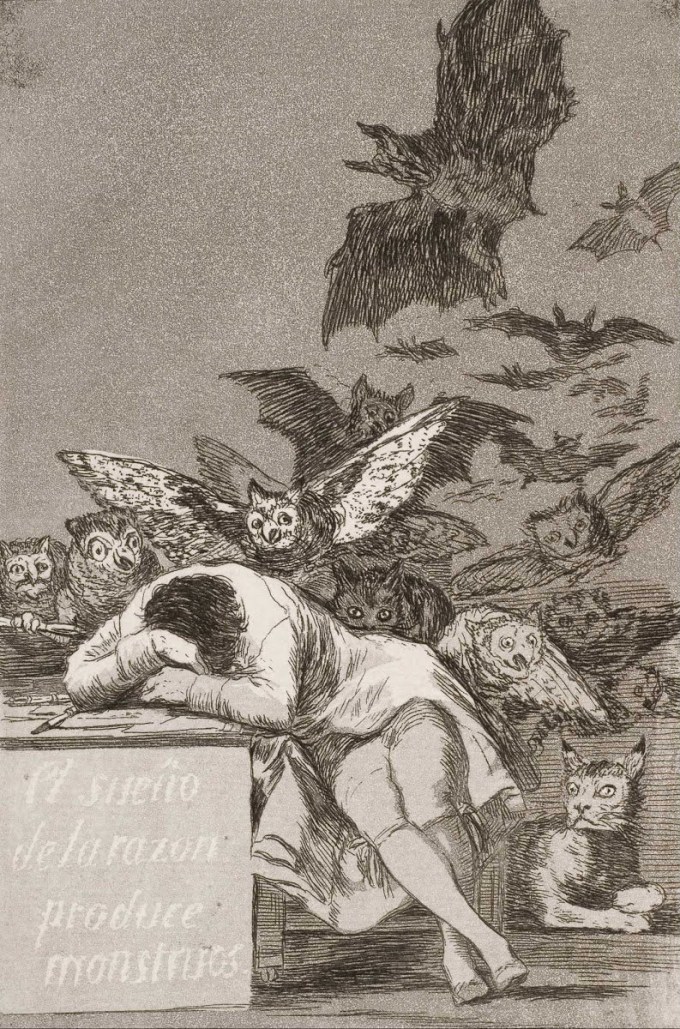
The sleep of reason (2) – Goya

I mentioned ‘the sleep of reason’ in my last post. I had in mind Goya’s Los Caprichos print series, and specifically plate 43, ‘the sleep of reason produces monsters’. Owls gather above the sleeping artist’s head, no owlish wisdom here, just confusion, compounded by bats swarming behind – the owls lit, the bats unlit, and below two cat-like creatures look out, lynxes maybe, one directly at us, black and ominous, drawing us in.

By 1799 when Goya published Los Caprichos the high hopes of the Enlightenment had faded – his time maybe not too similar to our own.

Sleep of reason

Goya is clear that we cannot live by reason alone. ‘Imagination abandoned by reason produces impossible monsters; united with her, she is the mother of the arts and source of their wonders.’

We have in recent times been short-changed on both. Imagination looking back not forward, reason pilloried as ‘expertise’. And for many us, for the first time in our lives, we feel the tide of human improvement, I won’t say progress, is running against us.

Can music help? Leonard Cohen’s words from his song, Anthem, have helped me. (I love singing it!) Simply the idea that there’s a crack, however formidable the surface textures might seem just now, there is a crack. A crack in everything.

Rings the bells that still can ring/Forget your perfect offering/There is a crack in everything/That’s how the light gets in.

Applies to the whole Brexit edifice. And the Trumpian. We haven’t come so far that we could now go back. Surely not.

I see that the artist Sarah Gillespie has made ‘the crack in everything’ the title of a painting. Maybe I’ll make it the title of a poem.

And another artist, Turner Prize-winner Wolfgang Tillmans, quoted in the RA Magazine: ‘ …this amorphous, right-wing, nationalist sentiment … has become the central issue of world politics …how, as a sort of avant-garde artist, do you engage with the number one political subject?’

How does an artist respond? Or a writer? A musician?

Propaganda has its place, but propaganda and art are not easy bedfellows. Caricature if it points up absurdity, gross behaviour and the like has a powerful role to play. But not if it only appeals to the already converted. In the hands of Hogarth, Rowlandson and Gilray caricature becomes an artform in itself. But we must tread carefully.

What we can’t do, in our anger or frustration, is allow ourselves to abandon reason, to let reason sleep awhile.

‘Imagination abandoned by reason produces impossible monsters; united with her, she is the mother of the arts and source of their wonders.’

Taking politics out of zenpolitics …

Back before I took ten days out from the world I wondered about the future of my zenpolitics blog. ‘Politics and creativity, blogs and poetry are uneasy bedfellows….There has to be something obsessive about a political blog, and I may want to put obsession behind me.’

Which, indeed, I do.

Trump happened while I was away. Here in the UK, judges insisted that the government couldn’t invoke Article 50 without first putting it before parliament. Theresa May had an embarrassing trip to India. She looked out of her depth. I could but don’t want to comment on all this. I’ve spent years doing so, and especially in this Brexit year. But with so much going on it’s almost a full-time job just to keep up to speed. Let alone comment.

We are in a time of crisis. Zenpolitics has always assumed a continuing broadly liberal agenda in Western politics, and that’s now very much under threat. If, as the Economist argues, Trump’s success is replicated in Europe, ‘the EU may eventually tilt toward a common assembly for mutually beneficial transactions rather than a club of like-minded countries with a sense of shared destiny’.

I will continue to argue for that shared destiny.  But to look out for insights and inspiration, and anomalies, and avoid day-to-day combat. Insights into politics, but also I hope into landscapes, real and imaginary, and travel.

I will as always aim to understand the other’s point of view. But there are a good few bastards out there, not to put too fine a point on it.

So I will sometimes fail.

Back to the world after ten days of silence 

I posted the message below on Facebook last Sunday. I wanted to put my feelings down while they were raw. Time inevitably anaesthetises, and I didn’t want to lose the impact of those morning hours. 

I’ve been out of all communication on a silent retreat in Herefordshire for ten days. (Why – another story and not for now!) I knew I’d be missing the American election but I had confidence. This morning a message from my daughter, Rozi, apologising for all the dreadful things that had happened in the world in my absence from it, concerned I might want to head back to my retreat and never come out again. That’s when I realised, 7.30 Sunday morning, that Trump had won.

Returning to the world after so long and so quiet away is emotional anyway. The Herefordshire countryside, the Black Mountains a high ridge out to the west, and the mist still lying in frosty fields, music on the radio… I was coping, just.

Back in Cranham – I learnt that Leonard Cohen has died. And that finally did bring out the tears.

I first sang Suzanne in a folk club in Oxford maybe fifty years ago, and I sang it again at an open mic evening just two week ago in Cranham. A few weeks before I’d sung That’s no way to say goodbye … And there was that wonderful radio programme recently about Marianne, and how they were in touch again shortly before she died.

‘It’s a cold and it’s a broken Hallelujah,’ in Cohen’s own words.

I and my generation have lost a hero. And there are new villains to fight. But there’s a new generation taking up the good fight and, thank God, my own children are out there among them.

Time to chill out?

Tomorrow I’m heading off to Herefordshire for ten days’ vipassana (insight) meditation. Up in the very small hours and no contact with the outside world, and silent throughout. I will put all politics behind me. I will have no way of knowing the American election result until five days after the result is announced. Much as the result concerns me I will be better for it. Clinton or Trump, the world will take what direction it will. Likewise Brexit. I in my small corner will re-engage when the time comes, just to be part of the process.

But continue with my blog? Time to let the world loose, spare the world – and myself – my take on it? Who listens, who reads? All along, over seven years, I’ve tried to put over my own considered view. To understand the world from a (sort of!) Zen perspective, but at the same time to engage.

Some of us may choose to stand apart, others to engage. Both are equally valid. As I put it when I stared this blog seven years ago I wanted to [take] the trash and the hyperbole out of politics and [try] to look at people and issues in a way that’s detached from emotion and as they really are. Can be very hard to find these days. Zen is living in the moment and not somewhere else past or future….

The downside? Blogs take over. You organise your moment-by-moment, hour-by-hour thinking in terms of how it might appear in a blog. It’s harder to skim, to browse, to just absorb what you read or hear.

Worse, blogs and creativity, blogs and poetry are uneasy bedfellows. There’s a randomness, an complete unexectedness, something of the suck-it-and-see about poetry. You’ve a starting-point and a sense of direction. And no idea of an ending

With a blog it’s all about argument and conclusion. Though occasionally, as in my last All Hallows post, a little bit of creativity creeps in.

So will I return to this blog when I’m back from my time-out?

There has to be something obsessive about a political blog, and I may want to put obsession behind me. To walk and run and sing and play my guitar; to meditate and dream, to create; to give practical help to a charity, a church, even a political party. To go with the flow of the world, rather than try and arrest it – try and put it down in print and words.

We shall see. Maybe I’ll start Zentravel blog, and the Tao, the Camino, the way, will be my inspiration. Maybe Zenpolitics will become occasional, and less politicised. More chilled.

Do come back and take a look sometime


Comedy rules – two great American novels 

We were in my last blog on the road in America, fifty years ago, give or take.

It put me in the mood for more America. Better wild and offbeat, I thought, rather than Frantzen-style intensive scrutiny. So having read the blurb I picked up Paul Beatty’s new novel, The Sellout, and read it just a week before it won the Man Booker prize last Tuesday. And that put me in the mood for a novel written almost fifty years ago, John Kennedy Toole’s A Confederacy of Dunces.

We’re in New Orleans, well away from all the California fun and games. Toole creates one of the great comic heroes, Ignatius J Reilly. A medievalist by education and inclination, preferring his own room and company, yet forced to work he creates chaos in the sales office of Levy Pants, and confusion in the streets as a hot-dog salesman. He is wonderfully quotable.

Optimism nauseates me. It is perverse. Since man’s fall his proper position in the universe has been one of misery.’ Advising us to avoid all of history apart from the early medieval he recommends that ‘for the contemporary period , you should study some selected comic books’. Strangely prophetic. ‘I suspect that I am the result of a particularly weak conception on the part of my father. His sperm was probably emitted in a rather offhand manner.’

Ignatius’s New Orleans is a place I’d want to visit: I was there in 1971, and might have met him, had he existed… but I listened to jazz and didn’t scratch below the surface.

Likewise Dickens, the LA ghetto brought back to life in Paul Beatty’s novel. Dickens had somehow dropped off the map. Along with segregation – blacks shutting out whites – Beatty’s hero and narrator wants to put it back. He also unwittingly takes on Hominy, a one-time child actor who insists on being his slave. So as a black man he’s taken before the courts, on charges of slavery and segregation, and the novel begins and ends with the case brought before the Supreme Court. Black comedy in every sense, but such is Beatty’s commitment to irreverence that he absolutely gets way with it.

Unlike Jonathan Frantzen’s families, who I wouldn’t want to meet, I’d love to have got acquainted with Toole’s and Beatty’s characters in real life. Though maybe not more than acquainted….

And now we have Donald Trump acting out one of the great American comedy turns. Only it’s not comedy. Would he was a novel, and we could laugh.

America shares its life with us. We could be put off but we know, or we should know, that our own lives in our own countries are just as absurd, just as lost and lonely, mixed-up, angry, funny, devoted, passionate. So two cheers for America. If only we could slip in there, past the miserable souls who staff the airport arrival halls – and wearing ear mufflers which let in the roar of both the big city and the prairie winds but shut out the news networks which blight every bar and home.

Something for Google to look into. I don’t want a Google glass which enhances my experience. Rather mufflers that screen out …

‘The normal parameters’

“I am endorsing Hillary. And all her lies and all her empty promises. I am endorsing Hillary. The second worst thing that could happen to this country. But she’s way behind in second place, you know? She’s wrong about absolutely everything – but she’s wrong within normal parameters.”

We enjoyed PJ O’Rourke at the Cheltenham Literature Festival. Serious, yes, but with a sense of the absurd which gets to the heart of things. There’s no-one else like him. (He’s a great fan on Jon Stewart, on the other side of the political spectrum.)

Who else is out there beyond Trump, beyond the normal parameters? A serious party game – where protagonists just might come to blows.

Thinking of the UK.

Farage, or farrago, as my spellcheck would have it, of course: he like Trump claims to be within boundaries. He’s fooled a good few people. But closet racism, and recent support for Trump, place him firmly outside.

Corbyn, with his past support for elective dictatorships like the Chavez regime, and backing from trade unions who muddle the pursuit of workers’ rights with political agendas from another era – likewise.

Sections of the Tory party, the libertarian Davies and Fox wing, are on the parameter edge, and should never ever be near positions of powers, let alone dictating.

O’Rourke takes inspiration from Hayek, and avows a small government, minimal intervention agenda. That’s firmly within. We’ve been battling in the UK and USA between big and small government for decades – and that’s the way debate should be.

*

Read on for O’Rourke on Brexit.

He recounted interviews he did for an American public radio programme: he’d set out to understand why Brits voted for Brexit. He quoted a ‘financier’ who argued that the euro and probably the EU was going down the tube sooner rather than later, so best get out now. (To which the obvious reply is – we’ll be hit amidships anyway, and immeasurably better to be in there, influencing proceedings.)

And a more cogent argument – this is no longer the country we grew up in. The older generation’s lament. It isn’t the same country of course, and it’s the same for every generation. The sanity of representative democracy normally allows us trade-offs between young and old, and we move forward, an erratic progress maybe, but progress nonetheless. But not when you chuck a referendum into the mix.

Not a point that O’Rourke made, but a US presidential election has some of the characteristics of a referendum, in the sense of the media blitz and the half-truths, and this time the blatant untruths. But running in parallel are the Congressional elections. There’s balance in the US political system (which sure as hell isn’t perfect!), which brings politics back closer to the centre, where both sides have their say, and policy evolves out of a rough consensus – policies and programmes balancing out over time.

(At least, there was a balance, before Tea Party, and Cruz, and acolytes, and now Trump, came along.)

But referendums on their own – overriding representative, parliamentary democracy… that’s another story.

‘Normal parameters.’ Depart too far, allow prejudice and ideology to take centre stage, and the damage could be irreparable.


China shock

A digression – an important digression – into trade policy. Maybe a little heavy-going, but important!

*

Apropos my comments in my last post on de-industrialisation, there’s an interesting article in the current (July) edition of Prospect, by the FT’s economics leader writer, Martin Sandhu.

Has the cause of growing inequality in the rich world since circa 1980 been caused by globalisation or technological change? In Sandhu’s words, by the late 1990s ‘… the economics profession settled on the consensus that technology more than trade was to blame. Then China joined the World Trade Organisation.’

He quotes Autor, Dorn and Hanson’s paper, ‘China Shock’, and highlights their conclusion that ‘Chinese competition had localised but substantial negative and long-lasting effects on the places particularly exposed to it’. ‘On one estimate more than half of [US] factory job losses can be attributed to the China effect.’

’… the imbalanced effect of trade liberalisation can only be corrected if the losers are compensated out of the overall gain – but more redistribution and greater public goods are not on the cards in Trump’s deck.’

Of course technology is also a key factor, so too the shift of power away from labour to capital – not least, the decline of trade unions.  Benefits have also been hit hard – even more in the USA than the UK.

‘It is no surprise that that people feeling powerless and alone in the face of their demotion yearn to regain control – to ‘take their country back’. That is what Trump promises them.’

So too the UK. ‘The same dream of regaining control …fuels the growth of socially-conservative nativist right-wing parties in Britain, France, Germany, Scandinavia and central Europe.’ Some of the same grievances have been picked up by Bernie Sanders as well as Trump. (We have nothing directly comparable in the UK.)

But whereas Trump talks of putting up trade barriers the Brexit message has been all about lowering barriers with the rest of the world , ‘to escape the walls of Fortress Europe’ – a rigorous free trade message. (Both the USA and UK insurgencies are of course agreed on immigration.)

Also bear in mind that economic theory ‘predicts that the effect of low-skilled immigration is the same as freer trade with countries that have a lot of low-skilled labour’. Put another way, freer trade (especially negotiated from a position of lesser rather than greater advantage post-Brexit) will hit hardest those areas already suffering.

(Some will course want to rubbish economic theory. That’s the mood of the moment.)

The impact of Chinese imports on British industry, and the resultant job losses, has been far far greater than the impact of immigration. And yet it’s immigration on which the Leave campaign has focused.

And the impact of free trade? Now that we’re escaping from an EU that’s perceived to be the over-regulated and slow-moving ?

‘…Brexit will not lead to a bonfire of the regulations, but a redoubled effort to harmonise rules – that’s what trade openness increasingly means.’

There’s an obvious and striking irony here – we put behind us the EU and harmonisation, and negotiations over TTIP (the Transatlantic Trade and Investment Partnership), and we find that we’re faced with just the same issues when we seek to negotiate free trade deals around the world. But without the clout the EU gives us.

More than ever it’s apparent that immigration for the Leave campaign has been a target of convenience. The issues we face as a country with regard to our future prosperity are of a very different order. Which is not to say that we shouldn’t pay heed to the specific impacts of immigration, but our future lies in facing up to the global context in which we operate, and in which we will be, post-Brexit, less equipped to operate.

And our response as a country to those who feel excluded and resentful will involve strategies which simply aren’t part of the Leave agenda. That’s the absurdity of the situation in which we find ourselves.


A battle against ideas??

There’s an anti-intellectual, anti-ideas, anti-authority (academic as well as political) mood out there, encouraged and fired up by the media. In the USA by Fox and shock-jocks, and Trump and his cohorts. In the UK by much of the popular press and, sadly, by Brexit campaigners. See below for two contributions, both with Facebooks videos, which highlight the dangers such attitudes present.

One, a Barack Obama speech to the Rutgers University Class of 2016. ‘In politics and in life, ignorance is not a virtue. It’s not cool to not know what you’re talking about… But when our leaders express a disdain for the facts, when they are not held accountable for repeating falsehoods and just making stuff up, when actual experts are dismissed as elitists, then we’ve got a problem.’

See: https://www.facebook.com/BusinessInsider.Politics/videos/1015027085240290/

As seen from the UK – ideas are out of fashion, reliable sources of information are cast as biased, or worse – establishment. Boris’s suggestion yesterday that Cameron had bought the support of big business by offering government contracts is the latest, and most absurd, example.

There have been dubious claims from leaders on the Stay side. But the weight of misinformation put out on the Brexit side takes some beating.

Almost every organisation of note, business and European, every country in Europe, groups like the Five Eyes security group (UK, USA, Canada, Australia, New Zealand) – they have all come out in favour of staying in. Are they all tainted, biased, dishonested, bribed? Are they all to be damned as elitist and establishment?

Obama’s is a rallying-cry, and a reminder of what we stand to lose.

And, two, there’s a Brexit ‘film’ doing the rounds… It begins with the words, ‘We, the people are being cajoled… into surrendering our democracy and freedom.’ ‘The EU is turning into a dictatorship.’ But, given that we’re a key member of the organisation, the selfsame EU, which determines those regulations, and if we leave we’ll have them foisted on us, it’s a very dubious argument.

Happily you don’t have to put up with any further commentary from me. There’s a very good riposte: https://www.facebook.com/scientistsforeu/videos/787984157970262/

If Scientists for EU will forgive me I’ll quote the first paragraph:

‘The whole documentary is about the need for deregulation. It’s fundamentally a neoliberal infomercial, painting history through the mantra of deregulation leads to growth and regulation leads to stagnation. They tell us that the EU is over-regulated, so we need to get out – and then we will economically prosper. That’s the thesis. The only problem is that they have no business/ economist backing whatsoever. Instead of interviewing CEOs of Airbus, Rolls-Royce, etc (all of which have come out for Remain), the documentary interviews just the standard clique of Nigel Lawson, Daniel Hannan, James Delingpole, Nigel Farage, etc… Politicians and right-wing journalists – with Kate Hoey thrown it.’

Do check it out.