A story about lemmings 

Hard to post anything on the subject of Brexit. Zenpolitics has been quiet for a while. The level of absurdity is too high. Talk of hard or soft as the only alternatives. Business, scientists, economists, all against. Incredulity that it could get this far.

Martin Wolf, in the FT, argues that we’re underperforming against our European partners of similar size, whether we look at increases in GDP, exports or productivity, proof surely that it’s not European regulation that holds us back but something more deep-rooted in British attitudes and industry – attitudes to the wider world, an over-focus on our home territory.

Jeremy Warner in the Telegraph recognises the same infirmities, but imagines that Brexit will somehow shake industry up, that it’s the EU that’s holding us back. Industry needs the shock: the mechanism by which the shock transforms isn’t mentioned.

Divorce is a shock, relationships are soured, couples don’t normally get back together. Could ‘just good friends’ ever be enough?

Companies having to divulge the number of foreign workers, as if by doing so they’d take on any more British workers. (It seems this may not now happen, a step too far, but other measures with the same intent remain under discussion.) A Home Secretary whose past record suggest she knows better, but who falls into line.

And so to the Tory party conference, an assembly of lemmings gleefully finding a cliff and looking to leap over, some in hope of a soft landing, others unconcerned if it’s hard. Maybe a few of the soft landers will live. Maybe not. Theresa May, our turncoat (loyalty to Cameron? closet believer in Brexit all along? serving her own ambitions?) PM, admits there will be bumps in the road. Some road.

The whole process is deeply unedifying. Once the Tories were split between supporters and opponents of the EU. Now the supporters are cowed, MPs looking to save their seats. Defying the logic of history and events. Falling in behind an anti-immigration agenda. Playing along with the racists closet or otherwise in their number. There’s a cowardice, a self-serving mentality about it all. They and we will look back in shame on this example of how mass hysteria can take over a political party. On a press which soaks it all up, and reflects it all back.

As a country we are bigger and better than all this. But Labour is obsessed by internal wranglings, old obsessive loyalties clouding the minds of those who ought to be out there, strident in their arguments. Anti-establishment loyalties on the left encompass the EU as well – anti-capitalist means anti-EU. We turn inward, pay heed to ideologies of left and right, we shuffle nervously, and accept ‘it’s going to happen’. Let Brexit take its course. We will get on with our lives. Phoney war. Nothing’s happening now. The stock exchange is buzzing with revenues taken in a depreciated currency. Because nothing is happening now a hazy logic suggests nothing ever will.

God help us all.

Woolly journalism

There is too much woolly talk and poor journalism on the subject of Brexit. Too many people asserting that one referendum vote is enough – enough to turn history on its head. One moment in time – and we have a paradigm shift.

An example was on Radio 4’s The Long View, with Jonathan Freedland, this morning (1st August). I missed much of it, so if I do it an injustice I apologise. One of the contributors recognised that the way the country is split is a big issue – with big Remain majorities among the young, the educated, and city dwellers.

But another suggested that academics (I think we’d consider them educated) were horrified because, whereas elections over the years had been squabbles between right and left, now their own personal interests were affected. The suggestion being that their opposition was self-interested and self-indulgent. But – they, the academics, know – and I know – and my friends know – and a few million others out there – we all know – that our concerns lie at a deeper level – about a way of looking at the world, with an open not a closed mind – about being European and internationalist – taking a positive rather than a cynical view of the world – looking to the future with optimism. (It’s there writ large in the comparison between all the enthusiasm and aspiration of the Democratic convention last week, and the negativity of the Republican convention the week before.)

The programme enlisted Diarmaid MacCulloch, Oxford historian, to make a ‘long view’ comparison between Henry VIII’s break with Rome and Brexit. It took a long time for the implications of that break to work through the country, to rework the fabric, to change irrevocably beliefs and practices – twenty years, forty – and longer. Could we be in for something similar this time – a slow, gradual, inexorable change to a different view of the world – to a different world?

To my mind the very notion that there’s a comparison is absurd. I’d agree that Henry’s decision was pretty arbitrary, a whim, the result of an obsession, influenced by a (un)favourable reforming wind from the continent, and an executor and manipulator in chief who knew how to execute (too literally) and manipulate – yes, maybe we can have fun drawing comparisons. But that there are any real searching comparisons with any relevance for our time – that’s a load of baloney.

A 52:48 vote in favour of an ill-thought through proposition based on misleading and sometimes mendacious arguments does not represent a paradigm shift.

As another example of bad journalism we have Ed Conway in The Times. (I’m relying here on a summary of his article in The Week).

The wider world is all too keen in Conway’s view to blame the world’s problems on the Brexit: ‘Britain’s great gift to the world: a giant pre-cooked excuse for absolutely everything.’ That’s nonsense, he says. We’d all agree. And it’s not of course what the wider world is saying. Brexit is, however, part of a big picture that the wider world does find worrying.

For Conway the problems in the world economy have been ‘baked into the system’ for some time. To be specific: unemployment rates, productivity, demand. But it’s been ‘easier to blame (problems) on Brexit’.

Arguing from one dubious proposition to another, he goes on to suggest that ‘if anything Brexit presents an opportunity’. ‘For years G20 members have been paralysed in the face of a global showdown. If Brexit provides an excuse for tackling this by spending more on infrastructure, tearing down regulations, printing more money, so much the better’.

An excuse to spend – to spend our way out of a crisis. Brexit it seems could be an excuse for throwing caution to the winds. More an argument I associate with the Corbynite left.

There are good arguments for increased spending on infrastructure, and there’s a debate about whether a further dose of QE would be helpful. But that debate should have nothing to do with Brexit. Unless it is – as this is how I’d construe Conway’s argument – we spend and print money out of desperation following a post-Brexit slump in economic performance and confidence.

I started with The Long View, and a massive non-sequitur – Henry VIII and Brexit. And I’m ending with another – Brexit and global economic reform.

The pre-referendum debate was characterised by wild assertions and woolly thinking. The post-referendum ‘debate’ is sadly no better.

Words, words, words

Words, words, words…

I’ve read the Economist on Brexit, and now the New Statesman. I’ve browsed Daily Mail and Telegraph headlines, watched Panorama. Read the Guardian. Skipped through The Week. I’m gutted and I’m glutted.

A few conclusions, and that means, inevitably, more words.

I remain (in every sense) passionate about the European ideal, about being open and open-hearted toward the world, about influence gained by working with others rather than influence lost by retreating, and pretending we can win friends from behind closed doors.

There are so many narratives out there. One is a narrative of gloom. Reaching wider than Brexit, there’s a sense of a failing world, of which the EU, China, Russia and a USA enthralled by Trump are all aspects. The philosopher, John Gray (writing in the New Statesman), is a good example. ‘We have to throw away the old progressive playbook.’

‘Not for a moment,’ would be my reply. But an acceptance that the progressive road is a rocky one, and for every step forward there might be two steps back – yes, that we must accept.

(Gray is closer to the mark on Labour: ‘Leading Labour figures have denied that the party’s stance on immigration is central to the collapse of its working-class base.’ Look to de-industrialisation they argue. But they’re avoiding ‘an inconvenient truth’.)

Anger, resentment, betrayal – on the Remain side, felt so deeply a week last Friday morning. Anger, resentment, betrayal – on the Leave side, building up over many years.

On the Remain side we need to be wary of our language, and our emotions, and our surprise. At the same time we can be scornful of the likes of Libby Purves laying into disconsolate Remainers: ‘liberal and lefties weeping into their lattes.’ You don’t have to be liberal or leftie – you just have to European, and an optimist, and open in outlook.

It’s been helpful to run through a few of the reasons given by ordinary people explaining their reasons for voting to leave, on Panorama and elsewhere.

Immigration: ‘no room in schools, not safe in our jobs … a weaker economy a price worth paying… racism shouldn’t be used as a smear against the voiceless.’

‘The bosses love foreign workers… The housing situation is the UK is abysmal… Now to be poor is a sin… One million migrants into Germany…’

We can, on the Remain side, argue for ever that immigration has a substantial net benefit to the UK economy, but there’s no doubt that free movement between countries with different working conditions, radically different levels of pay and welfare benefits has impacted directly on the lower-paid and less-skilled. Free movement is an important (but arguably not a necessary) principle for a free market, but it’s caused significant dislocations. Yes, we should have anticipated this and provided the necessary health and education infrastructure. But we’ve been in a recession, and our focus has been elsewhere….

While there is no gainsaying the impact on jobs and pay, the experience of specific localities has been written up and wilfully exaggerated. This is where UKIP and the Mail, Sun and Express come into play. The fear of immigration, the supposed threat to our national character, has had a major influence nationwide, and helps explain the Leave vote in areas with low immigrant populations. Addressing dislocations caused by immigration will have little effect on this element of the Leave vote. Fear easily becomes prejudice and runs deep. And aligns with a disdain for the political class – also encouraged by the popular press.

There’s another narrative we heard on Panorama – the disappearance of the old shops from the High Street – as if this was a consequence of the EU. So much has been shovelled together and the EU was the first and easiest target – there are no such easier targets in general elections.

Beware referenda – populism is not ‘as it is being used today a term of abuse applied by establishment thinkers to people whose lives they have not troubled to understand’. (John Gray.)  Rather it is a chance for the population at large to vent its anger. And there are out there many skilled operators who know how to exploit that anger for their own purposes.

Try de-industrialisation as an argument with ordinary people. Immigration is much easier. Put the two together and muddle it with the loss of sovereignty argument and you have a potent mix.

(To return briefly to de-industrialisation.  The impact of China and global trade hardly gets a mention. And yet cheap imports have driven industrial decline more than any other factor. Trump talks up the issue but it hasn’t featured in the referendum debate. Instead we’ve had a focus on the EU as the source of all our ills. If we seek to revive our industry we should be working with Europe and not stigmatising it. The problem lies elsewhere.)

‘I would love to see the break-up of the EU. Nation states should be free from the voluntary shackles offered by cynical, deceitful, anti-democratic, sneering, control freaks.’  ‘The EU is doomed to fail.’

OK, I’m on the side of the cynical, deceitful… Much of that language one could apply to the manipulators of opinion in the popular press.  (Far from cynical, many of us are idealists – but our idealism is not rose-tinted. More than ever now it has to be practical.)

Deceitful, no, but, yes, the perception that Brussels has reached out too far is widespread, and many who voted to remain share that view. The EU is not doomed to fail. But cutting back on EU directives, worrying less about harmonisation, would be wise. Will the EU pick up on that message?

A comment from a Leaver on the left: ‘…we shall set our own agenda. We shall be able to keep our public services and not be forced to privatise them, and if we chose we can renationalise our industries…’

An awful lot from across the political spectrum can be stuffed into one pot. Many will be disappointed.

And finally, from another source, The Economist, we have the liberal agenda: ‘…liberals need to restore social mobility and ensure that economic growth translates in to rising wages… battling special interests, exposing incumbent companies to competition, and breaking down restrictive practices’. Yes, I agree, but that is a long process, and in truth we’re unlikely ever to get there, and en route there will many, maybe too many, casualties, and if there’s one message from all this, from Brexit and all its other manifestations in Europe and the USA it’s that

we have to look out for casualties.

We are in a crisis moment, at a turning-point. The new world we saw emerging after the fall of the Berlin Wall has turned a little sour. A new liberal, open dispensation seemed to be within our grasp. Instead we’ve seen the old hierarchies reinforced, new hierarchies emerge, new elites alongside the old, with aspirations to culture, to learning, to the good life, on the one hand – and a liking among too many for extraordinary ostentation…

… while the rest of us look on and maybe we aspire to achieve for ourselves, or we shrug and disregard, or we envy, or we disdain. The new order has brought radical disparities of wealth, at the same time as earnings as a percentage of capital have reduced. There’s a widespread sense of being left behind – a sense of a brave new post-war world disordered and old verities overturned.

For us true believers, we must continue to aspire, to work together, to put our trust in the younger generations – but we must address directly and immediately and with wisdom the big issues we’d turned a blind eye to for many years.



Another day and another …

… and another. There is no end in sight.

A febrile and emotional atmosphere, 150,000 Tory members out in the shires with the final decision on the new Tory leader. They will represent the nation. Even more so since there’s no new parliamentary election planned.

And once the leadership election is over, the big question – whether to invoke Article 50 sooner, or later.

The general disruption and shenanigans on all sides in the meantime will keep us in a state of both panic and amusement.

Quite where Labour will end up is likewise impossible to predict – a separate but related battle in its own right for the soul of the nation – who in the end does Labour represent?

Those who visited this uncertainty and foolery on us will be pilloried by history. Boris has now departed the scene, but he bears a heavy responsibility. He paraphrased Brutus in his recent withdrawal speech: ‘A time not to fight against the tide of history but to take that tide at the flood and sail on to fortune.’

If the tide for him is Brexit, a withdrawal and a ‘glorious future’, he should reflect on the fate of Brutus (he took his own life) and how futile his gesture in holding back the imperial tide.

Back to reality …

Peter Wilby in the New Statesman: ‘… the European project that led to the EU was – and in some respects still is – an an attempt to embed humane and liberal values so deeply that the nightmare [of war and violence] could never be repeated.’

That remains my view as well, but obscured and obfuscated by reactions (some valid, some not) against elites and establishment, against authority and expertise, against neglect and ostentation, post-industrial decline and globalisation, together with …

false perspectives on the past, colouring absurdly-imagined perspectives on the future (Daniel Hannan being one such errant dreamer),

neo-liberal attitudes and policies which with Ayn Rand lurking as a ghost in the room will only make division worse,

immigration and refugee crises, again with deeper issues, this time regarding population movements, tucked away in the shadows.

The optimism and open hearts of younger generations against the certainties of age, idealism against anger and cynicism. (We will need to reduce the voting age to 16, and maybe younger (!), to counter the increasing numbers of the elderly.)

Not forgetting the dangers of referenda, of populism, of a popular press in the hands of barons who bought their stake in the national debate. The triumph of mendacity and misinformation. The dangerous subjugation of parliamentary democracy, which is slow burn and should always be so, to the politics of the moment.

It’s one hell of a mix. To quote Wilby again: ‘Now new monsters, more frightening than Johnson or Farage, emerge across Europe to challenge those values. I was confident that none would acquire serious power. Now I am not so sure.’

We are fighting chimera and obsession and absurdity when there are big issues out there – population, the future of work, the fairer apportionment of resources, and much more, not to speak of the violence and hatred which are always looking for fertile ground in which to take root – they should be our focus.

Working with international bodies – the UN, and the EU, and all the others forums where we get together and talk. The very existence of such forums, in the wider context of history, is a miracle in its own right.

Matched against this there’s the gathering of Beaconsfield Conservatives shown on the news last Sunday (3rd July), so pristine, chatty, engaged in discussing the rival merits of candidates for the leadership), and all so far removed from reality. It might have been a garden in September 1939.

I’ve always loved politics and political discussion – but do I enjoy walking on a tightrope over a precipice?

The same again please

Written before May announced and Johnson renounced, and then Gove pronounced. More on that later…

I’ll argue to the end for the re-assertion of parliamentary democracy (over referenda) and continued membership of the EU. And millions with me, I know. But, if that doesn’t happen, what should we argue for – what should we demand?

The same…

If we can’t have the EU we need the EU without the EU. The same workplace, health and safety, and environmental legislation, the same Europe-wide agreements in science, the same cooperation in the arts.

What we still want to be a part of came about because of the EU. That fact will be more than apparent for many of us. Maybe the realisation will strike home for a few Leave voters.

The same vision: that’s more difficult – the open inclusive vision that many of us have is simply not shared. And that, as long as it doesn’t shade into bigotry and prejudice, I can just about accept – I must accept. (That it did so shade in the referendum is a challenge for all of us.)

The same trade deal: all save a few economists on the neo-liberal wing of the Tories (or beyond that wing) would like to be spared tariffs, would want to be part of a single market. EU regulations would have to be adopted by the UK – little option but to do otherwise – and any reining back would be a betrayal of civilised values.

Compromise is sometimes possible: in some areas we have to take a stand. And that means immigration, the devilish strand that is woven through history. Our forebears somewhere way back were immigrants, and their progeny a generation or two down the line took up against the next wave. Each generation has to manage the issue as best and as widely as it can.

Wisdom in a referendum too easily goes out the window, as it has done here. Fertile ground for wild statements appealing to the worst in people. I would have trusted Cameron to bring that wisdom to any negotiation. I think I might also trust Stephen Crabb. Start out with a degree of humility not arrogance. Boris Johnson has today disqualified himself, though there’s no more humility there than in his nemesis, Michael Gove.

Brussels and Trafalgar Square

Two contrasting events from yesterday (Tuesday 28th):

First, Nigel Farage having the perverse temerity to turn up in Brussels to a session of the European Parliament and throw insults. ‘…virtually none of you have done a decent day’s work in your life’. Some of us would be inclined to level the same charge at Farage. Matched against a Scottish MEP, Alyn Smith, who begged MEPs to help Scotland stay in the EU. ‘I want my country to be internationalist, co-operative, ecological, fair, European …Scotland did not let you down. Please, I beg you, cher colleagues, do not let Scotland down now’.

Now, which side do we want to be on? The mean-spirited or the open-hearted? Europe is an attitude of mind. The Leave side claim to be European, but only if you believe in a Europe where we retreat behind our national frontiers. As part of that narrative the EU itself has to be pilloried. I like what I saw of the EU parliament yesterday. Not something I’d always say: no-one argues it’s a perfect institution! But you don’t leave an institution like the EU. You change, you reform, you build, you work together.

One addition: Quentin Letts, in the Mail, had this is today’s paper: ‘The parliament’s president, Martin Schulz, whose only previous job was running a bookshop, appealed for hecklers to desist.’ One could write a whole article about the idiocy of that remark. Running a bookshop is a far superior occupation to that of journalistic hack. I’ll leave it at that. I know booksellers, having been in publishing all my life. And I can recognise a hack at fifty yards.

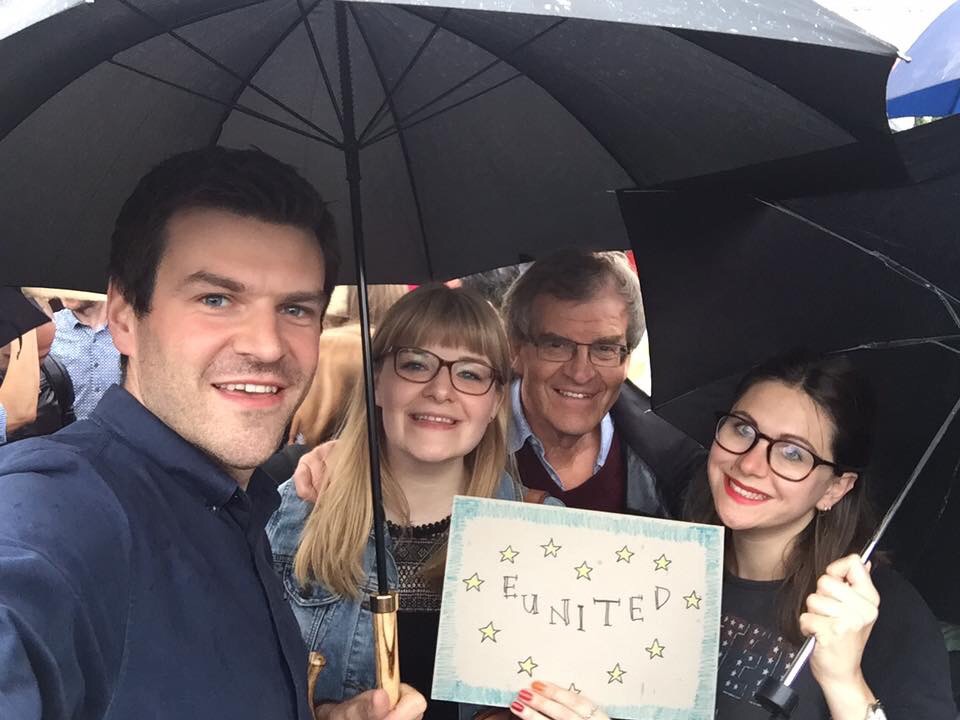
The second event: the Colliers, Chris, Ben and Rozi, in Trafalgar Square for a pro-EU demo. Also Rozi’s best and oldest friend Lucy. My ex-wife Kathy was I’m sure with us in spirit. An international event, it’s London after all, and one I’m proud to have been a part of.  And I’m proud that our family though no longer together in one sense is so together on this. We all did something right over the last 30 years.

I had to leave the demo and head off to an evening class. In the rain, a 1/2 hour walk. I arrived and the tutor was in full flow… on the subject of the EU. Pro-Remain, but believing we should go along with the result. The class then got my riposte. ‘No pasaran,’ as they say in Spanish (they shall not pass), or ‘no lasagne’, as my mobile phone spellcheck suggested to me last weekend.

The emotions all this brings out are surprising. My plan had been for a quieter mretirement!

I learnt later that the demo had moved on down to the Houses of Parliament. Maybe not so much a demo as a celebration. Being a European, a citizen of the world, is a good place to be.

The anger is still there

Four mornings on and the anger is still there. Meeting a friend last night, I’m greeted by ‘hello’, followed by ‘I’m angry’. To take one instance.

Cameron gave a statement in the Commons yesterday. Questioned whether the infamous £350 million a week would all go the NHS, this was ‘a matter for his successor’ was the gist of his reply, and he sat down with a slight smile.

It was the slight smile that worried me, angered me. This was politics at its very worst, playing games at a time of crisis. In the absence of any plan from the Leave side we are heading into an abyss. The Tories would like to delay the negotiations until a new PM is in place. The EU on the other hand cannot afford to delay – uncertainty and contagion are their big concerns. Hollande and the Italian PM Mario Renzi have both emphasised that exit must be processed quickly so that the EU can focus on what should be the biggest issues – fighting terrorism and strengthening borders (and, I’m sure, the wider issues associated with the refugee crisis).

If our government delays the likelihood is that the EU will draw up its own terms and present them to the UK on a take-it-or-leave-it basis. In any negotiation, any normal negotiation, you put your case down, coherently and cogently – and early. Get in there first. Stake out the ground. The way this is playing out it is we who will get staked out.

What I would have thought (and hoped) is that Cameron, playing the statesman not the politician (and taking into account the legacy he’d like to leave), would realise that the only option open to him now is to announce to parliament that the UK will continue to be a member of the EU. Given the referendum result we, the UK, would be seeking further reforms (the referendum result  has given him a powerful mandate) but we would remain, not leave. He should remind the House, and the nation, that the result of the referendum is not legally binding, and parliament in all matters is sovereign. There will be an awful lot of flak, more like heavy shelling from some quarters, but the country would be spared a long-drawn-out disaster. All that we’d suffer would be loss of face.

His justification would be watertight: the Leave camp have no plan, economic indicators are dire, our reputation in the world is at serious risk of being terminally damaged, above all the welfare of each and every citizen, of all of us, is threatened if we continue as we are at present.

There have been arguments from the likes of Digby Jones (ex CBI chief) that we could manage very well in the world outside the EU. Up to a point, that could be true. We could function OK, at a lesser level than now, but we would function. But that issue is theoretical.

The real issue is where we are now, and the imperative of taking action now to avoid the chaos ahead.

The referendum – for the record

Musings I put on Facebook before and after the referendum result. (Read in conjunction with my last post:  24th June – the day after.) Plus a quote from a brilliant post by my son, Ben.

8th June

I came back on Monday from Spain to find – no surprise – good old England more than ever entangled in the referendum debate. My trip underlined, as did walking across Spain on the Camino last summer and autumn, what we’d endanger by voting to leave on the 23rd.

On the one hand we have a remarkable trading bloc, an open market which in all previous ages would have been inconceivable. And on the other we have – we share – a common European mentality, a sense of a common European heritage. It’s not just a British heritage but a European heritage that we, as seen by non-Europeans, present to the world.

Are they small achievements?

We have 28 countries all working together, with many a disharmony – as you’d expect – but still working together. It is unprecedented. Don’t take it for granted. It didn’t just happen.

One market with its four freedoms – free movement of goods, capital, services and people – requires the same trading conditions across the continent, and agreement has not been easily negotiated or easily won.

Europe – the EU – is unique in world history – nations after centuries of conflict finding a remarkable level of common ground, and working together, and presenting one face to the world – not just a trading bloc but an exemplar to the world of cooperation, decency and integrity – a collective advocate of social justice and equal rights – a model for the world of how a continent can put past enmities behind it.

I hope and pray we don’t have the too easy cop-out of a ‘plague on all your houses’ influencing the vote on 23rd June. Or that too many of us have recourse to a ‘close borders and close minds’ attitude. Yes, there’s much wrong with Europe, with the EU. But we should be working to put it right, to make it function in the interest of all Europeans.

By that I mean public servants, teachers, children, employers and employees, professionals, artists, musicians, charity workers, the retired, the unemployed, the disadvantaged, immigrants – and those who feel their lives are threatened by immigration.

All Europeans – anything less than that and we will continue with the same problems, the same tensions we have now. And given the impossibility of closing borders in our modern world, they will get worse.

24th June

I was a counting agent for Stronger in Europe last night, in a west London borough, and as early as midnight I could see how the Leave votes were piling up. Sometimes there would be a run of as many as ten Leave votes before a Remain vote or two showed up. That brought it home. We can’t easily take on the Mail’s bile and bitterness but we can take up the standard from Jo Cox, be proud of Britain (and in her case Yorkshire as well!), proud of Europe and what it’s achieved and where it’s come from over the last seventy years, and be open and open-hearted toward the world. That’s a challenge, and one I think with the young people if not the old fogeys of Britain on our side (a generalisation of course – I am by some definitions an old fogey!) I’m sure we can rise to. What happens over the next few months is all highly uncertain. The Tories need a majority in parliament, and as we’ve seen recently there are Tory MPs like Anna Soubry who do understand the issues and will continue to fight for the cause. 52% is not a done deal.

25th June – from Ben Collier’s post

It’s not about us. ….It’s about the union we’ve just left behind when we should have been part of leading it. It’s about the years of progress we’ve just undone for purely selfish and narrow-minded reasons. It’s about the fact that there are bigger issues to solve in this world than our own day to day problems…

26th June  – in response to a post from a UKIP-supporting friend:

Tony, I agree, we shouldn’t let friendship suffer. I remember the great solidarity shown by UKIP supporters at the Spelthorne count on Thursday night. They were good people. But I believe passionately they were wrong. When someone says to me they cried for twenty minutes when they woke in Friday morning and heard the news – I understand why. For so many of us, so many millions of us, we can see no good reason for leaving, we see only damage to ourselves, to the wider world, and to our place in the world. The EU has brought Europe together after centuries of conflict, and created a single and highly efficient market. We accept that it needs reform – and we want to be part of that process, not watching on the sidelines. In the end it’s about how we see the world – and I know that’s what you’d say as well. We may profoundly disagree – but it’s important we listen to each other. All best, Chris

Extract from Tony’s post:

Trying so hard not to open or read messages that are negative about our leaving the EU. It is upsetting that once good friends and family members are falling out…

27th June

My last post on the referendum result. We have, so many of us, expressed our consternation and shock over the result, and we’re united in arguing for an open, open-hearted, outward-looking, international Britain. That will guide our future actions – will guide mine. My aim, one I share with millions – to see the result overturned.

At the same time – the Leave vote was for many a protest vote, against marginalisation, elites, the ‘establishment’. And that needs to be immediately addressed. One starting-point would be to scrap HS2 without further ado, and switch investment to developing infrastructure nationwide. Can we seriously imagine HS2 bringing any benefit to the North-East?

Social media and Facebook. Why were so many of us so surprised by the result? We couldn’t have imagined 52% for Leave. Could we? The danger of social media is that it’s all too easy to exist inside our own cocoons, linking up only to those who share our outlook on the world. AC Grayling has argued that the Leave vote was irrational: I don’t agree. There were reasons, and we need to understand them.

An extension of this argument: don’t let the referendum vote undermine friendships. Which is the point made by the exchange between Pooh and Piglet that I shared yesterday. Keep talking. Don’t let either side patronise the other.

Having said that when it comes to Faragian misanthropy, and all its various manifestations in the media – there is no shared ground. Likewise, for me, the neo-liberal agenda which has hijacked the debate.

And finally, there has been much good stuff, many wise and passionate posts and articles written over the last few days. I shared one such last Friday – from my son, Ben Collier. If you missed it, do scroll back to read it!

In Ben’s words, ‘It’s not about us. …It’s about the union we’ve just left behind when we should have been part of leading it. It’s about the years of progress we’ve just undone for purely selfish and narrow-minded reasons. It’s about the fact that there are bigger issues to solve in this world than our own day to day problems …’

24th June – the day after

Many responses to this absurd nonsensical vote for Leave. Anger, anxiety, recrimination. Being ashamed for the country, ashamed at the way we’ll be seen by the rest of the word, ashamed maybe that we didn’t see it coming.

A sense we’ve let down young people across the country, who voted by a substantial majority for Remain. We being the old fogeys.

What we must not do now is acquiesce, accept that the people have voted, and imagine we can’t challenge the vote itself and its consequences.

Just how constitutional is a referendum in the first place? It was established by an act of parliament so it is clear by this simple fact that parliament takes precedence over referenda. We don’t have a written constitution but the supremacy of the House of Commons is clearly established. It can make legislation, and it can remove legislation.  We shouldn’t assume, mustn’t assume, that yesterday’s vote is forever.

Referenda

The referendum expressed ‘the will of the people’, it will be argued. But did it? The will of the people at one moment in time. The will of the people as directed by a popular press which has been pursuing an anti-EU agenda for many years, and an anti-immigrant agenda. A popular press that plays on prejudice and seeks to portray isolated instances as widespread patterns of behavior – that looks to disparage, mock and scorn at every opportunity. The damage all this does to public debate is immeasurable. And given the importance of maintaining a free press there’s little we can do about it.

‘The will of the people’ …  in theory it exists, in practice it is easily influenced, ever-changing Next week, next month, it could express itself very differently.

Parliamentary democracy is arguably Britain’s greatest gift to the world. We elect representatives, they divide into different parties and groupings which debate and pass legislation which has at least been fully considered and argued in a (usually) sane and calm environment. Elections are open to populist rhetoric, and they can be divisive, but they elect parliaments which balance opinion and establish consensus in a remarkable way.

Why in earth should we want to subordinate a parliament to a plebiscite-based democracy?

Referenda polarize opinion too readily, as they have done this time, encouraging wild statements and mis-statements, sometimes total untruths. They give some kind of equivalence to both sides, however untenable the position one side might be. (I’m thinking of the BBC.) Opinions in the country are now so divided, tempers so frayed, that rifts engendered could take years to heal.

That said, now our ire has been roused we must act on it. At a more trivial level by keeping up the pressure on Boris. Boris found himself faced with a hostile crowd when he left home this morning. I hope that continues to happen. He needs to be aware of the consequences of his actions.

The next stage

Cameron will resist pressure from the EU to quickly invoke Article 50. So he should. There’s a big Remain majority in the Commons and they must ensure that no precipitate action is taken before we have not only a new Tory leader and prime minister (and I’d hope a new Labour leader) but also an election.

If the Brexit mood is maintained, then Tory MPs who’ve voted Remain may succumb to local party pressure and agree to vote for Brexit legislation in the next parliament. If they don’t, they may find themselves de-selected. But if they hold out, then the new parliament is likely to have a pro-Remain majority. In which case, back to my argument above – which should take precedence – a parliamentary majority, or a referendum vote? That could of course become an election issue in itself. Feathers will fly.

We can’t know how this will play out. But it will be interesting.

The Brexit vote

Some of us feel angry and ashamed. But rightly or wrongly, there were and are strong emotions on the Brexit side. I was very aware of that observing the count at my local council offices on Thursday night. A roughly 65:35 Leave majority.

Why so many? It’s important to know, and we must deal with their anger without indulging our own too much. Resentment at elites, suspicion of authority and expertise – a legacy of the financial crisis, and the expenses shambles. A related sense among many of being left behind, forced into part-time work, low pay. Among the more fortunate a sense of others on the gravy train, doing better, and unfairly so, than they are. Immigrants: if jobs are still there wages are lower than they would otherwise have been. And often a simple fear of immigrants, even when they may never see more than one or two in their locality.

Much of this has been played upon and wildly exaggerated by the UKIP and the media, but there is some truth here. If there is resentment, we have to address it. If government austerity measures have exacerbated feelings of being marginalized, we must deal with that too. It won’t help if we disparage and cry foul. If towns  in the North-East feel that all the focus and investment is down south – they’re right. (Please divert HS2 finance into a network which serves everyone, including the North-East.) We have to get to the root of the matter. It won’t stop the Mail or Sun seeking out incidents they can exploit, but we have to limit their opportunities to do so. And we must be, in two words, more inclusive.

Brexit leadership

Several strands. All need to be addressed head-on, for what they are.

Immigration – UKIP and the closet racist agenda of Nigel Farage, making racist attitudes somehow acceptable, attempting to link the refugee crisis and Eastern European immigration in the popular mind.

Arguments about sovereignty and accountability, EU extravagance, sclerotic administration.  (Mostly specious, but can be made to sound convincing.)

The neo-liberal agenda, which the Tory right has managed to squeeze through under the radar in the guise of reducing regulation.

More broadly, looking inward, looking back, shades of Empire, and a belief we can go it alone. The fairy tale land Boris would like to inhabit.

Our response

We can take up the standard from Jo Cox, be proud of Britain (and in her case Yorkshire as well!), proud of Europe and what it’s achieved and where it’s come from over the last seventy years, and be open and open-hearted toward the world.

That’s a challenge, and one I think with younger generations on our side I’m sure we can rise to.

52% doesn’t have to be a done deal.

Final thoughts …

Final thoughts on the EU. Unless provoked!

A friend sent me the link to the Brexit movie, which I mentioned two posts ago.  I viewed and responded to her as follows:

“I’m proud to be a liberally-minded outward-looking Englishman, European, citizen of the world. Any film or message that begins with ‘we the people’ is automatically suspect. Pretending to refer back to the American constitution, but sounding more like Oswald Mosley in the 1930s.

There’s much wrong with the EU. There’s bound to be with any institution which brings together 26 nations. But the important thing is that it’s brought them together. We live in peace, amazingly. After fighting each other pretty much forever. We trade successfully, and we can only lose by leaving. The Leave story here is a disgraceful misrepresentation. Fully-argued surveys on one side against rose-tinted speculation on the other. Which do we go for? And trade means regulations and standards – we will need them anyway if we want to trade with Europe. And on the environmental side, and that includes animal welfare, I’m delighted to see that our standards have been taken up by the EU, and that means countries with much poorer standards than ours.

Listen on iPlayer to Paddy Ashdown  on Any Questions last Friday [13th May] taking apart Liam Fox when Fox tried to dismiss all the world institutions – the IMF, OECD etc – that argue for the UK staying in the EU as somehow biased or self-serving or in the EU’s pay. Only by traducing the integrity of these institutions (and none have come out favouring Brexit) can the Leave campaign make a case for themselves – and it’s profoundly to their discredit that they try. Likewise Mark Carney and the Bank of England – should he not issue warnings when warnings are what his role as Governor requires of him?

I walked the Camino across northern Spain with fellow Europeans last autumn. Not with the Brexit-minded. But with people mainly younger, mainly much younger than myself. They are the future. There’s a spirit of optimism, of sharing.

Sovereignty – that’s how the film begins. Sovereignty is worthless unless you work with others, and that means sharing some of that sovereignty. The EU is what we make of it – and we have one of the dominant voices there.

Immigration – on the plus side, an incontrovertible net benefit to the economy, on the debit side, pressure on resources and in some cases, jobs. How we control immigration (and still get the benefits) should be the issue, not how we oppose it.

Do we really want to turn the world against us?

Boris’s comments about the EU wanting a European superstate as Hitler did are disgraceful. We are the EU. The EU doesn’t have a separate existence. Linking it to Hitler is atrocious history, and populism of the worst kind.

Someone somewhere said he hoped the film would enlighten and entertain. It does the opposite.”