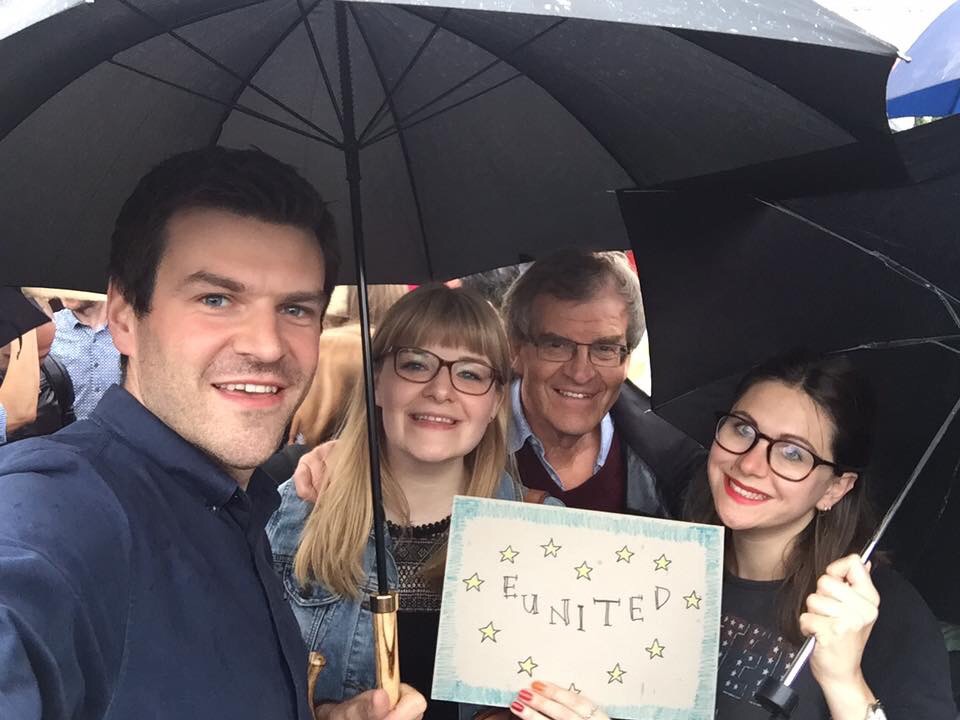
The anger is still there

Four mornings on and the anger is still there. Meeting a friend last night, I’m greeted by ‘hello’, followed by ‘I’m angry’. To take one instance.

Cameron gave a statement in the Commons yesterday. Questioned whether the infamous £350 million a week would all go the NHS, this was ‘a matter for his successor’ was the gist of his reply, and he sat down with a slight smile.

It was the slight smile that worried me, angered me. This was politics at its very worst, playing games at a time of crisis. In the absence of any plan from the Leave side we are heading into an abyss. The Tories would like to delay the negotiations until a new PM is in place. The EU on the other hand cannot afford to delay – uncertainty and contagion are their big concerns. Hollande and the Italian PM Mario Renzi have both emphasised that exit must be processed quickly so that the EU can focus on what should be the biggest issues – fighting terrorism and strengthening borders (and, I’m sure, the wider issues associated with the refugee crisis).

If our government delays the likelihood is that the EU will draw up its own terms and present them to the UK on a take-it-or-leave-it basis. In any negotiation, any normal negotiation, you put your case down, coherently and cogently – and early. Get in there first. Stake out the ground. The way this is playing out it is we who will get staked out.

What I would have thought (and hoped) is that Cameron, playing the statesman not the politician (and taking into account the legacy he’d like to leave), would realise that the only option open to him now is to announce to parliament that the UK will continue to be a member of the EU. Given the referendum result we, the UK, would be seeking further reforms (the referendum result  has given him a powerful mandate) but we would remain, not leave. He should remind the House, and the nation, that the result of the referendum is not legally binding, and parliament in all matters is sovereign. There will be an awful lot of flak, more like heavy shelling from some quarters, but the country would be spared a long-drawn-out disaster. All that we’d suffer would be loss of face.

His justification would be watertight: the Leave camp have no plan, economic indicators are dire, our reputation in the world is at serious risk of being terminally damaged, above all the welfare of each and every citizen, of all of us, is threatened if we continue as we are at present.

There have been arguments from the likes of Digby Jones (ex CBI chief) that we could manage very well in the world outside the EU. Up to a point, that could be true. We could function OK, at a lesser level than now, but we would function. But that issue is theoretical.

The real issue is where we are now, and the imperative of taking action now to avoid the chaos ahead.

The referendum – for the record

Musings I put on Facebook before and after the referendum result. (Read in conjunction with my last post:  24th June – the day after.) Plus a quote from a brilliant post by my son, Ben.

8th June

I came back on Monday from Spain to find – no surprise – good old England more than ever entangled in the referendum debate. My trip underlined, as did walking across Spain on the Camino last summer and autumn, what we’d endanger by voting to leave on the 23rd.

On the one hand we have a remarkable trading bloc, an open market which in all previous ages would have been inconceivable. And on the other we have – we share – a common European mentality, a sense of a common European heritage. It’s not just a British heritage but a European heritage that we, as seen by non-Europeans, present to the world.

Are they small achievements?

We have 28 countries all working together, with many a disharmony – as you’d expect – but still working together. It is unprecedented. Don’t take it for granted. It didn’t just happen.

One market with its four freedoms – free movement of goods, capital, services and people – requires the same trading conditions across the continent, and agreement has not been easily negotiated or easily won.

Europe – the EU – is unique in world history – nations after centuries of conflict finding a remarkable level of common ground, and working together, and presenting one face to the world – not just a trading bloc but an exemplar to the world of cooperation, decency and integrity – a collective advocate of social justice and equal rights – a model for the world of how a continent can put past enmities behind it.

I hope and pray we don’t have the too easy cop-out of a ‘plague on all your houses’ influencing the vote on 23rd June. Or that too many of us have recourse to a ‘close borders and close minds’ attitude. Yes, there’s much wrong with Europe, with the EU. But we should be working to put it right, to make it function in the interest of all Europeans.

By that I mean public servants, teachers, children, employers and employees, professionals, artists, musicians, charity workers, the retired, the unemployed, the disadvantaged, immigrants – and those who feel their lives are threatened by immigration.

All Europeans – anything less than that and we will continue with the same problems, the same tensions we have now. And given the impossibility of closing borders in our modern world, they will get worse.

24th June

I was a counting agent for Stronger in Europe last night, in a west London borough, and as early as midnight I could see how the Leave votes were piling up. Sometimes there would be a run of as many as ten Leave votes before a Remain vote or two showed up. That brought it home. We can’t easily take on the Mail’s bile and bitterness but we can take up the standard from Jo Cox, be proud of Britain (and in her case Yorkshire as well!), proud of Europe and what it’s achieved and where it’s come from over the last seventy years, and be open and open-hearted toward the world. That’s a challenge, and one I think with the young people if not the old fogeys of Britain on our side (a generalisation of course – I am by some definitions an old fogey!) I’m sure we can rise to. What happens over the next few months is all highly uncertain. The Tories need a majority in parliament, and as we’ve seen recently there are Tory MPs like Anna Soubry who do understand the issues and will continue to fight for the cause. 52% is not a done deal.

25th June – from Ben Collier’s post

It’s not about us. ….It’s about the union we’ve just left behind when we should have been part of leading it. It’s about the years of progress we’ve just undone for purely selfish and narrow-minded reasons. It’s about the fact that there are bigger issues to solve in this world than our own day to day problems…

26th June  – in response to a post from a UKIP-supporting friend:

Tony, I agree, we shouldn’t let friendship suffer. I remember the great solidarity shown by UKIP supporters at the Spelthorne count on Thursday night. They were good people. But I believe passionately they were wrong. When someone says to me they cried for twenty minutes when they woke in Friday morning and heard the news – I understand why. For so many of us, so many millions of us, we can see no good reason for leaving, we see only damage to ourselves, to the wider world, and to our place in the world. The EU has brought Europe together after centuries of conflict, and created a single and highly efficient market. We accept that it needs reform – and we want to be part of that process, not watching on the sidelines. In the end it’s about how we see the world – and I know that’s what you’d say as well. We may profoundly disagree – but it’s important we listen to each other. All best, Chris

Extract from Tony’s post:

Trying so hard not to open or read messages that are negative about our leaving the EU. It is upsetting that once good friends and family members are falling out…

27th June

My last post on the referendum result. We have, so many of us, expressed our consternation and shock over the result, and we’re united in arguing for an open, open-hearted, outward-looking, international Britain. That will guide our future actions – will guide mine. My aim, one I share with millions – to see the result overturned.

At the same time – the Leave vote was for many a protest vote, against marginalisation, elites, the ‘establishment’. And that needs to be immediately addressed. One starting-point would be to scrap HS2 without further ado, and switch investment to developing infrastructure nationwide. Can we seriously imagine HS2 bringing any benefit to the North-East?

Social media and Facebook. Why were so many of us so surprised by the result? We couldn’t have imagined 52% for Leave. Could we? The danger of social media is that it’s all too easy to exist inside our own cocoons, linking up only to those who share our outlook on the world. AC Grayling has argued that the Leave vote was irrational: I don’t agree. There were reasons, and we need to understand them.

An extension of this argument: don’t let the referendum vote undermine friendships. Which is the point made by the exchange between Pooh and Piglet that I shared yesterday. Keep talking. Don’t let either side patronise the other.

Having said that when it comes to Faragian misanthropy, and all its various manifestations in the media – there is no shared ground. Likewise, for me, the neo-liberal agenda which has hijacked the debate.

And finally, there has been much good stuff, many wise and passionate posts and articles written over the last few days. I shared one such last Friday – from my son, Ben Collier. If you missed it, do scroll back to read it!

In Ben’s words, ‘It’s not about us. …It’s about the union we’ve just left behind when we should have been part of leading it. It’s about the years of progress we’ve just undone for purely selfish and narrow-minded reasons. It’s about the fact that there are bigger issues to solve in this world than our own day to day problems …’

24th June – the day after

Many responses to this absurd nonsensical vote for Leave. Anger, anxiety, recrimination. Being ashamed for the country, ashamed at the way we’ll be seen by the rest of the word, ashamed maybe that we didn’t see it coming.

A sense we’ve let down young people across the country, who voted by a substantial majority for Remain. We being the old fogeys.

What we must not do now is acquiesce, accept that the people have voted, and imagine we can’t challenge the vote itself and its consequences.

Just how constitutional is a referendum in the first place? It was established by an act of parliament so it is clear by this simple fact that parliament takes precedence over referenda. We don’t have a written constitution but the supremacy of the House of Commons is clearly established. It can make legislation, and it can remove legislation.  We shouldn’t assume, mustn’t assume, that yesterday’s vote is forever.

Referenda

The referendum expressed ‘the will of the people’, it will be argued. But did it? The will of the people at one moment in time. The will of the people as directed by a popular press which has been pursuing an anti-EU agenda for many years, and an anti-immigrant agenda. A popular press that plays on prejudice and seeks to portray isolated instances as widespread patterns of behavior – that looks to disparage, mock and scorn at every opportunity. The damage all this does to public debate is immeasurable. And given the importance of maintaining a free press there’s little we can do about it.

‘The will of the people’ …  in theory it exists, in practice it is easily influenced, ever-changing Next week, next month, it could express itself very differently.

Parliamentary democracy is arguably Britain’s greatest gift to the world. We elect representatives, they divide into different parties and groupings which debate and pass legislation which has at least been fully considered and argued in a (usually) sane and calm environment. Elections are open to populist rhetoric, and they can be divisive, but they elect parliaments which balance opinion and establish consensus in a remarkable way.

Why in earth should we want to subordinate a parliament to a plebiscite-based democracy?

Referenda polarize opinion too readily, as they have done this time, encouraging wild statements and mis-statements, sometimes total untruths. They give some kind of equivalence to both sides, however untenable the position one side might be. (I’m thinking of the BBC.) Opinions in the country are now so divided, tempers so frayed, that rifts engendered could take years to heal.

That said, now our ire has been roused we must act on it. At a more trivial level by keeping up the pressure on Boris. Boris found himself faced with a hostile crowd when he left home this morning. I hope that continues to happen. He needs to be aware of the consequences of his actions.

The next stage

Cameron will resist pressure from the EU to quickly invoke Article 50. So he should. There’s a big Remain majority in the Commons and they must ensure that no precipitate action is taken before we have not only a new Tory leader and prime minister (and I’d hope a new Labour leader) but also an election.

If the Brexit mood is maintained, then Tory MPs who’ve voted Remain may succumb to local party pressure and agree to vote for Brexit legislation in the next parliament. If they don’t, they may find themselves de-selected. But if they hold out, then the new parliament is likely to have a pro-Remain majority. In which case, back to my argument above – which should take precedence – a parliamentary majority, or a referendum vote? That could of course become an election issue in itself. Feathers will fly.

We can’t know how this will play out. But it will be interesting.

The Brexit vote

Some of us feel angry and ashamed. But rightly or wrongly, there were and are strong emotions on the Brexit side. I was very aware of that observing the count at my local council offices on Thursday night. A roughly 65:35 Leave majority.

Why so many? It’s important to know, and we must deal with their anger without indulging our own too much. Resentment at elites, suspicion of authority and expertise – a legacy of the financial crisis, and the expenses shambles. A related sense among many of being left behind, forced into part-time work, low pay. Among the more fortunate a sense of others on the gravy train, doing better, and unfairly so, than they are. Immigrants: if jobs are still there wages are lower than they would otherwise have been. And often a simple fear of immigrants, even when they may never see more than one or two in their locality.

Much of this has been played upon and wildly exaggerated by the UKIP and the media, but there is some truth here. If there is resentment, we have to address it. If government austerity measures have exacerbated feelings of being marginalized, we must deal with that too. It won’t help if we disparage and cry foul. If towns  in the North-East feel that all the focus and investment is down south – they’re right. (Please divert HS2 finance into a network which serves everyone, including the North-East.) We have to get to the root of the matter. It won’t stop the Mail or Sun seeking out incidents they can exploit, but we have to limit their opportunities to do so. And we must be, in two words, more inclusive.

Brexit leadership

Several strands. All need to be addressed head-on, for what they are.

Immigration – UKIP and the closet racist agenda of Nigel Farage, making racist attitudes somehow acceptable, attempting to link the refugee crisis and Eastern European immigration in the popular mind.

Arguments about sovereignty and accountability, EU extravagance, sclerotic administration.  (Mostly specious, but can be made to sound convincing.)

The neo-liberal agenda, which the Tory right has managed to squeeze through under the radar in the guise of reducing regulation.

More broadly, looking inward, looking back, shades of Empire, and a belief we can go it alone. The fairy tale land Boris would like to inhabit.

Our response

We can take up the standard from Jo Cox, be proud of Britain (and in her case Yorkshire as well!), proud of Europe and what it’s achieved and where it’s come from over the last seventy years, and be open and open-hearted toward the world.

That’s a challenge, and one I think with younger generations on our side I’m sure we can rise to.

52% doesn’t have to be a done deal.

Final thoughts …

Final thoughts on the EU. Unless provoked!

A friend sent me the link to the Brexit movie, which I mentioned two posts ago.  I viewed and responded to her as follows:

“I’m proud to be a liberally-minded outward-looking Englishman, European, citizen of the world. Any film or message that begins with ‘we the people’ is automatically suspect. Pretending to refer back to the American constitution, but sounding more like Oswald Mosley in the 1930s.

There’s much wrong with the EU. There’s bound to be with any institution which brings together 26 nations. But the important thing is that it’s brought them together. We live in peace, amazingly. After fighting each other pretty much forever. We trade successfully, and we can only lose by leaving. The Leave story here is a disgraceful misrepresentation. Fully-argued surveys on one side against rose-tinted speculation on the other. Which do we go for? And trade means regulations and standards – we will need them anyway if we want to trade with Europe. And on the environmental side, and that includes animal welfare, I’m delighted to see that our standards have been taken up by the EU, and that means countries with much poorer standards than ours.

Listen on iPlayer to Paddy Ashdown  on Any Questions last Friday [13th May] taking apart Liam Fox when Fox tried to dismiss all the world institutions – the IMF, OECD etc – that argue for the UK staying in the EU as somehow biased or self-serving or in the EU’s pay. Only by traducing the integrity of these institutions (and none have come out favouring Brexit) can the Leave campaign make a case for themselves – and it’s profoundly to their discredit that they try. Likewise Mark Carney and the Bank of England – should he not issue warnings when warnings are what his role as Governor requires of him?

I walked the Camino across northern Spain with fellow Europeans last autumn. Not with the Brexit-minded. But with people mainly younger, mainly much younger than myself. They are the future. There’s a spirit of optimism, of sharing.

Sovereignty – that’s how the film begins. Sovereignty is worthless unless you work with others, and that means sharing some of that sovereignty. The EU is what we make of it – and we have one of the dominant voices there.

Immigration – on the plus side, an incontrovertible net benefit to the economy, on the debit side, pressure on resources and in some cases, jobs. How we control immigration (and still get the benefits) should be the issue, not how we oppose it.

Do we really want to turn the world against us?

Boris’s comments about the EU wanting a European superstate as Hitler did are disgraceful. We are the EU. The EU doesn’t have a separate existence. Linking it to Hitler is atrocious history, and populism of the worst kind.

Someone somewhere said he hoped the film would enlighten and entertain. It does the opposite.”


No more on Brexit?

Well, almost.

Time I think to bow out of talking about Brexit in this blog. It’s taking me down paths I don’t want to go. It’s so easy to be intemperate, and that’s no surprise, and indeed inevitable, given the importance of the issues involved. Recent specifics:

We’ve had the Tory MP Steve Baker laying into the Remain campaign for its petty smears, which is a bit rich giving the diet of outrageously misleading reports we get from the Eurosceptic press.

There’s Ian Duncan Smith on Michael Heseltine: ‘a voice from the past’ in response to Heseltine’s comment that Boris’s ‘judgement is going’ – not ‘going’ but transparently ‘gone’.

And Chris Grayling refusing was it nine times to give a straight answer on whether or not he supported Boris Johnson’s comments equating the EU’s ambitions with Hitler’s.

And at an institutional rather than personal level we have the right-wing Eurosceptic press.

Ownership concentrated primarily in the hands of ‘press barons’ is a serious issue for any democracy which aspires to be a mature and stable entity. Freedom of the press and oligarchical control are not compatible.

There’s an excellent outfit called InFacts that takes the Eurosceptic press to task for its persistent and egregiously wrong or radically misleading reporting. It’s well worth reading.

They, and we, have to hang in there.  

A battle against ideas??

There’s an anti-intellectual, anti-ideas, anti-authority (academic as well as political) mood out there, encouraged and fired up by the media. In the USA by Fox and shock-jocks, and Trump and his cohorts. In the UK by much of the popular press and, sadly, by Brexit campaigners. See below for two contributions, both with Facebooks videos, which highlight the dangers such attitudes present.

One, a Barack Obama speech to the Rutgers University Class of 2016. ‘In politics and in life, ignorance is not a virtue. It’s not cool to not know what you’re talking about… But when our leaders express a disdain for the facts, when they are not held accountable for repeating falsehoods and just making stuff up, when actual experts are dismissed as elitists, then we’ve got a problem.’

See: https://www.facebook.com/BusinessInsider.Politics/videos/1015027085240290/

As seen from the UK – ideas are out of fashion, reliable sources of information are cast as biased, or worse – establishment. Boris’s suggestion yesterday that Cameron had bought the support of big business by offering government contracts is the latest, and most absurd, example.

There have been dubious claims from leaders on the Stay side. But the weight of misinformation put out on the Brexit side takes some beating.

Almost every organisation of note, business and European, every country in Europe, groups like the Five Eyes security group (UK, USA, Canada, Australia, New Zealand) – they have all come out in favour of staying in. Are they all tainted, biased, dishonested, bribed? Are they all to be damned as elitist and establishment?

Obama’s is a rallying-cry, and a reminder of what we stand to lose.

And, two, there’s a Brexit ‘film’ doing the rounds… It begins with the words, ‘We, the people are being cajoled… into surrendering our democracy and freedom.’ ‘The EU is turning into a dictatorship.’ But, given that we’re a key member of the organisation, the selfsame EU, which determines those regulations, and if we leave we’ll have them foisted on us, it’s a very dubious argument.

Happily you don’t have to put up with any further commentary from me. There’s a very good riposte: https://www.facebook.com/scientistsforeu/videos/787984157970262/

If Scientists for EU will forgive me I’ll quote the first paragraph:

‘The whole documentary is about the need for deregulation. It’s fundamentally a neoliberal infomercial, painting history through the mantra of deregulation leads to growth and regulation leads to stagnation. They tell us that the EU is over-regulated, so we need to get out – and then we will economically prosper. That’s the thesis. The only problem is that they have no business/ economist backing whatsoever. Instead of interviewing CEOs of Airbus, Rolls-Royce, etc (all of which have come out for Remain), the documentary interviews just the standard clique of Nigel Lawson, Daniel Hannan, James Delingpole, Nigel Farage, etc… Politicians and right-wing journalists – with Kate Hoey thrown it.’

Do check it out.


And if we leave?

If you prefer me writing country notes, or you’re American, and you’re not too interested in British or European politics, do give this post a miss! Though there are a good few parallels with Trumpery.

Also, if you’re expecting me to be mild-mannered, and avoid personalities, well, not this time. There is some pretty egregiously bad behaviour out there.

If you read the press and indeed listen to the BBC news you can get depressed, even feel beleaguered if you support staying in the EU. Michael Heseltine’s demolition of Boris Johnson yesterday, primarily over his linking the EU and Hitler’s ambitions, was featured in the Times, but not in the popular press. Heseltine would be ‘very surprised’ if Boris ever became the leader of the party, and that of course is an implicit part of the Brexit agenda. (How left-of-centre Brexit supporters can justify to themselves facilitating a Boris premiership I don’t know.) So however absurd Boris gets, he remains untouchable – and he is of course aware of that.

I don’t believe for a moment that Michael Gove shares Boris’s view of European history. I wonder (to myself only so far!) whether he might just change sides at the last. He is already tainted by association.

I also wonder what will happen if Boris does, after a Cameron resignation, become PM. Would all his party fall into line? I somehow doubt it – the party is badly split.(Just how far will all this mutual abuse extend?)  So he wouldn’t of course command a majority in the Commons, and in the event of an election there’s a very good chance that a pro-EU parliament would be returned. Would the Tories be able to campaign as a single party? If they did and they’re returned as the largest party, but well short of a majority, would they then still try and force through Leave legislation?

Another scenario: Nigel Farage asserts that, if the result is small Stay majority, there will be a clamour for a second referendum. I haven’t heard it from the Stay campaign yet, and I guess they’re too wise to make the comment – but if the result is a small majority for Leave, I expect there will also be a big clamour for … a second referendum.

Oh the joys of uncertainty and chaos!

If we weren’t all so deeply involved, if a potential Brexit hadn’t got calamity written all over it, these would be fascinating times. They will make good history ….


Three absurdities: 3) privatising the BBC?

And one more, absurdity that is, along similar lines to my last post:

Listening to two Tory MPs on Radio 4 debating the BBC (there’s a White Paper on the BBC about to be published):

one MP recognising that the BBC is much-loved and works well as it is –  we’ve all misgivings, but we can be proud …

and the other arguing that it would do much better in the private sector, as a subscription channel, and there it could do so much more. Precisely what I wondered, and how would it in the end differ from Sky?

An example of the kind of private-sector lunacy which affects and afflicts the Tory right.

They’ve a doctrinaire fear of the state, a ‘we’re all disciples of Hayek now’ mentality, a libertarian impulse which misreads history, scorns the role of the state and government, fails to recognise how state and enterprise can work together (and have done so remarkably over the last two hundred years) – and in the event disregards what the ordinary person wants.

It’s a perverse form of elitism. It’s a fetish, a dogma, which also infects the EU debate, a shadow agenda hiding behind the issues of immigration and sovereignty.


Three absurdities: 2) selling off council houses

And another absurdity –

I’ve been reading (Prospect magazine, on the future of cities) about Porto, in Portugal, and how the mayor, Rui Moriera, ‘has pledged not to sell a single council house and instead invest in a programme of renovations and converting derelict buildings into new ones’.

‘We could easily make 10% of our budget every year by selling houses. If you do that you can build a lot of bridges and lots of mayors like that. But it will kill the city. The city will lose all the flair that attracted people in the first place.’

The government here plans the further sale of council houses, and new bridges are planned for London of course. And in time as we lose the social mix, and city-centre estates are replaced by new ‘mixed-use’ developments, London will lose its flair.

In London, and across the country, building more social housing, allowing councils to start building again, encouraging housing associations, has to be the way forward. Not obliging them to sell off their stock, when housing is a vital commodity, more than that, fundamental to our future, and existing private sector plans simply aren’t coping.

Doctinaire considerations – private over public – bid down the practical. (See my third blog, my third absurdity.)

Three absurdities: 1) HS2

Back to politics, and avoiding the referendum:

HS2, the great white unwanted straight-line snake that will reduce journey times by a few minutes or an hour or by some other insignificant short and quite unnecessary time, when there’s always useful things to do on trains, and anyway

trains go to the centre of cities, and businesses unless they’re banks or headquarters don’t hang around in the centre of cities

and if they can have all the conferences and conversations they need in virtual or in e-mail form

Upgrade existing lines, improve the motorways, both are vital – but don’t cut mega-expensive swathes through the heart and soul of the country, and spend money so much better used elsewhere.

Infrastructure, Lord Adonis (infrastructure supremo), isn’t about the big gestures, it’s about Devon, and Cornwall, and Wales, Nottingham and Derby, and Norwich and Newcastle, it’s about all the ordinary towns, the ordinary places – not just the metropolises

Too late I fear on this one, the political parties have all closed in behind it, after initial doubts. I remember the Economist making the contra case, but they have gone quiet.

Realising that some battles are lost, I fear this one is.