Kind of Blue – Miles Davis, football and the night sky

In case you’re wondering. This isn’t Zenpolitics. It’s me, sounding off. This will happen occasionally. I might occasionally touch on politics. And Zen remains a lodestar for me. But trying to put the two together in today’s world is a fool’s game. But that won’t stop me, from time to time, sounding off.

**

You lose so much more when you don’t know what it is you’re losing.

Jazz

I recently caught up again after forty years with Miles Davis’s Kind of Blue. I was listening on Apple Music via my iPhone. I let it run and more music followed, all of which I engaged with, but none of which I’d chosen. My old CD player sits quietly by, like my CDs, reminding me of days when I chose my own music, rather than ‘my’ music choosing me.

There’s so much choice in every possible field out there. Algorithms are our masters and mistresses and they can be so much fun. They do the choosing for us. But it’s their pathway, not ours.

*

Can I apply the same line of reasoning to baseball and from there to football (soccer, if you will)? It’s data analysis that’s the starting-point for what follows. Algorithms have now taking it all so much further.

Baseball

I’ve just read Michael Lewis’s ‘Moneyball’. (Having also caught up with the movie. Both are marvellous.) Billy Beane, general manager of the Oakland As, is the hero. He disallows all the personal judgements of the coaches old and new who trusted their instincts and experience. On what basis?

The early-80s had seen a revolution in financial markets. Data was computerised and risk could be offset by grouping mortgages and loans into financial instruments which revolutionised both the markets and precipitated extraordinary growth. No-one had thought until the mid-90s of inputting baseball data, every aspect, every player, past and present. The big event as every American and few Brits know is the annual draft, when players are selected. The stakes are high and the bidding rapid and the more you know about a player the better you can match him to your requirements.

One Harvard maths graduate hadn’t followed the path to Wall Street. He analysed every bit of baseball data he could access and then came to work with Billy Beane, and they put together teams (their players kept getting poached, so ‘teams’ is the word) which out-performed the big-league teams with only a third of the budget. Their players were highly effective at some specific aspect of the game, not all. They balanced their skill sets, where other teams went for the all-rounders, the big hitters, the more obvious superstars.

Football

They were scorned and ridiculed by the old school. Now it’s the norm. Also for other sports. I saw a T-shirt yesterday (they come with a million different messages) with all the different team formations we now talk about in football, variations on 4-3-2-1 upwards and downwards. (Liverpool have played 4-2-3-1 for the majority of games this season.)

Players must have the characteristics to fit a manager’s preferred set-up. One message from Oakland: you need manager, coaching team and owner all of one mind and in it for the long term. (Or at least until disaster strikes!) Another message: scouts and manager have to look for players who might not be the most glamorous, who may be undervalued elsewhere, but who might just blend into the kind of lower-budget teams, the likes of Bournemouth and Nottingham Forest, who’ve proved they can take under-performing big names apart.

The big teams have of course now learnt the same lesson. They stretch their recruitment net wide. (Check out the algorithm-based assessments of Premier League players that the Football Critic website runs each week.) But there are always the smaller clubs who undistracted by current success recruit teams that can take on anyone. Maybe they’re just using algorithms better. Watching how all this happens is one of the joys of football!

All this close analysis does sound heavy duty. Is putting a decent team together now very little about hunch and much more about data? Be that as it may, it does mean that the clever small guy can sometimes come out on top against the not-so-bright big guy, and that does just keep on happening.

Michael Parkinson wrote about his childhood memories of ‘Skinner’ Normanton and Barnsley FC. And remember Vinnie Jones from thirty years ago? OK, they kicked a few shins and pushed the boundaries. But how much have we lost by football losing the hard boot and the raw edge?
*

We could apply similar arguments to almost every sphere of life these days. We’re told, for example, that if you find yourself a green field, could be a football pitch (no floodlights), and look up to the sky, you can find all the planets in alignment this month. We all troop outside and try and fathom what’s going on.

What we miss is the fact that the night sky on a clear night is always amazing. The fun lies in tracking the planets month by month.

Take the world as it comes. Don’t try and boss it too much.

Better a team of non-algorithmically-chosen players making music (sometimes massively off-key) on a football field? Or an information-driven well-oiled machine that knows how to win?

It’s a question to which there isn’t a simple answer.
The wind is blowing

Did Israel bomb the Al Ahli Hospital last night, or was it a misfiring Hamas rocket? If it is proved to be the latter, the Israelis are almost vindicated, in their eyes, and maybe many Americans. Also yesterday, an Israeli bomb hit a UNRWA school and at least six people were killed. Whatever the actual figure, the numbers killed by Israelis bombs in Gaza are appalling.

I won’t rehearse recent events here. We’ve all read about them. For Israelis, for all of us, the events of last Saturday week are reminders of the Holocaust. But I am also reminded of many wartime situations where the aggrieved party wreaks terrible vengeance on civilians. Whatever they say, that is what the Israelis are doing. It should be uppermost in Israeli minds. And it isn’t.

How can you have the open spaces and relative affluence of southern Israel and, across a fence, two million people living in poverty? Hamas and militant Islam have little or nil regard for human life. But Israel by its actions has given them a cause, a casus belli, and a location.

Israel and Palestine as two separate states working together, with no illegal settlements and Jerusalem a shared city. It is conceivable. Tragically, the current Israeli government continues to fall into the trap Hamas has laid for it. And the wider world takes side, and distrust between nations grows deeper.

How would I feel if I were Jewish, as so many wonderful people in my life (not least my best and wisest teachers) have been and are? Or an Israeli? And…. how would I feel as a Palestinian? As an Arab? As a Muslim?

Borders are the great curse of humanity. Our urge to possess. Or it could be our urge to reclaim. Behind and across too many borders are leaders, usually of an autocratic mindset, for whom violence is always an option, stored away, but excusable, they imagine, in certain circumstances, and of their choosing. And they are persuasive. Populist is not an unreasonable word to use.

I recalled Leonard Cohen’s song ‘Partisan’ last evening, listening to reports from Gaza.

When they poured across the border
I was cautioned to surrender
This I could not do
I took my gun and vanished

An old woman gives him shelter, but the soldiers came and ‘she died without a whisper’. Then three verses in French, and final one in English:

Oh, the wind, the wind is blowing
Through the graves the wind is blowing
Freedom soon will come
Then we’ll come from the shadows.

I was also, yesterday evening, watching a movie, Walk With Me, about the Vietnamese Zen Buddhist and peace campaigner, Thich Phat Hanh. He wasn’t allowed back into Vietnam after 1973 by the Communist regime and he set up his Plum Village community in the Dordogne in France.

The movie is about individuals funding truth, finding their own peace. About landscape and community. But also about a battle with self, running, all the time, and arriving home. There is tacit and expressive and wonderful mutual support. You watch the seasons pass.

Isolationist? Remember that Thich Phat Hanh was an active peace campaigner, who risked his life. He died last year. He was, finally, back in Vietnam. He knew all about borders.

Heading home to Manchester

I was up in the Pennines last week, visiting Hebden Bridge, and overnighting in Heptonstall…

I am high above the valley and the streets are cobbled and steep. The sun is shining through a gentle drizzle, and a mother, holding a child in one hand and pushing a buggy with the other, stops for a moment on the slow uphill to the school. They are the only people in sight.

Round the corner is the octagonal Wesleyan chapel (no corners for the devil), a place of worship for 260 years, but not beyond the end of May after which there will be no more regular services. The grave of my great-great-grandfather rests alongside one wall.

All a far cry from street demos in France and Israel, the immigration bill in parliament, a new leader for the SNP. A far cry you would think from anywhere. But not with the help of public transport, of a train line which opened in 1840, from Manchester.

Down the hill and in half an hour I’m on my way, arriving just 45 minutes later, in a spectacular downpour. Manchester is associated with drizzle. Not today. I’m close to the site of the IRA bomb of 1996. New build everywhere. Selfridges, Harvey Nichols, and the vast and overwhelming acres of indulgence of the new Arndale Centre. Along Deansgate and King Street, and many back streets, Victorian Manchester is still looking good, but not so Chancery Place, where my father as a solicitor ran his practice for fifty years. They’ve demolished the soot-blackened stone and the gargoyles I remember and in their stead they’ve squeezed a sixteen-storey all-glass abomination.

Manchester today has a confidence all its own. Morrissey, the Smiths, the Stone Roses, Joy Division, Oasis, and more… they’ve all helped. United and City (in that order) likewise. Also good local governance, and a mayor, Andy Burnham, who leads from the front. It’s reclaimed its old sense of purpose, which it had all but lost when I was a child. Having the BBC over in Salford has helped.

Born and bred in Bramhall, just outside Manchester, it is my city, and it’s been my calling card, my way of establishing my credentials, in many conversations in many places around the world.

My great-grandfather had a tailoring business in Hebden Bridge, with branches in a number of Lancashire towns, and a base in Manchester itself. The train journey I took last week to and from Manchester was in every sense his lifeline, connecting to his suppliers and indirectly to the world.

I’ll let Manchester have the last word, the Manchester of my great-grandfather’s time. I’m quoting David Ayerst, biographer of the Manchester Guardian, as it was, writing fifty years ago:

‘Edwardian Manchester was still in an economic sense something like a city state. The ties [of its merchants] with New Orleans or Alexandria; with Constantinople, Hamburg, Calcutta and Shanghai were in many respects closer than with Birmingham or Newcastle… a still growing proportion of mankind were clothed from the stately warehouses that lined Portland Street.’

I’m inclined to think that given the disastrous failure of London to chart a course for the UK in our modern world we need to look again to Manchester.

Ukraine, Russia – and the world

Do I head to Northern Ireland with this post, or to Ukraine, or to India, or stay back home…? Northern Ireland, and that absurd boast from Rishi Sunak that Northern Ireland now has the best of both worlds. It can trade with open borders with the rest of the UK, and with Europe. Just as we all could do before June 2016. We will leave it there.

Ukraine: the issue our government should be focusing on. Instead we have and will have more of that ruinous Brexit aftermath.

It was my privilege with many of my fellow villagers to attend a Ukraine evening at the Ukrainian Social Club in Gloucester, which dates back to immediately after the Second World War. One highpoint was the dinner, with local dishes, beginning with borsht and ending with a layered coffee cake. Next came an auction, with a highlight being a very fine birch-wood clock, retrieved I believe from a bombed-out factory. It will in the near future have pride of place on the wall of our village hall. And, finally, a concert: solo violin, accordion, a Cossack dancer of extraordinary style and agility, and singing – adults and children – and Oksana in a long white dress and silver boots leading us, it seemed incongruously, but maybe not so, in the chorus of Dylan’s Knocking on Heaven’s Door.

They were fundraising, we have to remind ourselves, for a war. Even Switzerland has to re-think its historic neutrality, though it’s not there yet. But more than that, we had a sense of a country, a culture and a language, and a thriving democracy (corruption issues notwithstanding). The contrast with their eastern borderlands, and with events in Donbass, is so extreme. And yet, Russia is the land of Pushkin and Tolstoy, of Dostoevsky and Chekhov, of Pasternak and Solzhenitsyn and Mandelstam.

(Thinking of Donbass … Shakhtar Donetsk are one of Europe’s leading football teams, but they no longer play in Donetsk. In 2014 they moved to Lviv and now are playing matches in Kyiv.)

And they love their Shakespeare in Russia. I thought of Shostakovich’s curiously-named opera, Lady Macbeth of the Mtsensk District. The story is very different from Shakespeare but we have Lady Macbeth (she is planning a murder) as a universal trope or archetype. But I’m assuming any hint of the subversion of an existing order would be too much in Putin’s Russia, as it was in Stalin’s.

We went to Stratford for the Royal Shakespeare Company’s production of The Tempest last Thursday. Prospero and Ariel are played by women, and quite brilliantly and convincingly so. There was a very special and personal link between them. Could we imagine a woman playing Prospero in a Russia where gender roles are increasingly narrowed down to the old male and female and ‘there-shall-be-no-other’ split?

We are curtailing our imaginations, we are losing creativity. Erdogan imprisons any journalist with a creative and thereby critical take on the country’s fortunes. He’s an example to Narendra Modi, responding to a recent highly critical BBC documentary with a police raid on BBC offices in India, on the grounds of tax irregularities. A charge of corruption is the reason for the arrest of one of the leaders of a rising opposition force in India, the Aam Aadmi party.

Istanbul’s mayor, a leader of the main Turkish opposition party, has been sentenced to over two years in prison for ‘calling members of Turkey’s supreme election council “fools” in a press release three years ago’. There’s a crucial election coming up.

Rupert Murdoch admits that his TV channels in the USA went along with the Trump lie about a stolen election. They are polishing their hate figures in the USA, polishing their anger. There’s a very relevant comment in an article by William Davies in the current London Review of Books. He highlights Donald Trump’s ‘affective state of seemingly constantly being on the verge of losing his temper’, adding ‘a sense of danger and excitement to his political career’. ‘Boris Johnson, by contrast, always appears to be on the verge of bursting out laughing’. Both approaches win converts, as we’ve seen only too well.

We have to be watchful on all sides and everywhere. Republicans in Congress are challenging the levels of expenditure on the Ukraine war. Maybe they aren’t as foolish and sinister as Trump in his cosying to Putin, but they haven’t fully bought into the reality that this is where democracy, as we understand it, stands or falls.

The reality is that democracy is for many, on the right primarily but also on the left (think Lopez Obrador, known as ‘AMLO’, in Mexico), seen as the way to power, and once they have that power they are keen to pull up the democratic drawbridge after them.

Bring on the Ukrainians: they are focusing our minds. We can see where our complacency might lead.

Distant rooftops

I watched Andrew Lloyd Webber’s Cats last night, via YouTube and The Show Must Go On.  I loved it – for its music, its singing, dancing, choreography, characterisation. The whole things knocked me out.

I’m taking it as my stepping-off point on a very different subject. From musical theatre to hard-core political theatre.

There’s a revealing short article, part of a feature on trade, by Liz Truss (Minister for Distant Rooftops) in the current edition of Prospect.

She highlights the many long international supply chains ‘with little resilience to shocks’. The answer is, she believes, ‘not isolation and self-sufficiency – neither of which are credible in the interdependent world we live in. Instead we should broaden our range of trading relationships, so we are not limited to just one country, bloc or continent. We can then begin to achieve the kind of diverse supply chains that will safeguard us against future crises.’

This is what you’d expect from one of the authors of that cheerful libertarian document, Britannia Unchained, and trailblazer of the dream world of Global Britain.

(I’m reminded of Dick Whittington, a cat from another time and place, seeking his fortune – but this time in China.)

I’d like to pitch against that, as a down-home example, Preston’s policy of prioritising local suppliers. Two radically different paradigms. Preston’s is compatible with global trading relationships. But not with a libertarian free-market paradigm, whereby you source the cheapest goods and services, regardless of origin. Boris Johnson has indeed singled-out Preston for back-handed praise: recognising its success but making it clear it isn’t the way forward for the country.

(Boris, our absentee prime minister: ‘Whatever time the deed took place,/Macavity wasn’t there!’ Only, in Boris’s case, he too often hasn’t been there in the first place.)

It should be self-evident, but sadly isn’t to the current Cabinet, that local and international need to work in tandem.

Diversified supply chains, even if they are achievable in Truss’s romanticised world, will not safeguard us against future crises. The further we reach beyond Europe, and the more we’re exposed to issues of distance and transport, and all the problems that arise from political and military conflict, the higher the levels of risk.

The latest edition of The Economist is on the same page, though not quite the same tack, as I am: ‘The pandemic will politicise travel and migration and entrench a bias towards self-reliance. This inward-looking lurch will enfeeble the recovery, leave the economy vulnerable and spread geopolitical instability.’

No-one is arguing against global trade. The reverse. Pursue it as hard as we can. But it’s essential we secure our base, and that is our local and national economies – and indeed European economies. That need not be ‘an inward-looking lurch’.

I shouldn’t push parallels with Cats too far. But – secure your own rooftop, then your wider patch. Don’t rely on Mr Mistoffelees, aka Dom Cummings, to magic your way out of trouble.

An obsession with global trade is especially bizarre from a government which secured its election on the basis of an appeal to the country’s insular instincts. But that’s taking us back to old arguments.

‘… a new day will begin,’ as Elaine Page sings. It won’t come the way we’re going now.


Three days at the Cheltenham Literature Festival 2019

I read that Ian McEwen has read everything on Brexit, admitted to being an obsessive. He’s just written a book, Cockroach, about a cockroach which wakes up to find it’s become prime minsiter. He admits to a lack of subtlety.

I keep reading on Brexit. Never was a subject so pervasive and invasive. But any kind of orginality requires deep reading. And life just now has other attractions!

What can a literature festival offer? The Cheltenham Literature Festival is on my doorstep. One of the great advantages of living out of town, in the country, but not as much in the country as you might think. Maybe the Hay Festival is my favourite, by a small margin – the scale and vibe is overwhelming, and I love it. Cheltenham is urban, and you’ve a cafe and street culture which sets it apart.

I’ll take language as my theme. Not maybe what the organisers of the Cheltenham Literature Festival had in mind. They’re celebrating their 70th birthday. But what is literature if not language. Though language may not be literature.

It’s Saturday morning. I’ve yet to read David Nott’s book, ‘War Memoir’, about his life as a frontline surgeon, operating, literally, in the world’s most violent places. He was our first event, and he came across, initially, in interview, as out of his element. But honest. He’d found when working under fire in Sarajevo a kind of high, an excitement, this was where he wanted to be. Less a moral compass than a vocation. But he found that compass and now trains surgeons to work beyond the specialisations into which they’re shoe-horned by modern hospital practice. He has met Mullah Omar, met ISIS, and his dedication to life made his denunciations of those who seek and exercised power and the language of power for its own sake, careless of death, all the more powerful.

Our next event, the debate ‘Populism: Death of Democracy’, was topical, though there was always the danger we’d simply be re-visiting well-trodden territory. So it proved. The debate was chaired by Leslie Vinjamuri, of the think-tank Chatham House. Matthew Goodwin brought a British perspective to the subject, and Amy Pope, ex Obama advisor, an American perspective. Do the origins of populism lie more in cultural or economic issues? Identity or issues relating to jobs and income? Populist leaders exploit both – the apparent undermining of national cultures, of ways of life – being left behind – victims – of a political system, of elites operating in their own interest. The issues are real, and the crisis, with hindsight, inevitable. But the debate went round in circles.

Focusing on language would have helped. The misuse of language has turned a crisis which might have brought people together in a common understanding into conflagration. Language brings together, its misuse divides. Post-truth was well-established before 2016. Fake news and disdain of real expertise took hold in 2016 and beyond. Current parliamentary debates have coupled disdain and anger in a way that challenges truth in language still further.

Amy Pope contributed an American standpoint: she sees hope in the wider race and gender representation in the House of Representatives. But as she admitted, that doesn’t address the issue of the resentments of the ‘flyover states’, everything, that is, between the East Coast and California.

Sunday morning. Time for my next event, a celebration of the life of the American novelist, Toni Morrison, who died in August. As an editor at Random House, the first black editor in US publishing history, she opened doors for black writers, and she herself opened up the realities of Afro-American life as never before. She didn’t whitewash, or glorify, or sympathise. She allowed language to tell it as it is, and as she saw it. And the language is wonderful, inspired, magic passages of writing which capture all the hurts and hopes and failures, resignation on the one hand and the search for identities and roots on the other. The panel were black women, writers and publishers, and I’m a white and male, and in a big minority in that Cheltenham tent. But I came away inspired. The panel spoke Morrison’s language – Miss Morrison as two of then called her. They quoted favourite passages, and the most resonant was the speech she gave at the Nobel-Prize-giving ceremony.

‘…the recognition that language can never live up to life once and for all. Nor should it. Language can never “pin down” slavery, genocide, war. Nor should it yearn for the arrogance to be able to do so. Its force, its felicity is in its reach toward the ineffable.

Be it grand or slender, burrowing, blasting, or refusing to sanctify; whether it laughs out loud or is a cry without an alphabet, the choice word, the chosen silence, unmolested language surges toward knowledge, not its destruction.’

‘We die. That may be the meaning of life. But we do language. That may be the measure of our lives.’

Next, another debate, ‘Who’s Next for the White House’. Leslie Vinjamuri again, joined by Sarah Baxter and Adam Boulter, both now of the Sunday Times, festival co-sponsors. As a choice, this was interesting, intriguing, but probably a mistake. We were on the same ground as the populism debate. And the same radical uncertainty of outcome. I may for my part see hope in a new and raised awareness coming through, or at least a cause we can identify with, in the opposition to populism. But where lies hope in the battle to be president? The Democrats are divided centre and left. Theirs is at least a debate I can connect to. Elizabeth Warren a powerful candidate, but with big-state ideas which could panic centrist voters. Trump is Trump, widening his river of no destination ever further and carrying his supporters along in the turbulence. We were asked for a show of hands at the end. Who do you think will be the next US president? Two-thirds, at least, thought Trump. Not me. I’d thought – Trump, no way, last time. Not again, that I cannot believe. Though were I to expect a Trump victory maybe my penchant for guessing wrong would somehow influence the outcome – and Trump would lose …

In the evening we had ‘An Evening of Joni Mitchell’. Note the ’of’. She is recovering slowly from a brain aneurysm, re-learning how to walk. She is not travelling. I knew that. Some didn’t. They expected Joni to be there. A 40-minte four-way ‘expert’ conversation talked about her childhood polio, speculated on its influence, touched on her relationships – but never on the detail of her songs. We’re back to language. They never touched on the language of her songs. What inspired her to write them. They are her legacy to the world. Would that come over in the second half? No. Her songs were given the full jazz band, wild sax, treatment, and the words got drowned. Very occasionally her rhythms came through. But while the music was almost OK, the treatment was a travesty.

And, finally, two events on the Monday. Smaller venues. The first in The Pillar Room, in the Town Hall. Two writers. Philip Marsden writing about a single-handed boat journey from Cornwall via the west of Ireland to the Summer Isles (the title of the book as well – I love the name) off the north-west coast of Scotland. You’re face to face with the sea, with the world, when single-handed. He’d walked with his aunt who lived in the North-West Highlands, and she’d died out there in an accident. Her library was full of books on (if I recall aright) on simplifying life, on Zen. Also talking at the event was Dan Richards about his book, ‘Outpost’, where he writes about bothies and cabins and lighthouses and even sheds at the bottom of gardens – your stepping-off points, as an explorer, of wilderness, or as a writer, the open spaces of the mind. The idea appeals, and I will buy the book. The authors are different as personalities,  Marsden aspiring to the slightly grizzled loner, Richards rather more (if he will forgive me) urbane. But for both experience is everything, and truth to experience, and truth to the way it’s expressed in language.

And finally, Laura Cummings, chief Observer art critic, and her family memoir, ‘On Chapel Sands’. Another smaller venue, The Nook: we sit round small tables, in greater comfort and more intimacy than usual. This was better for a writer whose book is about the brief and unexplained disappearance of a little girl for five days from a Lincolnshire beach, when she was only three years old. The little girl was the author’s mother. A long-time unsolved family mystery. She bravely followed the story where it took her. The small venue allowed intimacy and author tears.  In pursuit of the truth about the abduction, she dug behind family stories, as we’d expect, but she also interrogated family images. Her art critic skills proved useful. Photos can tell lies, or they can be bland – just another family photo. Or they can, as in this case, hide secrets which only a practised eye can reveal. A husband and wife photo from 1910 – but posed like a Vermeer, but Vermeer was all but unknown in England back then.

So, three days at the festival. For me it’s been, so far, above all about language. About the integrity of language. The natural substrate of a book festival you might think. But what’s struck me this time around is the importance of awareness of the role of language. A surgeon whose role would be so much less needed round the world if only power was subservient to truth. Politicians will, they must, use language as best they can to put an argument across. But to weaponise truth, which quickly becomes weaponising untruth, is a very different story.

Toni Morrison, and Philip Marsden and Dan Richards, opened/open up not narrow down the world. Language and shouting don’t go well together. Toni Morrison – a writer who engaged with an agonised world with extraordinary honesty – a writer of genius. And two writers who talk of quieter times, sailing or walking or writing. They’re not out to change the world, they don’t insist or demand. But they tell it like it is.

Reporting back from Cheltenham 2018

The Cheltenham Literature Festival that is – they also have music and jazz and science festivals!

It is wet, thoroughly so, and there is a wedding in the village, and the mist is down, a still presence yet the wind blows the leaves in the ash tree, and the lawn, emptied of leaves when we mowed it close yesterday, is now covered again. We have a talk at the literature festival, Neil MacGregor, late of the National Gallery and British Museum…

We parked nearby, and scurried to the food tent, where we drank coffees without any form of literary aid, not even a newspaper. Though The Times sponsors. Where were they? Then another scurry, across the gardens to the Town Hall …

MacGregor subject in his recent radio programmes and new book is on sacred objects, and their place in society. They focus the connection between religion and community, whether it’s the Lion Man, carved from mammoth ivory, discovered in a cave near Ulm, dating back 40,000 years …  or a 19th century model from Siberia (a Siberian people under threat from Tsarist expansion putting down a marker) of a celebration of the solstice, also made from mammoth ivory, this time recovered from the melting permafrost… or Our Lady of Kazan, the protectress of the old Russia, and the new, with a photo of Putin and his torso bathing beneath the icon. (Not the original but a 16th century copy, but that hardly matters – and even the copy has a remarkable story.)

The icon supports power, and the state, whereas the Virgin of Guadeloupe marks a vision of a local peasant boy of the Virgin, which a reluctant church accepted as genuine, and it then became the symbol of all Mexicans, of the Mexican people. MacGregor also highlighted the statue given decades ago by America to France representing the flame of the Statue of Liberty, but given its situation above the tunnel in Paris where Princess Diana died, now a shrine to Diana, who has become a modern protectress for many.

What I wondered is how a resurgent China fits into this picture. China has its own symbols, establishing continuities with the past just as the Cultural Revolution tried to remove them. This is the all-powerful State overriding the local and the individual – co-opting the individual. Will we, can we, ever re-establish our connection with the sacred? Will state symbols come to dominate? Or the symbols of mass culture? Will they be the limits of the sacred?

To the festival the following afternoon, for a debate on the financial crash and its continuing legacy, with Alastair Darling, Kamal Ahmed and Rachel Lomax, former deputy-governor of the Bank of England. A high-quality discussion, with the hard experience of the first two providing insights – for example, the instant support from the USA when asked by Darling to keep the support going for RBS after the markets closed in the UK – would that kind of cooperation happen now? As for the banks, punishment has been meted out on a much bigger state in the USA, but accountability has hardly changed. And as for future issues – fintech, automation, AI – they didn’t really come to grips with any of this. But they only had an hour…

Back home, and hour or two’s respite, supper, then into Cheltenham again for a Leonard Cohen evening, with a conversation between three Cohen devotees, a rock musician, a music journalist, and a wonderful white-haired 70-year-old Canadian, Ted Goossen whose main job is translating from the Japanese (the new Murakami novel also features at the festival, and he’s translated) but he’s been singing Cohen songs in clubs since he was 16 – which suggest 1964 or 1965, beating me by a year or so.

Suzanne remains the first love of many. Chelsea Hotel was the journalist’s favourite – she focused on the word ‘that’ when Cohen says in the last line he doesn’t think of her (‘her’ being Janis Joplin) ‘that often’. Cohen returned to meditation seriously in his last years: Goossen spoke movingly about this side of Cohen, and the Zen connection. Likewise mention of Cohen’s love of Lorca, and duende, that mood of celebration and dance and melancholy that is so much part of Andalucia.

The second half of the evening had a big amateur orchestra and singers, The Fantasy Orchestra, combining in crazy yet wonderfully musical fashion to play and sing a variety of songs, memorably a big and bubbling lady in a cotton ‘William Morris’ dress who belted out So long Marianne, and had us singing along with the chorus… ‘Ring the bells that still can ring’- the message hit home. ‘There is a crack, a crack in everything,’ words that have cheered me through the recent dark times. They ended with Hallelujah – what I hadn’t realised is how long Cohen had laboured over the lyric – some eighty versions.

We all sang the chorus … not quite the usual Cheltenham event!


Walking for charity with Melanie

We’ve been out walking, 10km (not miles, that’s the way it is these days), for ‘Walk the Wards’, a charity event to raise money for local hospitals in the Cheltenham area. (My partner, Hazel, is a volunteer on the oncology ward at Cheltenham Hospital.)

There’s something wonderfully positive about such events. I’ve run marathons for charity, but this was more laid-back, more focused – one charity, not many, and walking, so time to think, and no crowds to cheer you on, just mud (too much rain overnight) and a sense of common purpose.

The mood continues into the afternoon, this afternoon, Sunday afternoon. It’s drizzling outside.

It was drizzling – raining – at Woodstock in 1969, when the singer Melanie came on stage for her first-ever performance to a big crowd. The audience were lighting candles to beat back the rain. (We had imagination in those days!) She came away, as she said, a celebrity, and with the chorus of ‘(Lay Down) Candles in the Rain’ in her head. ‘I left that field with that song in my head, the anthemic part.’

Lay down, lay down, lay it all down…let your white birds smile/at the ones who stand and frown./Lay down, lay down, lay it all down…let your white birds smile/at the ones who stand and frown.

We were so close, there was no room, we bled inside each /other’s wounds.

We all had caught the same disease..and we all sang, the songs /of peace.

I wasn’t at Woodstock, but I listened and lived it back in 1969. Listening to Melanie singing Ruby Tuesday (in the bath, after the walk!), and that catch in her voice – something of the old optimism came back to me.

Today’s walk, ‘Walk the wards’, did a little bit of the same. Brought back the optimism.

In this overly negative, too often backward-looking era, with Barack Obama a memory (though still an inspiration), we have to hang on to the ‘can-do’, make it new, share it with our kids and their kids.

Another Melanie song, ‘Peace will Come’:

And my feet are swimming in all of the waters /All of the rivers are givers to the ocean /According to plan, according to man …

Oh there’s a chance peace will come /In your life

Each generation feels the push-back, each new generation has to push forward, all progress is slow, but if the older generations can find it in them to join with the younger, as I did with my two children, very grown-up children, last year, opposing Brexit in Trafalgar Square, then there is hope…

And yet… a mention of Brexit slips in. Many walking today will be Brexit supporters. Nothing is ever simple.

Gloucester, Easter Sunday morning

Easter Sunday, and a forecast of dullness belied by brilliant sun, and a blue sky which set off the white stone of Gloucester Cathedral. 8pm, early morning communion in the choir, before the high altar. Above us the great 14th century window reputedly commemorating the battle of Crecy. About thirty people at communion, come 11pm the cathedral will be packed, chairs await them in every corner of nave and aisle. After communion I waited awhile, and stood at the back of the nave, looking toward organ and altar, and all was (for a few minutes) empty, not a soul, just the great Norman columns in stately procession toward the transept, and the simple vaulted ceiling, in sharp contrast to the wonderful fan vaulting of the choir.

(Should anyone wonder why a blog with zen in its title should be comfortable with early communion… There’s a silence, a time for contemplation, in the early morning. I’ll say no more than that.)

In the cathedral precinct there’s major landscaping, and fences everywhere, but lift your eyes to the cathedral walls, the tower and the sky, and there is all the space, and all the serenity you could wish for in the world.

Ivor Gurney has a close association with the cathedral.  The son of a Gloucester tailor, he was composer, writer of songs, poet, and a celebrant of the Gloucestershire landscape, in his poems from the front, and in his letters. Windows in the Lady Chapel commemorate him, and I always pay a visit when I come to the cathedral – but not today. The Lady Chapel is fenced off, major renovations until the autumn. They will make for easier access, and maybe more people will find sanctuary there, and take in the wonderful stained glass (by Tom Denny) of the Gurney memorial. He survived the first war, but his mind didn’t, incarcerated in a mental home in Kent he longed for his home county, and the Severn vale, where he’d walked countless times…

One place he walked was Cranham, whose woods he celebrated, and where I am now. Reached via the Portway, down and up which I drove an hour or two ago. Gurney would have walked, and he’d have seen that amphitheatre of woodland and meadow opening up ahead, farms either side, and a vast sky above. He was obsessed with the idea of beauty, above all the beauty of his home county. It gave him comfort in France. He recalls in a letter home how the tower of the church of Merville reminds him of Gloucester’s tower. Both churches rise above the landscape, are landmarks, and inspirations.

Walking back to my car, I passed along pedestrianised streets, stained, a little ragged, forlorn, and empty on an Easter Sunday morning. Only Macdonalds and Burger King open, and they only just. How would Gurney have responded to the decay of his old city? To the contrast between shops, and cathedral and precinct, an absolute contrast. How I wondered as I walked back could the city be revived, made vibrant and colourful as a city centre should be – and keep all the while the quiet and sanctity and celebration of the cathedral and its surrounds.

One of many questions this Easter, an Easter where questions seem to crowd in on all sides – so many questions where there are no obvious answers.

The sleep of reason (2) – Goya

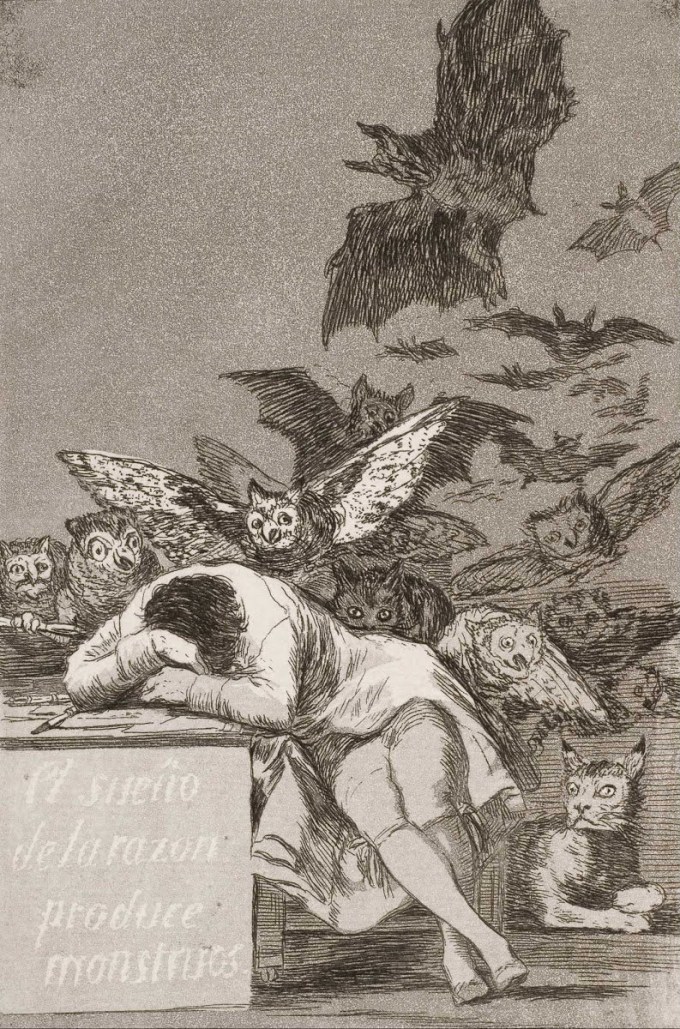
I mentioned ‘the sleep of reason’ in my last post. I had in mind Goya’s Los Caprichos print series, and specifically plate 43, ‘the sleep of reason produces monsters’. Owls gather above the sleeping artist’s head, no owlish wisdom here, just confusion, compounded by bats swarming behind – the owls lit, the bats unlit, and below two cat-like creatures look out, lynxes maybe, one directly at us, black and ominous, drawing us in.

By 1799 when Goya published Los Caprichos the high hopes of the Enlightenment had faded – his time maybe not too similar to our own.

Sleep of reason

Goya is clear that we cannot live by reason alone. ‘Imagination abandoned by reason produces impossible monsters; united with her, she is the mother of the arts and source of their wonders.’

We have in recent times been short-changed on both. Imagination looking back not forward, reason pilloried as ‘expertise’. And for many us, for the first time in our lives, we feel the tide of human improvement, I won’t say progress, is running against us.

Can music help? Leonard Cohen’s words from his song, Anthem, have helped me. (I love singing it!) Simply the idea that there’s a crack, however formidable the surface textures might seem just now, there is a crack. A crack in everything.

Rings the bells that still can ring/Forget your perfect offering/There is a crack in everything/That’s how the light gets in.

Applies to the whole Brexit edifice. And the Trumpian. We haven’t come so far that we could now go back. Surely not.

I see that the artist Sarah Gillespie has made ‘the crack in everything’ the title of a painting. Maybe I’ll make it the title of a poem.

And another artist, Turner Prize-winner Wolfgang Tillmans, quoted in the RA Magazine: ‘ …this amorphous, right-wing, nationalist sentiment … has become the central issue of world politics …how, as a sort of avant-garde artist, do you engage with the number one political subject?’

How does an artist respond? Or a writer? A musician?

Propaganda has its place, but propaganda and art are not easy bedfellows. Caricature if it points up absurdity, gross behaviour and the like has a powerful role to play. But not if it only appeals to the already converted. In the hands of Hogarth, Rowlandson and Gilray caricature becomes an artform in itself. But we must tread carefully.

What we can’t do, in our anger or frustration, is allow ourselves to abandon reason, to let reason sleep awhile.

‘Imagination abandoned by reason produces impossible monsters; united with her, she is the mother of the arts and source of their wonders.’