Beware converts

(reference article by David Goodhart in the FT Weekend, 18th March 2017)

Beware converts. Or better, conversions. People who change sides, as Ronald Reagan did, and I remember the one-time New Stateman editor turned right-wing commentator, Paul Johnson. And didn’t Melanie Phillips, she of the vitriol and the non-sequitur, once write for the Guardian? To switch abruptly suggests an over-simplification of argument, you switch from believer to atheist, you’ve seen the light, you’re St Paul on the road to Damascus.

The most important corrective is always to see the other side, to take it, argue it, from time to time. You don’t have to be a racist to argue in favour of restrictions on immigration, or an inveterate woman-hater to argue against abortion. Passions run deep in life and politics, especially when you’re young, and if you’re not passionate in your 20s then you ought to be. But if we’re looking to educate young people in citizenship, let’s also make that civility, and more than civility, empathy, and more than empathy, tucking yourself inside the other’s shell from time to time.

Why am I writing this? There’s a fine political commentator, David Goodhart, founder of one of my favourite magazines, Prospect, and he’s just published a book entitled ‘The Road to Somewhere: The Populist Revolt and the Future of Politics’. He divides the population very broadly into ‘somewheres’ and ‘anywheres’.  Anywheres are more mobile, usually university-educated, they have ‘high human capital, [they] will thrive in open, competitive systems and only be held back by prejudice or protectionism’. Freedom of movement, membership of the EU, will have obvious advantages. Somewheres are ‘more rooted, generally less well-educated… and prioritise attachment and security’.

It’s a helpful distinction. A typical urban community is disparate, and local communication minimal. A suburban or small-town or village community is more likely to be a community – to be more homogeneous, localised – and people talk to neighbours, meet up at sport clubs and the like.

So where’s my gripe with Goodhart? He wrote an essay back in 2004 about the tension between diversity and solidarity, he thought it uncontroversial, but he ‘met the intolerance of the modern left for the first time’. He was even accused of racism. (I’ve my own experience of this left-leaning mentality.) Goodhart now claims to have left the tribe – but he then describes it as ‘the liberal tribe that had been my home for 25 years’. [My italics.]

I’m a liberal, four square, and first and foremost I don’t accept I’m of the left, modern or otherwise.  Nor the right. Nor the ‘centre’, wherever that might be. I’ve long argued for compassion, caring (shared but interpreted differently by left and right) and community. As well as initiative and enterprise. ‘Big society’ ideas left me cold because they were top-down, and community is instinctive, bottom-up. (The downside of London life is the isolation. The upside of village life can be – well, is – almost too much community.)

(The ‘liberal left’ is a popular term. It’s where many people stand politically. But ‘liberal’ and ‘left’ are distinct terms, distinct political placements. And elements of the press love to emphasise the ‘left’, so ‘liberal’ gets pulled off-centre, and damned for being something that it isn’t.)

Goodhart also has this throw-away comment: ‘Ask English people at a middle-class London dinner-party whether they are proud of their country and they will get bluster and embarrassment.’ Maybe his dinner parties, not mine – and don’t rely on dinner-parties for your straw poll!

He sees himself as a centrist, open to ideas from left and right: ‘Indeed I am now post-liberal and proud.’ I’d argue that he’s now achieved liberal status for the first time, having shed old allegiances. He accuses liberalism of an over-reach that produced the Brexit and Trump backlashes. That I think is too easy, too cheap, and a touch cowardly. We’re back to being a convert, taking sides.

Goodhart is taking a risk by pigeon-holing and denigrating liberalism, arguing for a more woolly, inchoate alternative, where people fall back on the instinctive protectiveness of tribes, whether some- or any-where. It’s left liberalism that’s his target, but he’s risking bringing down a wider liberal mindset at the same time.

Liberals, in their Liberal Democrat guise, within and especially away from the big city have a strong community emphasis. That’s why pre-Coalition they were so successful as a local level – and increasingly are now.

Curiously it’s where I think Goodhart is headed. It isn’t a retreat from liberalism, it’s an avowal of all that’s best about it, and he doesn’t need to be throwing sops to the harder elements of the right-wing, which is what I fear he’s been doing.

Abandoning your ‘tribe’ carries big risks. You can easily get tainted by another.
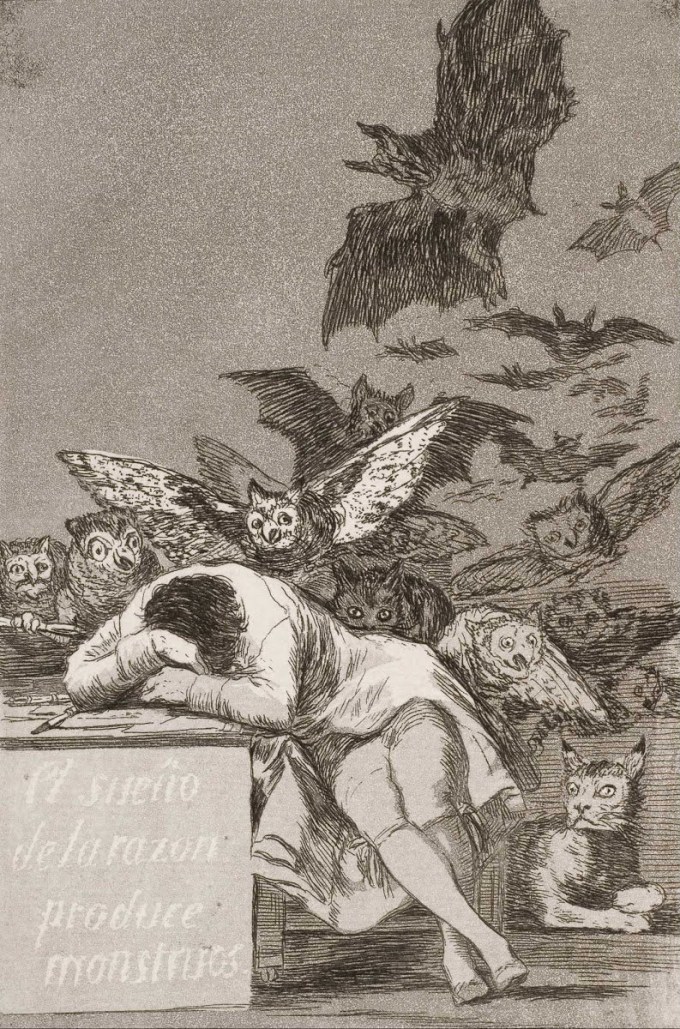
The sleep of reason (2) – Goya

I mentioned ‘the sleep of reason’ in my last post. I had in mind Goya’s Los Caprichos print series, and specifically plate 43, ‘the sleep of reason produces monsters’. Owls gather above the sleeping artist’s head, no owlish wisdom here, just confusion, compounded by bats swarming behind – the owls lit, the bats unlit, and below two cat-like creatures look out, lynxes maybe, one directly at us, black and ominous, drawing us in.

By 1799 when Goya published Los Caprichos the high hopes of the Enlightenment had faded – his time maybe not too similar to our own.

Sleep of reason

Goya is clear that we cannot live by reason alone. ‘Imagination abandoned by reason produces impossible monsters; united with her, she is the mother of the arts and source of their wonders.’

We have in recent times been short-changed on both. Imagination looking back not forward, reason pilloried as ‘expertise’. And for many us, for the first time in our lives, we feel the tide of human improvement, I won’t say progress, is running against us.

Can music help? Leonard Cohen’s words from his song, Anthem, have helped me. (I love singing it!) Simply the idea that there’s a crack, however formidable the surface textures might seem just now, there is a crack. A crack in everything.

Rings the bells that still can ring/Forget your perfect offering/There is a crack in everything/That’s how the light gets in.

Applies to the whole Brexit edifice. And the Trumpian. We haven’t come so far that we could now go back. Surely not.

I see that the artist Sarah Gillespie has made ‘the crack in everything’ the title of a painting. Maybe I’ll make it the title of a poem.

And another artist, Turner Prize-winner Wolfgang Tillmans, quoted in the RA Magazine: ‘ …this amorphous, right-wing, nationalist sentiment … has become the central issue of world politics …how, as a sort of avant-garde artist, do you engage with the number one political subject?’

How does an artist respond? Or a writer? A musician?

Propaganda has its place, but propaganda and art are not easy bedfellows. Caricature if it points up absurdity, gross behaviour and the like has a powerful role to play. But not if it only appeals to the already converted. In the hands of Hogarth, Rowlandson and Gilray caricature becomes an artform in itself. But we must tread carefully.

What we can’t do, in our anger or frustration, is allow ourselves to abandon reason, to let reason sleep awhile.

‘Imagination abandoned by reason produces impossible monsters; united with her, she is the mother of the arts and source of their wonders.’

Back to Brexit ….

A brief note – in the end not quite as brief as I intended! My reason for this post – to explain why I am not one of those who voted Remain but is now prepared to accept Brexit, to accommodate – accept that the vote has happened, argue we should make the best of it and get on with life.

A few reasons, in no particular order, as they say on Strictly Come Dancing, as follows….

The vote was won on a basis of a false prospectus and false promises. Even now – press headlines pick up James Dyson and Lord Bamford, two of the rare industrialists who supported Brexit.

We are a parliamentary, representative democracy, and we should live and die by that. Not be ruled by plebiscites, which are the first and last resort of populists and demagogues. (We currently have an unelected government, governing to its own and not the 2015 Tory manifesto, and which anticipates pushing Brexit through using the royal prerogative without, if it can help it, reference to parliamentary discussion or vote.)

The European Union is a remarkable institution. Unwieldy, bureaucratic, fractious, but it is the extraordinary coming together of 28 different nations, each passionate about its own interest, but likewise seeing the benefits, after two thousand years of conflict, of coming together. Our efforts should be concentrated on reform not withdrawal. (The EU has been pilloried for its poor handling of the refugee crisis, but I wonder how it could have been handled well, given all the fear and anxieties felt by 28 countries with very different histories. Had here been no EU, how would the crisis have been handled? With any less agony, any less suffering?)

A war which tore Europe and then the world apart ended only seventy years ago, a year before I was born. Before that another war, arguably even more terrible. We’ve had seventy years of peace, unprecedented peace. The EU symbolises and acts out that peace.

As an economic union, despite all the talk it’s a significant success. No serious economist would argue otherwise. Run a business which trades with other European countries, which I’ve done, and you’re aware of all the benefits. The danger is you take them for granted – assume they’d have happened anyway. There are also extraordinary levels of scientific, environmental and cultural collaboration, for which the EU has provided both the mechanism and inspiration.

The EU isn’t restrictive – unless you’re opposed to workplace and environmental rights. And we’re not going to do without the regulations by asserting our independence – if we want to trade with Europe, the regulations are the terms.

Where there is unnecessary red tape we need to be in there, ensuring it’s removed, instead of being passive observers. We are sacrificing engagement, and influence. We’ve used that influence well over the years.

Immigration is a perceived threat – where immigrant numbers are highest we had the highest Remain votes, where they were low the highest Leave votes. A perceived threat – nowhere near the actual threat that much of the press played up. Likewise no evidence that immigration has held wages down. Yes, pressure on schools and housing in certain areas – and the last government singularly failed to recognise that immigration, and other changes in our working lives, must be reflected in improved infrastructure. (Levels of immigration in recent years have been too high – I’m not arguing otherwise – and politically they’re unsustainable at this level. How you handle this while preserving freedom of movement is a mighty challenge, but not remotely a sufficient reason for Brexit.)

Behind immigration lies the identity politics, aligned with nation and race and social group, which we should be fighting every step of the way. Espouse patriotism not separatism. Patriotism based upon British values of openness, tolerance, free speech – and a tradition of welcoming strangers, bringing them into the fold, and letting them benefit our life and culture – blending in as countless immigrants have done before. Likewise refugees – there are limits of course, but our first instinct must be to welcome.

Related to this, the argument that British, the U.K., England, isn’t the country it used to be. The old generational cri de coeur. True, the pace is faster, and the landscape much impaired. But there have been many radical improvements, too easily discounted. As for the negatives –  the EU takes the rap. I may personally be in the old codger bracket, but I’m with the younger, pro-EU generation.

There’s a mood out there, encouraged by the right-wing press, and played along with by the BBC, that somehow it will all work out. In Philip Hammond’s words, there will be bumps in the road. There’s another much more likely scenario where we find ourselves out on a limb, with an agreement which is dictated to us, and which we accept out of necessity. The economic auguries are not good. Put simply, a crisis awaits us.

There is so much else that matters out there in the world which we were just about facing up to, and they’re now on the back burner in terms of government and public attention. Global challenges, new technologies, fundamental changes in our working lives. At home, infrastructure, the NHS – requiring focus and funding when attention is elsewhere.

We have a hugely inflated view of our presence and reputation in the world. We embody as a nation tolerance, free speech, we pioneered modern representative democracy, the world plays many major sports by rules we laid down. But this is Britain as was. Our current behaviour simply alienates.

To end, two further points –

I’ve mentioned openness above. We have always been open to the world, and the danger now is that we shut ourselves off. Look to the past. Seek one-off deals when others work together. Openness is state of mind, and in an atmosphere of fear and apprehension, in great part built up by the media, it is now challenged as never before in my lifetime.

In direct contradiction to Theresa May’s comments, whether we like it or not we are citizens of the world, citizens, along with all our neighbours, of Europe, and citizens of the U.K. My patriotism is undiminished, I’m British to my last breath, but I also share a common humanity  with every man and woman on the planet.

And finally – never imagine that the change you wish for works out as you anticipate.  It will not, and never has. Gut instinct will never provide. A wing and a prayer will never suffice.

I remember one egregiously daft piece imagining a post-Brexit Britain in 2025 by Daniel Hannan in the Telegraph. It was the stuff of dreams, and typified the dream world in which Brexiters exist.

Now isn’t the time to buckle under.

On the road 

Afoot and light-hearted I take to the open road,/Healthy, free, the world before me,  /The long brown path before me leading wherever I choose.              Walt Whitman, Song of the Open Road

Whitman walked, we’re driving. We’re in the USA. A far cry from the Camino. And yet….

We’ve not planned our journey, we don’t have expectations, there isn’t a goal. There’s no history along the way, the road is open, everyone and no-one has trodden this route before us. Encounters with God are accidental not planned. We don’t walk or shuffle, we drive. Our minds picks up the blisters, wheels the wear and tear, not our feet.

We travel in a straight line, travelling west, heading for the sierras and the ocean. America travels in straight lines. Or back east. Start in New York, or California. Route 1 or Route 66, or the Pacific Coast Highway. Keep travelling.

The hobo, riding the blinds… rootless … looking for work: ‘I’ve been doing some hard travellin’, as Woody Guthrie sang.

The Beats by contrast had it easy. Kerouac was out of Columbia University. But like the hobos they were footloose, in mind and body. Searching for God, as Kerouac put it, not work.

Heirs of Whitman, and Emerson, and Thoreau. Even John Muir, though the Beats travelled the road not the wilderness.

They’d escaped the impact of war, the road network arrowed across America, an invitation, the cars that travelled it were streamlined. How lucky and how unlucky they were. War and its aftermath were three thousand miles away, too young to fight or worry, they didn’t have to agonise over combat or parade a political conscience. They were beyond their upbringing… drugs and sex came easily. And jazz. California Zen was a convenient religion – Dharma Bums as well as On the Road.

The Midwest and California have their own dreams and myths. The Beats were originally out of New York, but found California. California lifestyle reinterprets America. Putting up a different dream against New York. Not a Hollywood dream. Precursors to hippies, but they didn’t seek to change the world – not just yet. Challenge because they couldn’t help it – witness the obscenity trials – but not change it. America was their head space, not a place beyond.

They could be measured, a little bit lyrical:

‘Nothing behind me, everything ahead of me, as is ever so on the road.’ (Kerouac, On The Road)

And out of their minds:

‘I saw the best minds of my generation destroyed by madness, starving hysterical naked,/dragging themselves through the negro streets at dawn looking for an angry fix,…./who passed through universities with radiant cool eyes hallucinating Arkansas and Blake-light tragedy among the scholars of war,/who were expelled from the academies for crazy & publishing obscene odes on the windows of the skull….(Howl, Ginsberg)

And as for me…

It’s 1971 – I’m on the open road, on the Beat trail, starting in New York, ending in California. A road journey, yes, but no automobile of my own. And I’m not hitch-hiking. Taking Greyhound buses city to city. The bus has its own iconography. Bus stations, hostels, camping out with friends in New Jersey, Toronto, Atlanta, Colorado, San Francisco, San Diego. Sleeping rough in Chattanooga. I couldn’t listen to music – but I could read. So Whitman and his streams of consciousness my companion. And Albert Marcuse. Mine was a counter-culture. I might teach history on California, but I wasn’t planning to sully myself with any other work along the way. No encounters with God, but charity from a Baptist preacher who paid for my breakfast and invited me to lunch with his family – but first I must attend his Sunday morning service, and hear him preach.

The long road north out of Texas, straight and parched and empty. Colorado I sensed was still Indian country. San Diego: we were all still hippies at heart. Barefoot and beaten by the sun. I could have tried surfing but instead I headed south, took to the road again, to Mexico. But the Mexicans wouldn’t let me in. Hair too long. Strange irony. They weren’t sure they wanted me back in America either. They cut back my visa to one month. I returned to Mexicali my hair shorn and my ears, unaccustomed to the sun, grew burnt and blistered, as I headed south to Oaxaca, the Yucatan and Chichen Itza.

Did the road came first, or the need to travel it? The road without destination, always going somewhere. Road movies aren’t about physical, but personal destinations. About setting out and avoiding arriving. Not seeking self-knowledge …but maybe achieving it. Though not knowing what to do with it.

My trip was my own road movie, before they invented the genre.

The road’s just one agenda for America. America has multiple agendas, it’s own powerful myths and images, but they have a kind of surface quality. Still a dream. Europe has multi-thousand years of history interwoven into its structures, artefacts and traditions. They root us, define us, hold us back and lift us up – America isn’t tied down – it looks for, loses, its way, finds it again.

James Dean on the one hand, Howl on the other. Drugs, sex, Zen … they are unto themselves, not adjuncts of another culture, a music, a street culture.

I’ve avoided the noise and anger and foolery of America for a while. But I’ll go back. Maybe because there’s no place for complacency – and no place for rebellion – quite like it. It has open spaces, and straight roads, and you can still be alone there. And the skies are big. And there are millions there like me. Chugging along, rebels at heart.

Mindfulness – the year’s most depressing trend

I chanced on a Telegraph article from last year – mindfulness ‘the most depressing trend of 2015’. And a headline I saw this week – ‘mindfulness is boring’.

I could spare myself the occasional read of the Telegraph, but I treat it as a penance. And the sport can be very good.

The Telegraph journalist from last year admitted she was only after a quick fix but felt qualified to opine that there was a ‘bigger, scarier point’. ‘Why are so many of us living lives we feel unable to cope with? How is it that we are so unhappy with our lots that we will willingly sit cringing in a room with our colleagues while remembering to breathe?’ She interviewed a wide variety of people for the documentary she was making, ‘even Buddhists’.

I am, I have to be as the author of this blog, a charitable soul, but the sheer inanity of her remarks take some beating. If I’m unhappy – it’s with this sort of drivel – the Brexit quick-fix mentality. If you want to find out how afflicted many of us our with our lives – read the Daily Mail.

Life is a slow burn, and if we could all give ourselves time to breathe, to show compassion – to be mindful – we’d be a million times better for it.

The Plough and the Stars

Were I to write a review of the Sean O’Casey’s The Plough and the Stars, which I saw at the National Theatre last night, ‘bloody marvellous,’ might do it.

Intense, overwhelming, the agonies of Nora, which destroy her, and death of Bessie Burgess, shot by a British soldier who thinks she might be a sniper – they are sustained, stretched out, they leave the audience on a knife edge of emotion, they’re heart-rending and overwhelming. I felt when the lights went up at the end that I’d been an intruder, an uninvited guest, wanting but unable to intervene. This was not a time or place to applaud. (But of course we did.)

Curiously, one reviewer thought the play ‘so heavy going and full of crude stereotypes’ that it’s hard to care about the characters. Michael Billington, in the Guardian, on the other hand, got its measure: … once the play starts to exert its grip, it never lets go, and leaves you shaken and stirred’.

How an audience could fail to be stirred by this production – that disturbs me. Are we so inured to passion and poetry? So stultified by the easy emotions of endless evening soaps that we can’t distinguish real emotion – the real emotion of great theatre – from its cheap substitutes?

Let O’Casey have his say in the subject.

“The beauty, fire and poetry of drama [he’s writing about the early 1930s] have perished in a storm of fake realisms. Let real birds fly through the air; real animals roam through the jungle, real fish swim in the sea, but let us have art in the theatre. There is a deeper life than the life we see and hear with the open ear and the open eye and this is the life important and the life everlasting. So to hell with so-called realism, for it leads nowhere.”

He doesn’t mind going for the jugular, he’s not afraid of big characters and big emotion – and in The Plough and the Stars he gives the roles that rend the hearts to women. This isn’t a play about the front line – that’s around the corner, down the road, at the General Post Office. The confrontations, the aggression, are at home and in the local bar. Long after the event O’Casey reflected on his own life, and explained his aggression:

“I have lived a troublesome life in Ireland, in my youth hard times in the body, and in my manhood years, a hard time in the spirit. Hardship in my young days taught me how to fight hard, for if that characteristic wasn’t developed then, it meant that one became either a slave or a lick-spittle…. “So I learned how to resist all aggressive attempts to make me a docile one, and could hit back as hard as he who could hit hardest. This gift (for an earned gift it is) kept within me when I reached the world of thought as it had been in the world of hard labor – at times, I fear, fighting what I thought to be aggression where none was meant.”

‘…at times, I fear, fighting what I thought to be aggression where none was meant.’

Almost a throwaway line. I’ll always (this is ‘zenpolitics’ after all) argue against anger and aggression, and argue for facing up to it as soon as it arises. O’Casey faced up to it after the event. But given there are no perfections in life, and that theatre – as well as quiet places (walking maybe by the Liffey) – should always play its part in human existence, then I’m almost on O’Casey’s side. Sometimes anger simply does overwhelm. Better to realise that later (as O’Casey does!) than never.

And if one result is great drama, great theatre – well, should I be complaining?

[Quotations above taken from the New York Times O’Casey obituary.]


Truth isn’t indivisible

…it’s in the eye of the beholder.

Truth, as seen in the context of the referendum.

It’s suspect, handed down from above, seen as establishment truth. People came to distrust all facts as ‘handed down’. False information, rumour, scandal came to have the same status as facts.

Deliberate manipulation of the news, by mis-statement (the NHS £350 million), or by presentation (the infamous UKIP refugee advertisement).

The Remain campaign tried to fight fantasy with fact, ‘but they quickly found that the the currency of fact had been badly debased’.  (Katharine Viner.) Facts were labelled as Project Fear and ‘quickly neutralised by opposing facts’.  ‘This is a disastrous mistake that ends up by obscuring truth, and echoes how some report climate change.’

The BBC were, sadly, a prime example of this tendency.

Viner also refers to the way that many news organisations have ‘steered themselves away from public-interest journalism and toward ‘junk-food news’. Chasing readers, chasing advertising, and for online readers chasing clicks. What is equally worrying is the mixing of the two, apparently hard news with sex and scandal.

Hard news has to function in the same way – as scandal. Minimise the effort required of the reader.

Truth isn’t sufficient unto itself. It needs a helping hand.

Wearing blinkers

The news media took over the referendum, the two were made for each other. But whereas it was banner headlines for the tabloids, reinforcing opinions and prejudices, social media worked in a different way.

Katharine Viner in a long article (‘How technology disrupted the truth’, 12th July) in the Guardian focuses on the social media ‘filter bubble’ and the way Facebook is designed to ‘give us more of what they think we want … our own personal stream has been invisibly curated to re-inforce our existing beliefs’.

Viner as a Remain supporter couldn’t, the morning after, find any comment on Facebook from anyone happy with the result. And they were out there – with a vengeance. Many of us I know had the same experience. Despair and tears.

Social media also reinforced opinions and prejudices, but in a subtler and entirely private way. Compare the tabloids: everyday I could check the headlines on news-stands if I chose. And still do. But no-one but me knew what my Facebook pages were saying – unless I chose to share.

Many Remain supporters were too much inside their own bubble, protected from the anger and resentment in town and country. They underestimated what was driving the Leave vote deep down. In that way social media may have had a significant influence on the referendum outcome.

None of this justifies the way the tabloids set out to inflame, distort and misdlead. But they were tapping into something at a deeper level which many social media users just didn’t understand.

Two separate worlds. They didn’t connect. Do they now?

Wimbledon, Cameron, China, Chilcot – a few thoughts for our times

Wimbledon: Andy wins in style, and for once an afternoon watching a Wimbledon final doesn’t extend into the evening. I’m remembering Federer against Nadal, was it five years ago – rain breaks and five sets…

Andy mentioned that the prime minister was in the crowd and asked almost as a throwaway – who would want the PM’s job? Should we just occasionally give politicians a break? Even the PM? He’s made a life-changing (for all of us) mistake, but he’s kept his cool, and laughed when Murray made his comment. I almost felt I could forgive him.

And tomorrow (13th July) he’s out for ever.

*

Other thoughts for our time…

‘Few middle-class Chinese people say they want democracy.’ (The Economist) Three possible reasons. For one, memories of Tienamen Square: economic freedom it seems doesn’t require political freedom. For another, the Arab spring – the dangers of insurrection.

And Brexit, yes, Brexit.  ‘A sign that ordinary voters cannot be trusted to resolve complex political questions.’ Another good subject for discussion. One riposte – only ordinary people can be trusted.  And who are ordinary people these days. The proletariat is no more, and they weren’t it turned out very good at dictating. And the Economist’s big feature is on China’s new 225 million middle class. And then we have readers of the Daily Mail.

*

One conclusion from the Chilcot Report: politicians should beware commitments which catch up with them later. Applies to Cameron of course. But Brexit supporters have put out all sorts of promises and expectations – with little chance of delivering on them. But you can get away with promises.

Also, beware plans based on best-case scenarios, which is what Blair and Bush worked to…They may get support in parliament (2003) – win elections – and indeed referenda (2016) – but they can come back to hurt and haunt you.

*

Mendacious campaigns – which side in the referendum debate was more mendacious?Unwise forecasts (which nonetheless could be right) based on Treasury models from the Remain side, which weren’t believed. But not mendacious. Promises with almost nil substance on the other side. Given they were presented as probabilities if not truths by the Leave side – I’ve no problem with the word mendacious in their case.

If we delay invoking Article 50 – how favourably will other countries respond? We’re still – the Leave side are – in a dream world, laced with false expectations. The EU countries’ point of view? Keep Britain trading and halfway prosperous, yes. But at the same time demonstrate that you don’t get way with being a turncoat. And remember too, the cards are all in your (the EU’s) hands.

To take just one example. Paying in – we stop paying – and yet we expect the same benefits.  Absurdity. The something for nothing culture – which the Brexit side in other circumstances rail against.

*

And finally – ‘groupthink’. ‘When Mr Blix’s inspectors failed to find any WMD the JIC (Joint Intelligence Committee) gripped by groupthink put it down to the Iraq’s talent for subterfuge’. We reinforce each others’ opinions, if one of us believes, we make it easier for the others. We’ve been gripped by groupthink these past few months. The ‘somehow it will all turn out right, because it always does’ school of thought. Nearly always. Sometimes. Or, more realistically, never….

Another day and another …

… and another. There is no end in sight.

A febrile and emotional atmosphere, 150,000 Tory members out in the shires with the final decision on the new Tory leader. They will represent the nation. Even more so since there’s no new parliamentary election planned.

And once the leadership election is over, the big question – whether to invoke Article 50 sooner, or later.

The general disruption and shenanigans on all sides in the meantime will keep us in a state of both panic and amusement.

Quite where Labour will end up is likewise impossible to predict – a separate but related battle in its own right for the soul of the nation – who in the end does Labour represent?

Those who visited this uncertainty and foolery on us will be pilloried by history. Boris has now departed the scene, but he bears a heavy responsibility. He paraphrased Brutus in his recent withdrawal speech: ‘A time not to fight against the tide of history but to take that tide at the flood and sail on to fortune.’

If the tide for him is Brexit, a withdrawal and a ‘glorious future’, he should reflect on the fate of Brutus (he took his own life) and how futile his gesture in holding back the imperial tide.

Back to reality …

Peter Wilby in the New Statesman: ‘… the European project that led to the EU was – and in some respects still is – an an attempt to embed humane and liberal values so deeply that the nightmare [of war and violence] could never be repeated.’

That remains my view as well, but obscured and obfuscated by reactions (some valid, some not) against elites and establishment, against authority and expertise, against neglect and ostentation, post-industrial decline and globalisation, together with …

false perspectives on the past, colouring absurdly-imagined perspectives on the future (Daniel Hannan being one such errant dreamer),

neo-liberal attitudes and policies which with Ayn Rand lurking as a ghost in the room will only make division worse,

immigration and refugee crises, again with deeper issues, this time regarding population movements, tucked away in the shadows.

The optimism and open hearts of younger generations against the certainties of age, idealism against anger and cynicism. (We will need to reduce the voting age to 16, and maybe younger (!), to counter the increasing numbers of the elderly.)

Not forgetting the dangers of referenda, of populism, of a popular press in the hands of barons who bought their stake in the national debate. The triumph of mendacity and misinformation. The dangerous subjugation of parliamentary democracy, which is slow burn and should always be so, to the politics of the moment.

It’s one hell of a mix. To quote Wilby again: ‘Now new monsters, more frightening than Johnson or Farage, emerge across Europe to challenge those values. I was confident that none would acquire serious power. Now I am not so sure.’

We are fighting chimera and obsession and absurdity when there are big issues out there – population, the future of work, the fairer apportionment of resources, and much more, not to speak of the violence and hatred which are always looking for fertile ground in which to take root – they should be our focus.

Working with international bodies – the UN, and the EU, and all the others forums where we get together and talk. The very existence of such forums, in the wider context of history, is a miracle in its own right.

Matched against this there’s the gathering of Beaconsfield Conservatives shown on the news last Sunday (3rd July), so pristine, chatty, engaged in discussing the rival merits of candidates for the leadership), and all so far removed from reality. It might have been a garden in September 1939.

I’ve always loved politics and political discussion – but do I enjoy walking on a tightrope over a precipice?