Messages home from the Camino Portugues

or …… Travels with a very small bear

This is the alternative blog – based on messages home to my partner, Hazel. Carlos, by the way, is a small Steiff bear she gave me before I set off on the Camino Frances last year. He sits, usually with his head out, in a small side pocket of my rucksack.

Wednesday 31st August:

Eating a very good octopus and bean stew after a stroll round the very lively streets of Porto. One girl belting out an Eric Clapton blues. Marvellous evening views of the river from the cathedral, the port houses of the likes of Cockburn and Sandeman still lining the shore. Hotel OK. I’ve bunk beds in the room as well as double bed – should I need them!!!

Thursday 1st September:

I’m sending a photo of Carlos (now on his second Camino!) taking in the view (the Atlantic, lost in the heat haze) just before we finished our walk. We (he and I!) are staying at the monastery in Vairao – beautiful location. Countryside surprisingly green, given the hot weather. Walked 17 miles in the hot sun.

image

Started 10.30, after exploring Porto by daylight, especially the cathedral – I loved the cloisters. Slept well and walked well. Only problem might be a plantar fasciitis recurrence – felt sore even before of started walking. Not bad, doesn’t really hurt… Staying in the high 80s here. I think I like it! Carlos thinks Portugal is …cool!

image

Friday 2nd September:

18 miles in 88 degree heat. Yes I did wear my sun hat! Shade always came to my rescue. Eucalyptus woods have a sweet smell! Two great cafes en route – they love peregrinos and make you feel like a celebrity. Barcelos is delightful – somewhere for you and I to visit when we do our northern Portugal trip!! (Did you know about that?) Tomorrow – 20 miles and no cooler – I’ll probably do 12 miles [I didn’t – I did 21] and stop off at an earlier albergue. Ponte de Lima does sound special.

There’s a spiritual quality in all this, somewhere, must remember that, and too much mega hot sun doesn’t help! Don’t worry – I will be sensible.

Saturday 3rd September:

Today probably the toughest of any Camino day – close on 21 miles in 90 degree heat. Took a longish lunch break, mega amounts of water – camels have a good plan, and did the last three hours down to Ponte de Lima in stages – 15 mins then water, then shade. Think feet OK, but they’re sore, and a blister needs watching! Wonderful rolling wooded country, maize and vines in abundance, but too little shade. Carlos complains he’s getting a tan! …Tuesday forecasting 40 degrees here – over 100F. Won’t walk after 10 – will begin at 6 maybe and make it a short day! [That at least was the plan!]

image

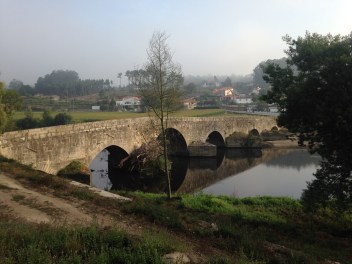
Ponte de Lima beautiful and bridge medieval, long and narrow, for pilgrims and horses, but the whole place is touristy. Currently sitting outside after a shower (communal!) and drinking a local craft beer….

Sunday 4th September:

Got to Rubiaes about midday after five hours walking – and that is enough! Sheltering in the albergue, as is everyone, no-one daft enough to be out there walking! Wonderful walk from the Lima valley – a high pass only 1400ft but rugged and the sun already hot. They’re collecting pine resin from the trees – plastic bags attached to capture – so a sweet smell. And big views. Hot tomorrow again – aiming for the Spanish border…[News that Strictly Come Dancing has started already]… God help us all! They’d all die dancing in this heat… Planning a 6.30 start – not too early – Roman bridges don’t look special in the dark!… Flip-flops a big success. Sore left foot no longer sore! But sore spot on right foot. Such is life!

image

Monday 5th September:

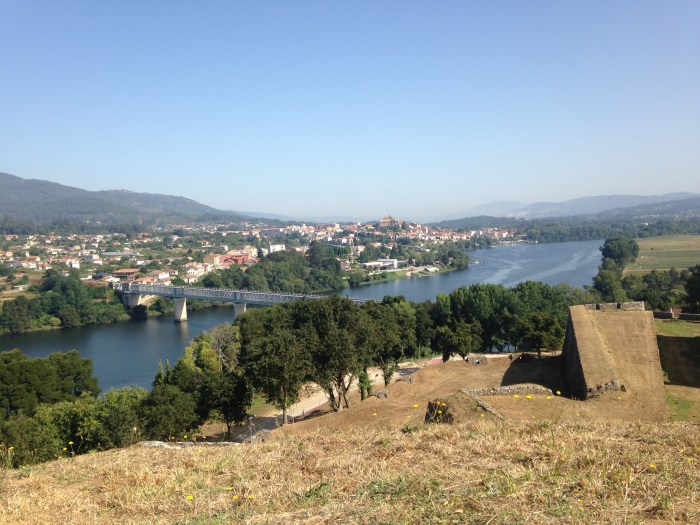
Having a coffee in Valenca, fortress above the Minho – view upriver takes some beating! Left at 6.10, arrived 11.30. Off to Spain in a few minutes – just 2km to Tui….
image

Now well-settled in Tui. Mixed dorms but we’re spared mixed showers! Breakfast with eccentric ex-postman from Wigan and chatted to Polish guy who has his own travel magazine, takes own photos and hates smartphone cameras! Otherwise I’ve been swinging along through beautiful country, Roman bridges – it was once a Roman road, wooded paths, a few red-barked cork oaks, and singing, and happily lost in thought – walking as the good Lord meant it to be. Heat building, but OK. Tomorrow is the mega heat day – should I leave at maybe 4.30? Could be 2 hrs walking in the dark… Time now an hour ahead – funny gaining an hour going north. Mega hot out there – can it really be that tomorrow will be 6 or 7 degrees hotter still?

Tuesday 6th September:

Our international party, Polish photographer, Antonio, Czech student, Michaela, and me, walked 22 miles from Tui to Redondela, leaving at 5.40 and arriving 2.10, in 97 degree heat. Feet done in but otherwise beginning to recover, aided by beer, water, bread and cheese. We kept talking and and helped push each other along. On my own – would I have made it? Other people on the Camino today included – more Poles, a group of Spanish scouts, and a Mexican couple. No Brits save me!… [Tomorrow] heading for Pontevedra. Easy walk, I think. Assuming I can walk! Feet in rebellion!…

[Message from home: ‘No Brit would be mad enough to walk in that heat.’] Are you suggesting I’m not British?! I’m not one of your lily-livered Brexiters! Antonio called out a moment ago – ‘How is Brexit?’ (meaning me) ‘Do not call me Brexit!’ I shouted back. Such are the burdens we old-school Eurobrits have to bear!

Talking of bears, Carlos got some serious attention today – he’s feeling better about things. Brave bear – coping with the heat. And I’m doing the walking for him, of course.

Wednesday 7th September:

Arrived Pontevedra 12.45, having left at 7.40 – last person out of the albergue. Most are gone by 6, but sunrise 8.10 here, and I want to see where I’m walking! Easy day, two healthy climbs, but sun came out late and I had my favourite breakfast – fresh orange juice, croissant and café con leche. Bounced along after that. Lesson for and from today – think of nothing, just take it all in! Staying in a cheap hotel – Hotel Virgin del Camino – better than vergin’ – it’s actually on the Camino! Now off to eat and sight-see.
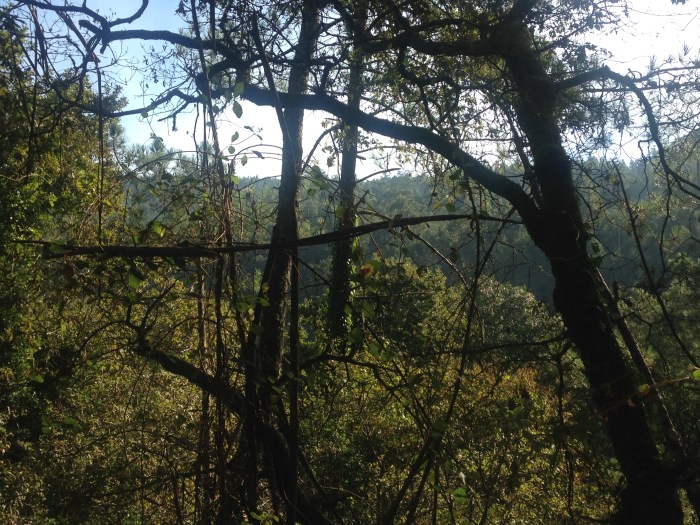
image

Carlos’s fur trapped in zip but I think he’s OK…[‘Might Carlos like his head out of the rucksack, so he can enjoy the views…’] Carlos does have his head out of the rucksack, all the time. Only the rain would keep him in. Sometimes he stretches out a paw and waves as well!… I loved Pontevedra but wandered around too long, and my feet are very sore…

Thursday 8th September:

Arrived Caldas de Reis at 12.15 – walked non-stop from Pontevedra, not far short of 4 miles/hr pace. Too many slow Spanish walking groups and I needed to get well away from them! They talk! Beautiful gentle country, bright sun, and temperature high 60s. That makes two happy bears – Carlos tambien! Wondering whether to call him Carlito – little Carlos. Ibuprofen and blister plasters helping – feet doing better than I expected. Now enjoying bread and tapas lunch!… Amazingly I’m now halfway through this jaunt!

Friday 9th September:

Arrived Padron 12.30. Enjoying a very good menu de dia in a local restaurant! …very modern albergue – bunk beds with curtains! Big plus – they’ve done all my laundry! Shortish but beautiful walk – oak, pine, chestnut, under a deep blue sky. Chilly first thing. Bumped into Martin, who I’d met in Tui, and we did a short tour – walking up the hillside to where St James [doesn’t sound right if you’re a peregrino – has to be Santiago!] is reputed to have first preached the Christian message in what must have been about 40AD. Martin an Irish Catholic so a good companion for this! House/museum of a legendary Galician poet – Rosalia de Castro – up the road so I trekked off for a visit. Early start tomorrow – will be tight to get there in time for midday mass.

Saturday 10th September:

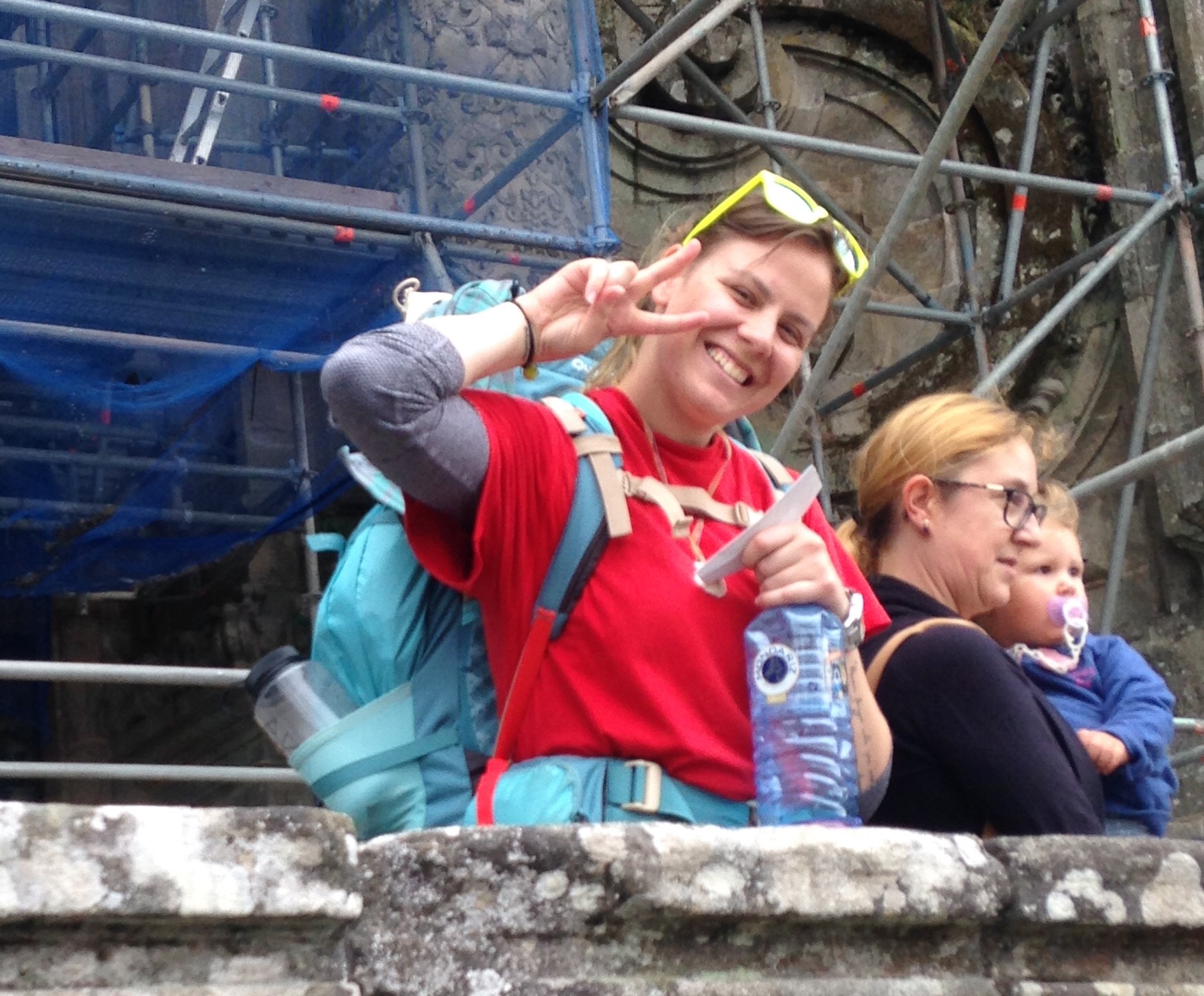
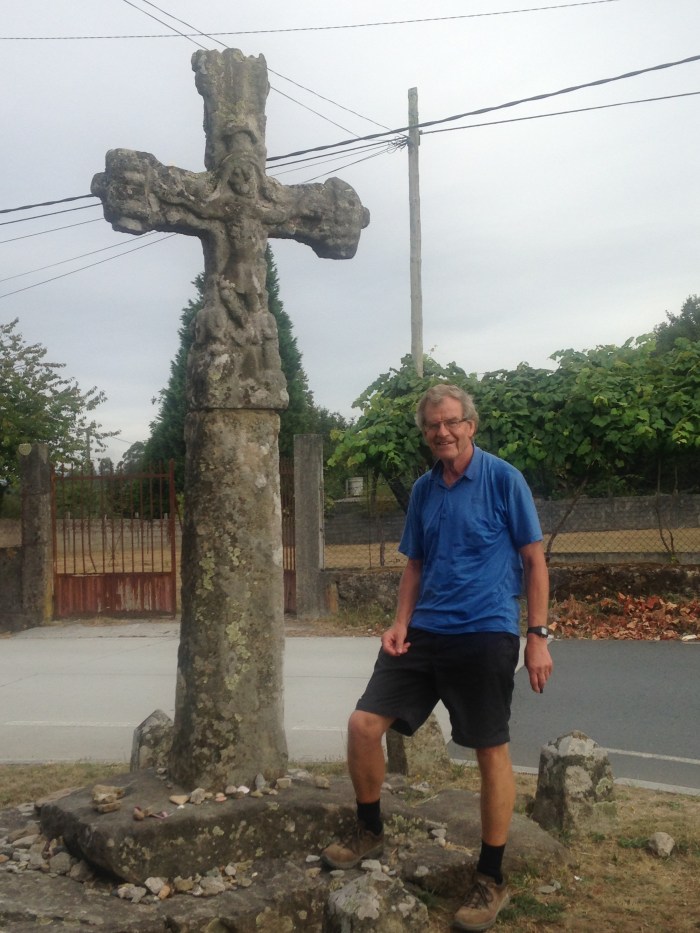
Photo [sent home, to Hazel, and to my son and daughter] taken a moment ago, 10.30, local time, 8 miles out from Santiago [I’m looking remarkably sprightly, all considered!] …
image

Arrived to music and carnival an hour ago. A mere 16 miles this morning and I chose to explore the longer way in – being a glutton for punishment (and I knew I’d missed the mass). Once I start moving I do walk fast – all that running and marathons and the like. Wonderful place to be – on the steps above the Praza do Obradoiro. Met my Czech friend, Michaela, from our big walk from Tui. Big shout of – Chris! Antonio around somewhere. And others I recognise – we’ve all walked a long way!

image

Sunday 11th September:

Mist down low over Finisterre [I took a bus, and did feel a bit of a cheat], there’s a little overhead sun but wherever I walk I won’t see much. Maybe it will add to be mystery, and there’s a lot out there….

The mystery is now the view, on a perfect evening! The mist cleared over the last hour. This is where you would, in classical times, pass over the horizon, to the other side, to the spirit world. No-one is closer than I am at this moment. Back in the now – you’d love it here – sun, sea and waves breaking gently. And warmth….  a wonderful day, in the end. I’d set out for the cape  about 4pm and walked and scrambled and stopped and pondered and took photos till about 8.30. Magic, all a big surprise. No idea what I’ll do tomorrow. Just got back to the port (the cape is 2½km away) and I’ve a plate of salad, and a jug of wine, in front of me….

image
View from Cape Finisterre

Monday 12th September:

Damp, cloud down, forecast dreadful, no point walking 17 miles to Muxia [there will be, has to be, another time!], left Finisterre on an early bus, back to Santiago, thought I’d go to midday mass, but refused admission – my rucksack too big! Must have been by a centimetre! Maybe I look dissolute. [Tonight in a cheap hotel] tomorrow back at my favourite, the Balalada. So far a bit of a damp squib of a day!… Bought a shirt, so feel less scruffy, had a snooze, and a coffee with Martin … wonderful evening mass, felt inspired. A bit of a downer of a day early on but you can’t have the ups without the downs! Tomorrow it will rain, but I will smile!

image
View from my bedroom window over Santiago

Tuesday 13th September:

Sitting on the steps of the Praza do Quintana, near the Holy Door specially opened this year for Pope Francis’s Year of Mercy. But it seems to be just another entrance for the usual tourists – the message lost. Pilgrim mass in English this morning, lots of Irish, and an Irish priest officiating. We all introduced ourselves, said where we’d walked from – which was nice. Then I toured the monastery of St Martin, hard by the cathedral – full of altars and choir stalls which put San Millan to shame – but nothing quite to compare with the sculptures of Santo Domingo de los Silos. Galician (!) hamburger for lunch, with Stones tracks in the background. Sun now, after rain, but a chilly wind. Latest invasion of pilgrims has arrived – they’re everywhere! Each day they invade – proud to have been one of them. Funny to think – back home tomorrow night.

Wednesday 14th September:

Wrote a Santiago blog late on yesterday – still work in progress. But now fired up to get out and see things again! Funny being on your own – you can go anywhere, anytime you choose, yet you want to share it, and share coffees, and chat, as we did back in May [Pamplona, Roncesvalles, Castrojeriz…].

[Two big events, not mentioned in messages home – searching out the statue in the Alameda park of Rosalia de Castro, who is already my hero, and then the Museum of Sacred Art, with paintings and statues and much more on the Camino and on pilgrimages worldwide – few people there, and yet it’s one of the best museums I’ve seen anywhere.]

For cool damp weather, come to Santiago… Now queuing to board my flight…Bus to the airport took me via the last stages of the Camino Frances route into Santiago. Everyone wearing ponchos, and the rain then got harder. Lots of sun for them on the way – shame that Santiago lets them down now. But if they don’t know already – they’ll soon discover it’s one of the most remarkable places on earth!

[Carlos, sensibly, has stayed all the while inside his pocket!]
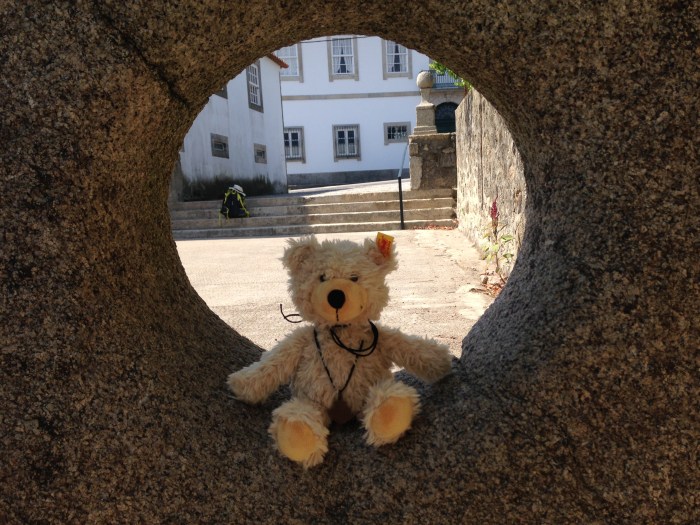
image.jpeg
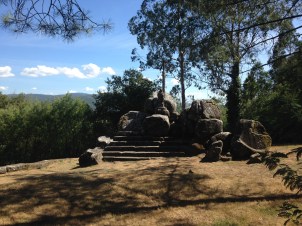
Carlos takes a break at Pedra Furada


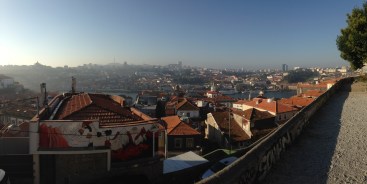
It’s Thursday 1st September. Two weeks ago as I write. I’m starting from the Catedral Se in Porto after delaying awhile, with the heat building, in the wonderful cloister. A city built on hills, with the proud river Douro beneath, big vistas, and along its banks the old port warehouses of Cockburn, Sandeman and the like.

(Amazing in the twilight also – the previous, Wednesday, evening. Porto faces west, and silhouettes against against the sky. Street music I like: one memorable trio, with the girl belting out Eric Clapton’s ‘Before you accuse me’. If I want to sing blues and sing it seriously… I’ve a long way to go!)

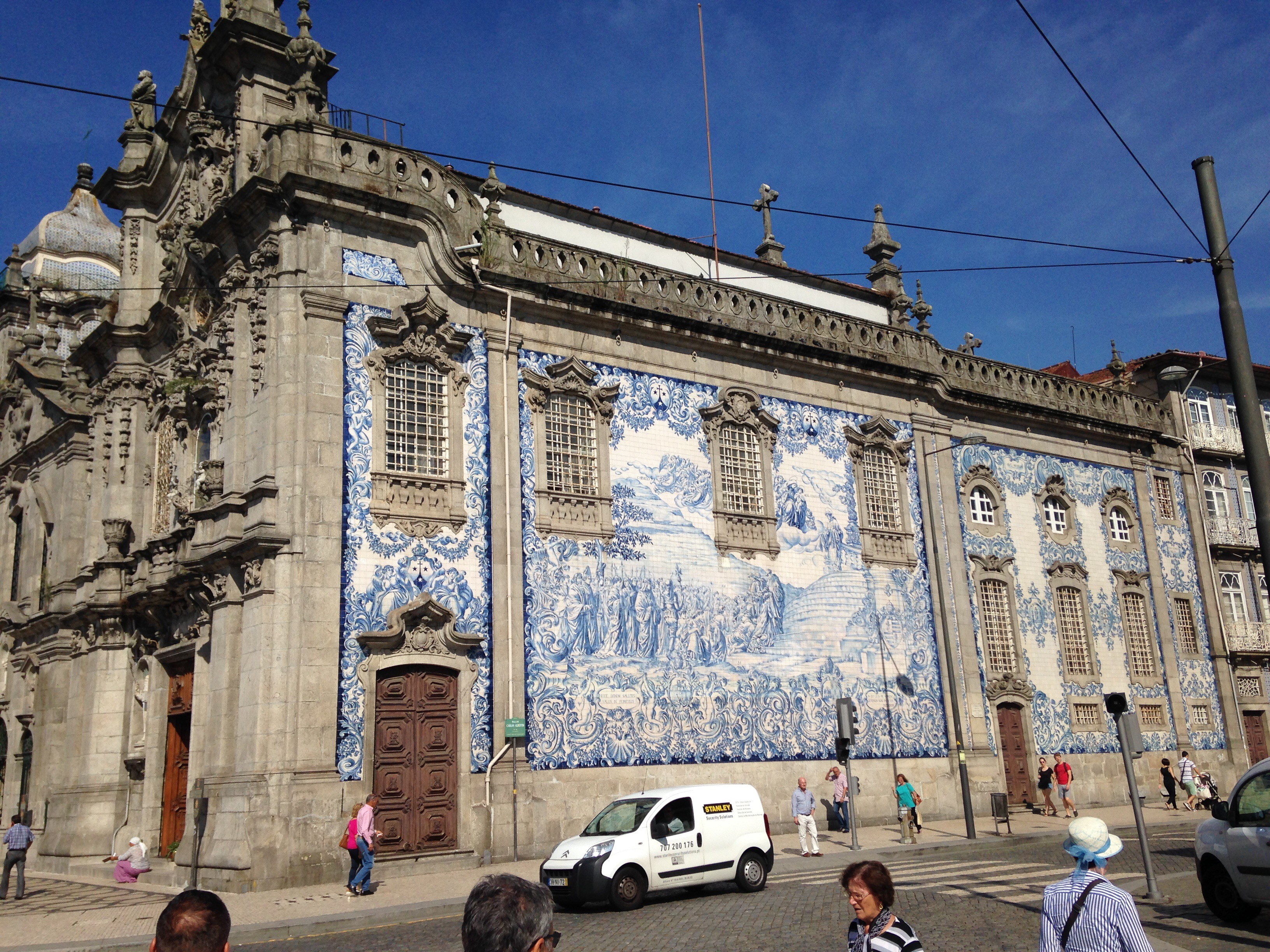
10am and sun already hot as I set off past the Carmelite church (the south side covered, and telling stories, in blue azulejos tiles), along the Rua da Cedofeita, which seems to contunue forever, and on through the suburbs. I haven’t gone far when I’m accosted by a stranger and invited to inspect a newly-opened albergue (Albergue Peregrinos Porto), which brings together under one roof all the best features that Oscar, the owner, has seen on his pilgrim travels. Next time I’ll stay there.

    img_9587-2

All the buildings, almost, have azulejos tiles, not least the station, and they tell stories, and the cathedral cloisters likewise, less so the outer suburbs. After maybe 12 miles of endless roads I’m into countryside, and a few miles beyond I’ve reached Vairao: staying in a monastery, beds not bunks, and it’s oh so wonderfully peaceful. No monks in sight, and there’s a single volunteer in charge – a Brazilian guy doing a two week stint. The meditation room I’m told is two flights of stairs up. No lights on the stone stairs: I stagger up in the total dark, and flick the light switch: Buddha and cushions but no sign of anything Christian! Yet this is a monastery. As a Dutch lady said to me a day or two later, she loves it all, but compared to the Camino Frances it’s not spiritual in the same way. Being a Camino, that spirituality has to be rooted in Christianity. Churches on the route are closed too often, and I miss the pilgrim masses. And the Templars, and Cluny, never got to work down here and put money into anything like the great Romanesque temples I love on the Camino Frances.

All that said – still an amazing trail to be following. Comparisons maybe miss the point!

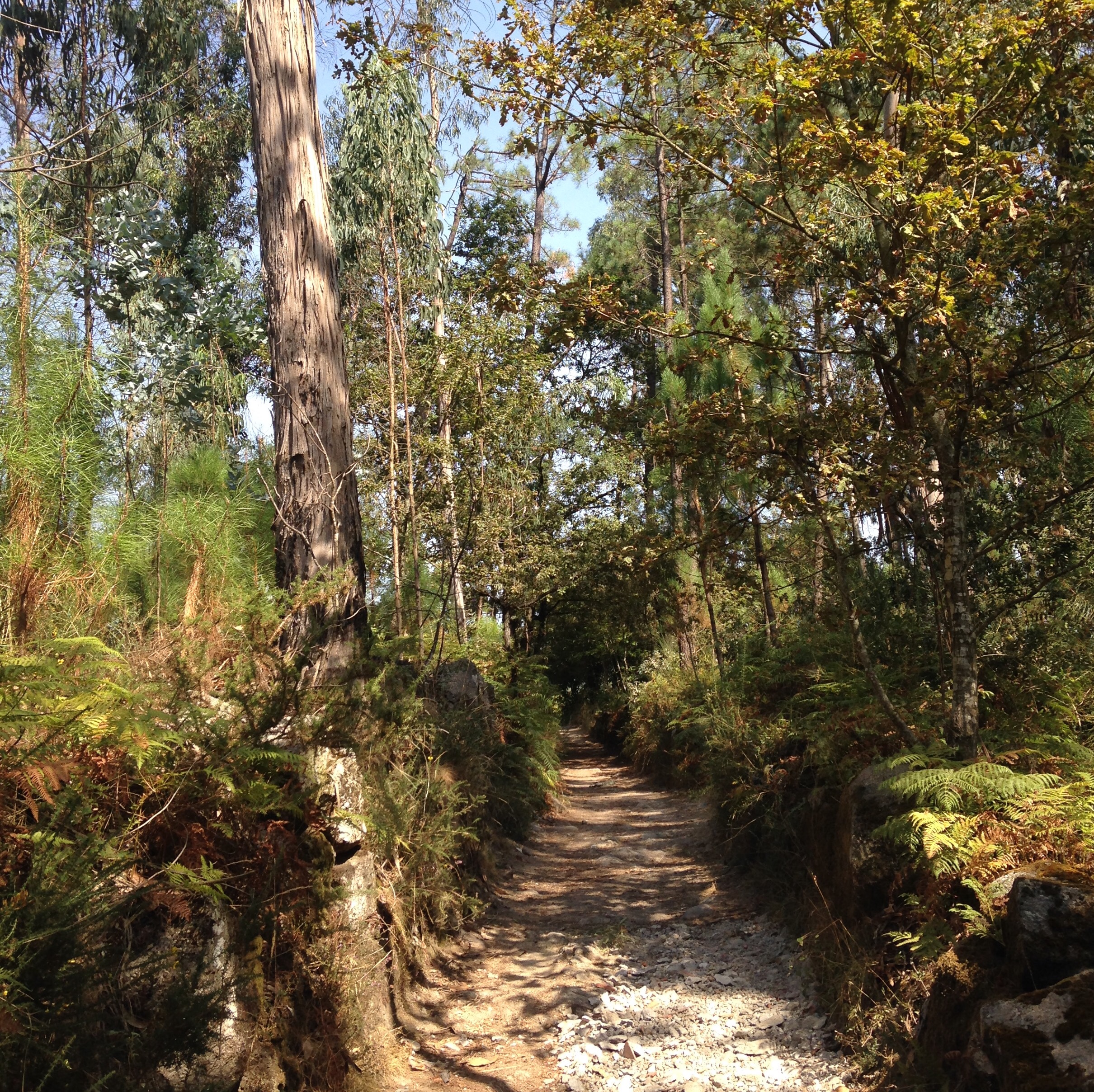
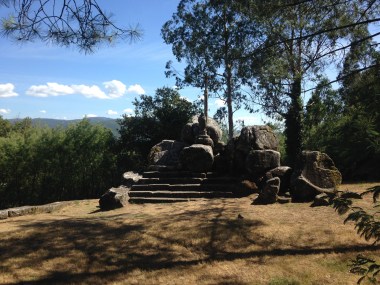
Friday 2nd. San Pedro de Rates, drinking water water water, and coffee, under an awning, the clock tower above, and the village square blasted white by the sun. The cafe owner (Cafe Macedo) loves pilgrims: big smile and handshake saw me on my way. Next – Dead Woman’s Peak – Alto da Mulher Morta. (Looked hard for Dead Man’s Gulch, but wrong continent.) Not enough shelter from the eucalyptus and pines as we gently climb. Pedra Furada – a megalithic disc, with a hole… stranded in a paved churchyard, but it still has mystery.

img_9690-1        img_9748-1

Barcelos, commanding the river, famous for its legend of the cock which crowed just in time (the victim was already hanging) to save an innocent pilgrim’s life. Now a garish cartoon cock, and he’s everywhere. One marvellous octagonal church, ornate decoration, and another severely Romanesque, the river directly below, with a mill by the bridge. Colourful umbrellas float above the main shopping street.  My albergue was in Barcelinhos, where checking in I’m greeted by the most beautiful girl in the world: dead on my feet and glasses coated with salt and sweat I walk into and rebound from a plate glass door. Impressing women is never easy. Also hurt my head!

Saturday 3rd. Getting hotter by the day. Drink suspect water from a fuente, mild tummy upset – doesn’t help! Ponte da Tabuas, old bridge and river forms a lagoon, and someone’s swimming… Dirt tracks and cobbled roads (all minor roads are cobbled) take you through maize and vines, the vines forming a narrow screen next to the walls of cleverly laid, heavy, solid  granite stones. These are old landscapes, little changed, by the path side, but the fields are often big, and sprinklers throw their water far and wide, and are happy to dowse pilgrims.

 img_9619

A roadside chapel dedicated Our Lady of the Snows. You long for snow in summer, and you don’t have far to go to find it in winter. It’s a lovely evocative name, sounds even better in Spanish: Nuestra Senora de las Nieves. A pulpit sits outside the west door: this intrigued me – was a priest from back maybe in the 18th entity the radicalising Wesley or Whitfield figure of his time ? Preaching out rather than in. There’s a bandstand opposite – what does this signify, I wonder?

One big blister by the time I limp into Ponte de Lima. Wide river with long and spectacular medieval bridge. There’s a big kayak race – why kayaks? Whatever, it’s a big event!  They know how to party here and it’s Saturday night … Supper outside with a Canadian girl and a Italian guy: she works in England at Stevenage hospital, was born in Dubai, has lived in Canada since she was three, and her parents were originally from India, and her boyfriend who she came to England to be with is – Welsh. The multinational Camino represented in one person. She’s walking from Braga to Santiago, another variation on the Camino theme.

Not quite so many walk all the way from Lisbon. Places like Coimbra sound magical, and there’s Fatima, a pilgrimage in its own right. Someone, for much of the Portugues route, and beyond, has happily drawn blue arrows facing the opposite way, the Fatima way, wherever there’s a yellow Camino arrow.

Sunday 4th. Sleep not too easy. Street noise right below the dorm window!  And everyone in my dorm is up at 5.30 – start early and beat the heat. No way can I sleep – so I’m off early to. By 10am climbing sharply, a rugged path to 1400 feet, big views back to the Lima valley, two evocative stone crosses with memorials and mementos, and pine trees with plastic bags attached: they’re collecting resin, and it’s thick and crystalline, and the smell is sweet.

Rubiaes, another municipal albergue. Down to basics – they pride themsleves on how minimalist they can get – as long as there are showers and bunks, they’re right, nothing else matters! And it’s 5 euros! Most of us there by 1pm. Late arrivals sleep on mattresses in corridors. Not much to do, the heat it seems exhausts more by doing nothing than by moving through it, save shower and wash clothes and read and talk and sleep and eat. This is not a metropolis.

Monday 5th. Checked out a Roman bridge in the half-light, we’re following for much of the way the Roman Antonine Itinerary XIX. A major route from the 1st to the 5th century. There are six-foot and bulky inscribed Roman milestones along the way. I love tracing out Caesar or Augustus with my finger. I reach the Spanish border by 11 – Valenca, Portuguese fortress, on a massive mscale, this is serious border country! Fortifications inspired by Louis XIV’s remarkable engineer, Vauban: they are on a vast multi-levelled scale. The Portuguese did not, and rightly did not, trust the Spanish!

    img_9649

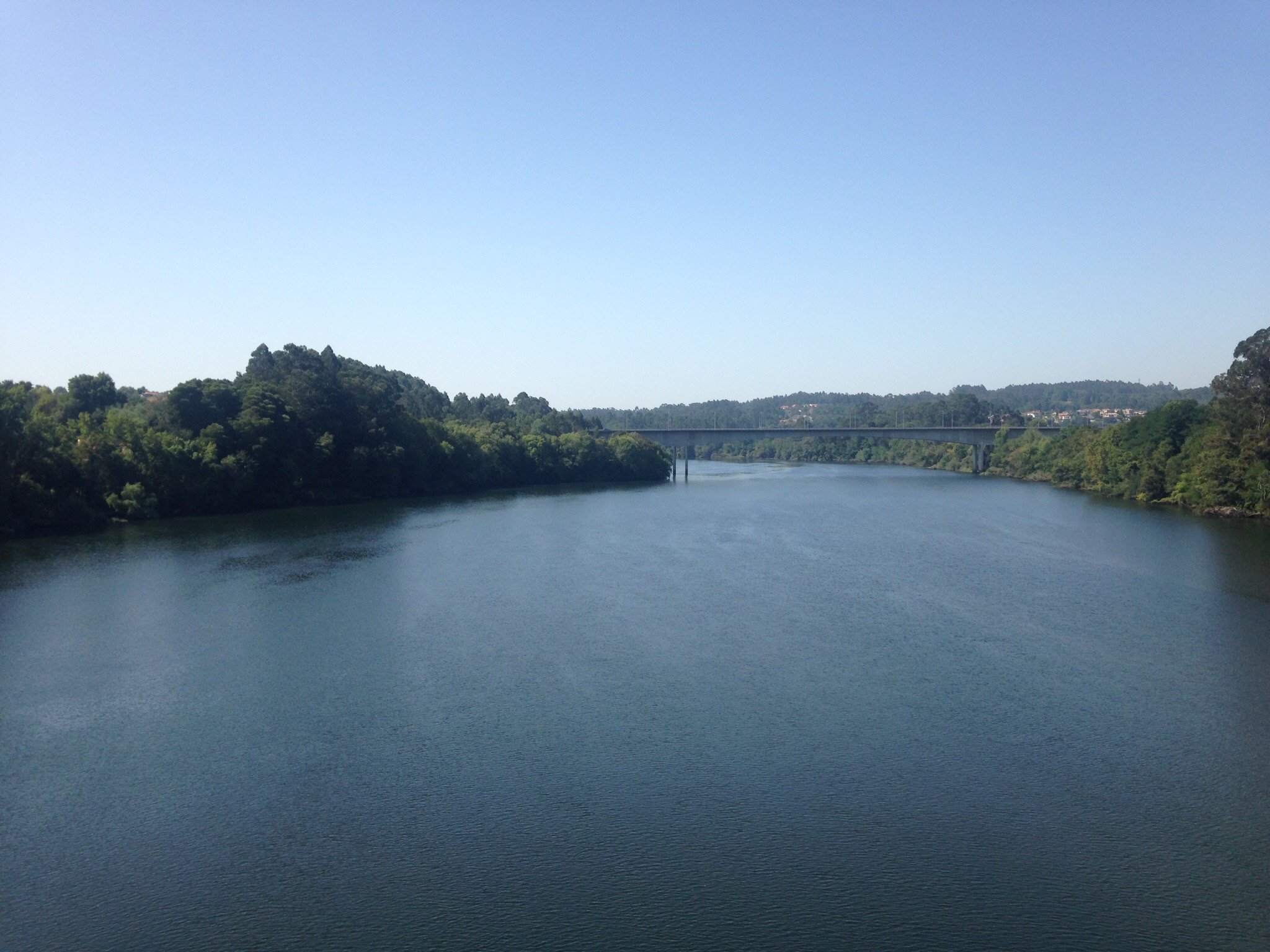
Views up and own the Minho river take your breath away. But most pilgrims head straight on, and tourists go for the nicknacks. Stop halfway across the bridge, straddling the border. River impressive – Ben (my son) and I went kayaking just below here ten years ago! Good memories.


Then on to Tui, Spanish border town, solid granite, cathedral a fortress, and cloisters the best place for cool! Carved portico inspired by the Portica da Gloria in Santiago. Dinner with Martin from Dublin (a retired engineer, he has a Camino tattoo on his upper arm) and Ken from Wigan. Broad Lancashire stalks the Camino..

Tuesday 6th. Big view from albergue up the Minho, first semblance of a breeze at 2, we’re all away by 5.30, 100 degree heat forecast. Stars bright, Orion already high, and Sirius just touching the horizon – winter stars, out of place in all this heat. We take the green route round Porrino, avoid the factories – three of us, a Polish photo-journalist, a Czech girl student, and a Brit. Pushing each other. After 22 miles we make Redondela, it’s getting close to 2pm. We get the last places in the dorm. Getting used again to mixed dorms – showers and loos separate. Male showers communal – back to school days! We’re close to a marvellous coastline, the Ria de Vigo: I follow the river and after a few 100 yards it opens out into a tidal creak – water flashing brilliant and enticing in the mega-sun.

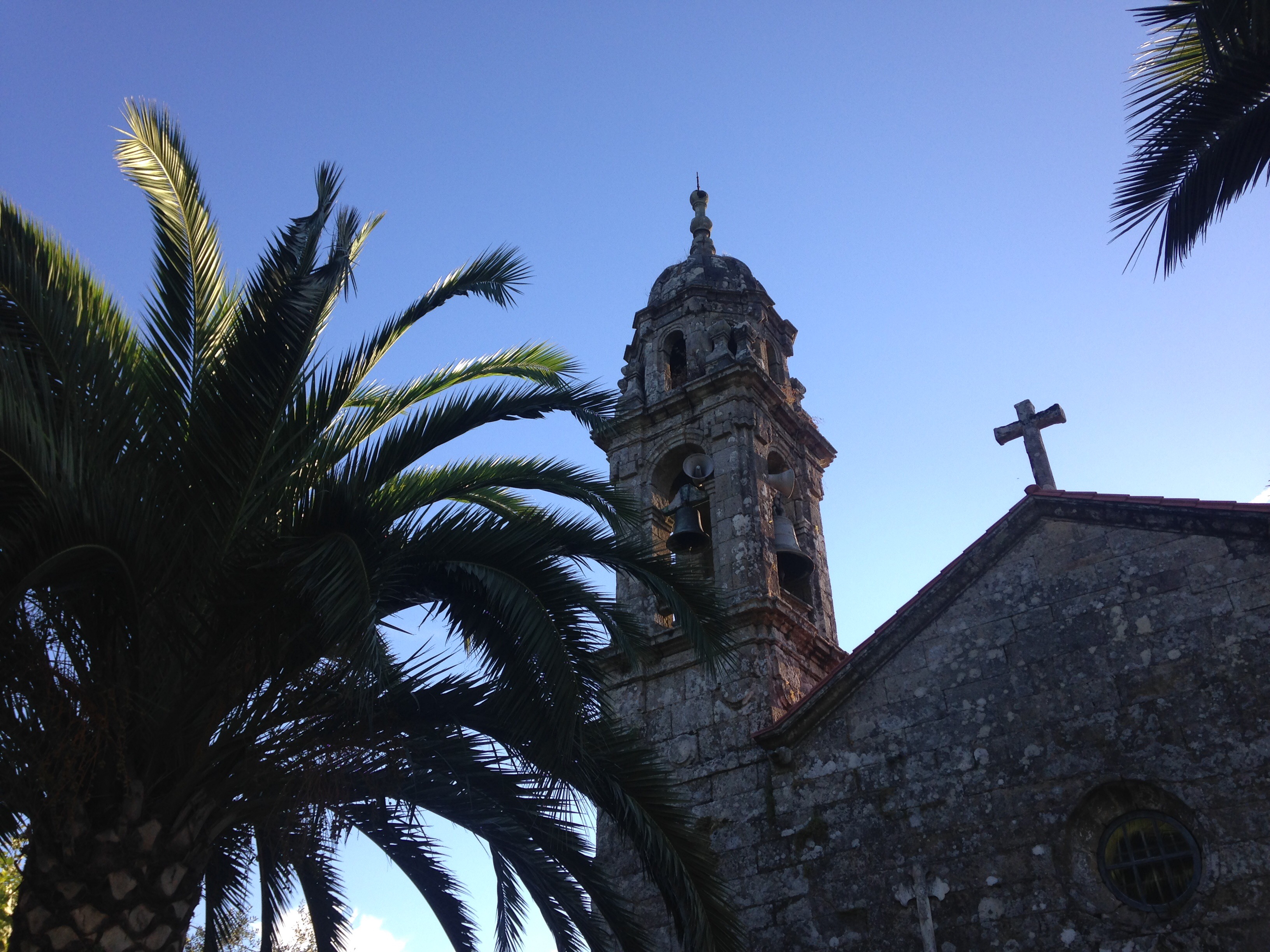
Most churches closed but their Romanesque bell towers stand out against the blue skies. I always detour to take a look, while others walk on. One way to find peace. I love the cruceiros, wayside crosses which can sometimes pack the full biblical cycle from the Fall to crucifixion into tableaux carved out of the granite. Everything, all the way from Porto, is granite. Not least the walls, and the narrow posts which would once upon a time have supported the vines that line the field edges.


Wednesday 6th. A shorter walk, to Pontevedra, via the river route – alder and birch mixed in, we’re almost into English greenery. But it’s hotter, and the shade deeper. Santa Maria a remarkable Renaissance basilica – the life of Mary climbs and fills the western front. Sanctuaria de Peregrino  a perfect 18th century rotunda – ground plan shell-shaped. I take a breather – take a cheap hotel! The Asador Virgin del Camino, my oft-related joke being that it’s better than vergin’, it’s actually on the Camino.

St James is more and more entwined with the pilgrim route, the closer we get to Santiago.

Thursday 7th. But first Caldas de Reis. Chatted to Christine from Canada on the way, she’s running a leadership course near Lisbon, and all participants have to walk the last stages of the Camino Portugues. Young people, working in not-for-profit fields, from all over the world.

Caldas – thermal waters, baths and springs since Roman times. Bathed my feet: water seriously hot. Got a disapproving look from a local – no longer a cool thing to do! Ice cream in the Xardin Botanicas – that was a better highpoint. Too much time to kill. Down by the bridge over the rio Umia there’s a wonderful tree-shaded restaurant: if only I’d known!

img_0011-1    img_0021

Friday 8th. Padron – where St James landed, or at least where he is supposed to have landed. Let’s assume he did! Much more fun that way. The stone to which he tied his boat lies beneath the altar in the Igrexa de Santiago. The hill above the Carmelite convent, the Santiaguino, is where he preached. After his execution his disciples returned to Padron with his body. I bumped into my friend, Martin, from Tui and we walked and talked the hill and its story together. Helps that he’s Irish! Below, in front of the Carmelite monastery there’s a vast platform – a viewing platform, for taking in the landscape, and not half bad for preaching either.

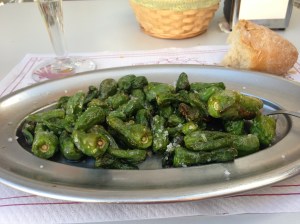
My albergue, all rather prosaic by comparison, is new, compact, and pristine clean – and the individual bunks had curtains. Also memorable: the menu de dia in a local restaurant, I’m now into main meals at lunchtime – do as the locals do. Not forgetting my evening pimientos de Padron, the local speciality.

Saturday 9th. James’s disciples buried his body in Santiago. What route would they have taken? My trail ran past the ancient Iria Flavia basilica, sacked by Almanzor in 997AD (he snatched the Santiago cathedral bells in the same raid), through run-down villages , through eucalyptus and pine, following a delightful wooded river valley, past the oldest of all the cruceiros, 14th century (I had my photo taken there, appropriate for someone who loves all the old stuff, the churches, the religion, however unfashionable that might be), then across the valley, through villages …then one river left to cross, just to tease, and a curiously rural valley for somewhere so close to the centre, another bridge, and finally tired legs into the old town, where it’s Saturday, and I seek out the traditional Portuguese gate of entry, and the different areas of the city are progressing in fancy dress and marching bands, drums and pipes, into the Praza do Obradoiro.

Sadly, as last year, the west front and the Porta da Gloria are covered in scaffolding, and that means I will have to come again! It’s Saturday, as last year when I arrived, but where last time it was politics this time it’s carnival in the streets, colourful costumes,  Galician pipers, big drums echoing down the ruas, captioned horses barely under control, high-steping middle-aged ladies looking gorgeous and showing off their legs, all the Santiago communities dressed up for a big day, and the rain holds off – just. Everyone heading for the Praza do Obradeiro. I watch from the steps with my friend, Michaela, from our big walk from Tui. By mid-afternoon it’s wet.

image               

Behind me is the Portico da Gloria. Under wraps. Inside the cathedral, at the back, there’s plastic sheeting, and you can get down on your knees and peer underneath, and two girls are sitting on stools, under arc lights, chipping away the grime of ages. I think it’s the statue of Master Mateo himself one of the girls is working on. I’d love to have touched heads with him, as pilgrims used to do, in the hope that a little 12th century genius might transfer to the 21st. Outside, on the great western facade, it’s slow work there too, and there’s a lift that trundles incongruously up and down. Just how did they get their building material, and their craftsmen, up there in past times?

Santiago’s history and tradition is now embalmed – explained and served up for pilgrims and tourists. Pick almost any period in its past and the story would have been radically different. In the 13th century destruction followed on a riot in the Quintana, and rebuilding followed. 15th century, another riot, the cloister damaged and rebuilt. I’ve been unable to find the reasons or the consequences, but stories of riots do bring us, as they brought the city centuries ago, back done to earth. What were the conditions the masons and journeymen in the 10th, 13th, 17th and all centuries inbetween worked under? Master Mateo and Archbishop Xelmirez may have been hard taskmasters.

Inside the cathedral it’s evening, and the Pilgrim Mass draws to a close. The great organ strikes up, the botafumeiro is released and pours out holy smoke as it swings in its great arc across the transept. Not I’d have thought the best way to fumigate pilgrims: it may not take our sweat but it does take our breath away. There’s a pilgrim mass in English every morning, in the Chapel of Our Lady of Sorrows. The Irish well represented, including five men in orange T-shirts who are all cancer survivors, and cycling together. The priest is a jovial, over-weight 69-year-old Irishman. I too am 69. We all introduce ourselves, a marvellous diversity, though quite a few like me have come from Porto rather than St Jean. Along one wall a mitred medieval bishop rests, on his side, head on one hand and his other, upper hand clasping the good book to his thigh. He seemed so content, in the sleep of the Lord, death could not touch him.

So many sculptures, and I love getting in close and taking in their expressions. Adjacent to the Porto Sacra are prophets and fathers of the church, and bishops and popes, not psychological portraits, but the sculptors had their fun, making each one different. Calm faces, cool faces, classical faces, and some at the opposite bizarre, plum ugly end of the spectrum. All those empty stares. And noses don’t survive the centuries well.

For paintings and sculptures if you want to see them not with a craned neck but close at hand, then check out the Museum of Sacred Art, a modern miracle of a museum housed within the old Mosteiro de San Paio on the Praza da Quintana. There’s the tabernacle in which St James is supposed to have been originally buried, and statues and paintings of Santiago and pilgrims from all over Europe. What did they wear in their feet, I wondered. Mostly sandals it seems, though one pilgrim had his feet wrapped round in what I assume was leather – almost a shoe!

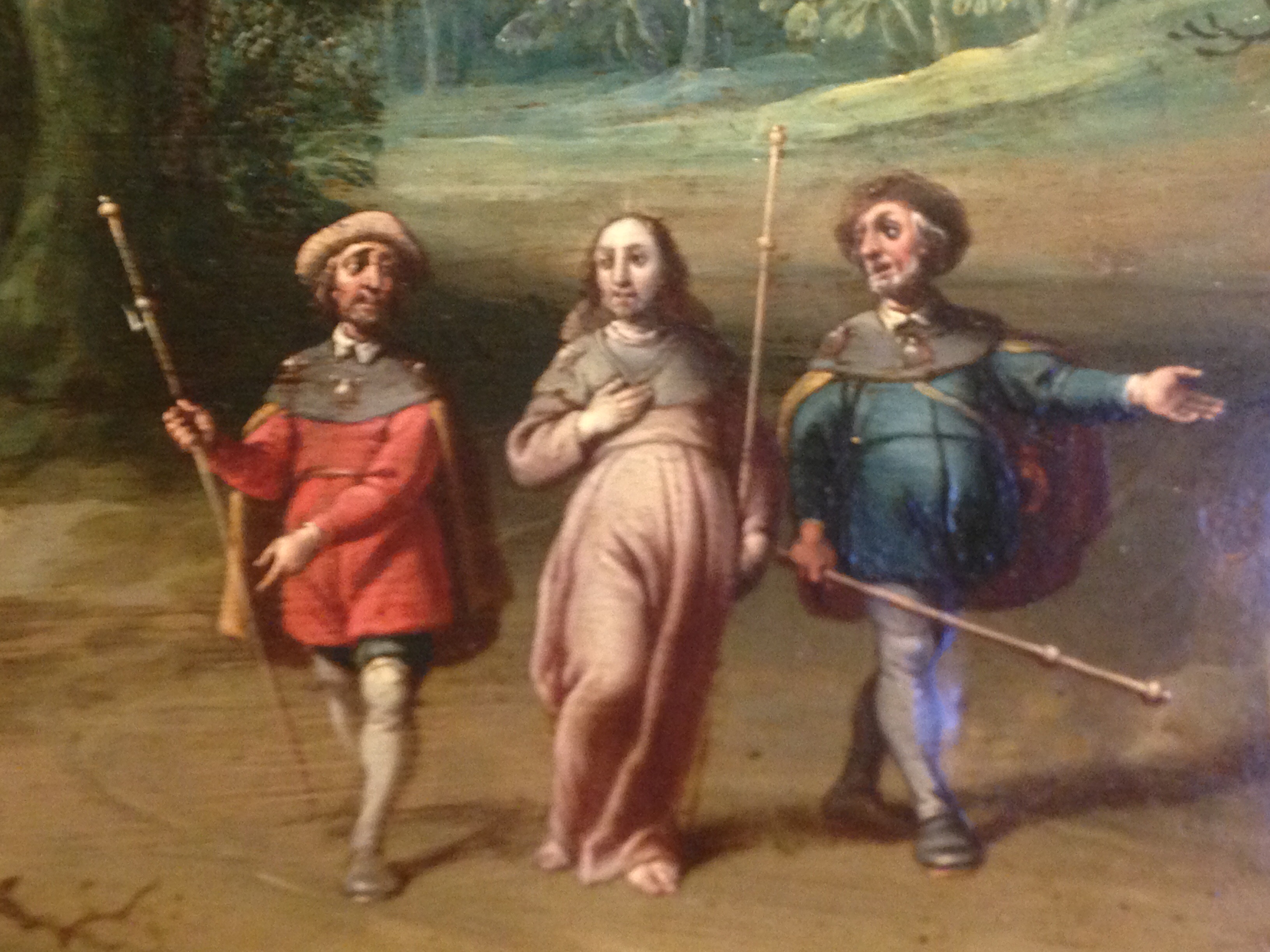
Pilgrimage is a broad concept. On a path, with a purpose. Once upon a time when we all walked we were all pilgrims… Jesus on the road to Emmaus was joined by two disciples who didn’t recognise him at first, and there’s a wonderful painting, 16th century, almost my favourite item in the whole of Santiago, of the three of them ambling along, talking animatedly beneath towering woodland. Small figures, and a big theme. Three modern pilgrims engaged in animated conversation wouldn’t look that different!


Jesus – lest we forget, the Pope decreed that that this should be a Holy Year of Mercy, and the Holy Door, the Porto Sacra, on to Quintana is open this year, as it would otherwise be only in those Holy Years when the saint’s day falls on a Sunday. But no mention of this in the cathedral: I saw a pile of unused leaflets, that’s all. And tourists were using the Holy Door as just another entrance. If you take confession, and mass, and are free not from sin as such but a disposition toward sin (wonderful semantics!) then you qualify for a plenary indulgence. I’m not a Catholic, and Luther railed against indulgences, but I love the idea of a Year of Mercy, and it’s a shame to see that’s it’s not impacting on the lives of tourists, and pilgrims, a little more.

img_0229      

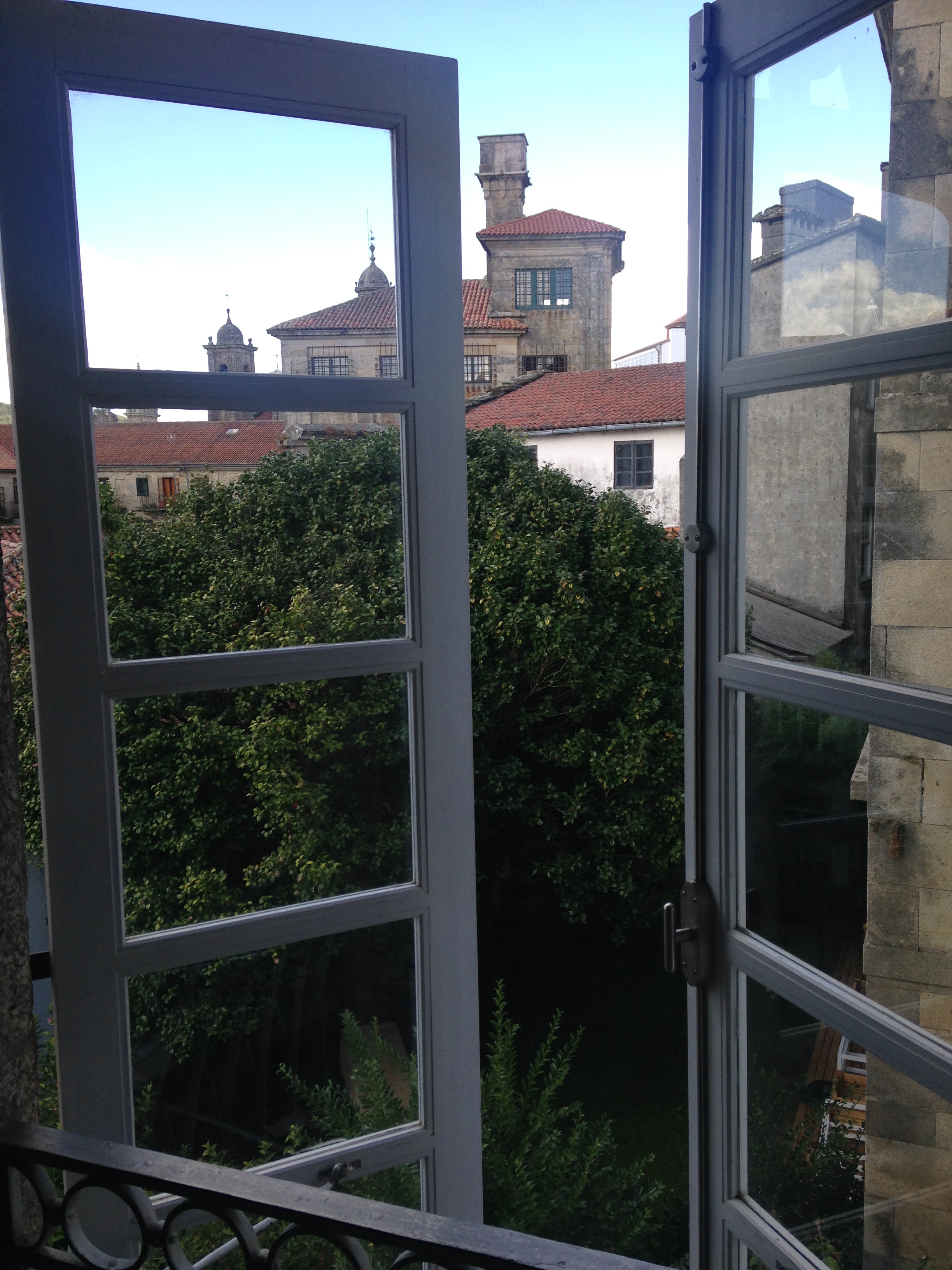
But Santiago works its magic anyway. My hotel, the Balalada, on the Rua da Xelmirez  (Xelmirez was archbishop in the early 12th century, and the driving force behind the building of the  cathedral), hides out in an old house, and my bedroom window looks over roofs and trees to one of the cathedral towers. There’s a bar four floors below my bedroom and on Saturday nights the party doesn’t stop until 5am, but if you’ve just walked 150, or 500 miles, you’re likely to sleep anyway, and next year – you can drink into the small hours, outside, in the cool of night.

Staying over two extra days I wandered the streets, explored churches, gazed up at high statues, spent time in cafes and restaurants and shops, but nothing quite beat my discovery of the Alamada park, which stretches away toward the sunset to the west of the city, endless green open spaces, trees and walkways, the church of Santa Susana in the middle, a perfect place on a hot day. If lived in the city I’d be retiring there to walk or to run, or with my book, or simply to find peace. And on the far side there’s a wonderful statue of Rosalia de Castro, Galician poet and national hero, whose house I visited in Padron. She has strong features, and a wise face, and I like her. No military celebration, or or pride or pomp, just humility, and wisdom, set on high, so we can look up to her. Below, carved into stone, are the titles of her books – poetry and prose. She had a melancholy cast of mind, there’s a sense of loss, and maybe that’s woven into the Galician sensibility. Not for me to say. But in this place of triumph for pilgrims I’ll end with a quote that’s just a little bit sad, but nonetheless evocative. Santiago is also a place for reflection.

I can only tell you that my songs/ rise in confusion from my soul/ like a sound from deep oak groves/ at daybreak,/ a sound which may be/ the wind’s tease,/ or the flower’s kiss,/ or the simple, but mysterious harmonies/ which, lost in this sad world,/ seek a way to heaven.


Beneath a tamarisk tree on the Cornish coast

Reading Seamus Heaney’s Glanmore Sonnets, sitting beneath a tamarisk tree on the north Cornish coast.

…hankering after stone
That connived with the chisel, as if the grain
Remembered what the mallet tapped to know.

That ties in well with the landscape all about me, which has memories of many millennia stored within its rocks, ancient tracks, stone-hedged fields and sand dunes.

I love its blooms like saucers brimmed with meal,
Its berries a swart caviar of shot,
A buoyant spawn, a light bruised out of purple 

Might that change the way you look upon the elderflower forever, or might it just be, depending on your mood, overwritten and overblown?

The tamarisk was planted long ago, when houses were cottages, and the land was ploughed, and the season was the farmer’s all year round, and not just the holiday-maker’s summer months. The wind scurries the fronds, a Cornish blue beyond and above, but they’re so fine that their susurrations lose out to the ash tree, which with the freshness of youth is a sounding-board for the breeze.

The tamarisk branches move uneasily, they creak, and the ash sways. The ash is all deep shade, the tamarisk a light touch of sun. A gull squawks, and when the wind falls low, there’s the distant sound of a combine harvester, for fields still do run away inland, when you climb beyond the pitched roofs and white facades of the holiday homes.

Inheriting a library

Inheriting books – that sets up a whole further range of problems. Problems I’m delighted to have but I’m also inheriting a responsibility. To a great aunt, who I knew well, but now I know her library – and I wish I’d known her better. Her books which take me through from 1910 to her death in the late 1990s are the story of her life – the intellectual, literary story. She read English at Oxford in the 1920s, but never worked, other than as a companion to a fierce-looking great-grandmother of mine, who I never knew.

When I downsized from house to flat I threw away some of the cheap novels (Everyman’s Library and the like) which had been her everyday reading staple – many duplicating books where I already owned copies, and others by authors hardly ever read today. But – for a few years now I’ve felt guilty. They were a mini-library, a personal story, and I wish we hadn’t parted company. I do sometimes imagine her up there, Auntie Frances, with a stern look and a gently wagging finger.

She was born in 1900 and her grandfather was the manager of a cotton mill, or so I understand, in Manchester, and he lived in Prestwich, and he was educated, a member of the new affluent middle class, that Manchester middle class which was the first real middle class in the whole wide world, and he was a book collector, and his books which my great aunt inherited were a pride and joy to her. And now to me.

As examples, two marvellous volumes, London City and London Suburb, which he subscribed for in the 1870s, and his name is in the back, along with all the other subscribers. Bound sets of Studio magazine. Beautifully bound volumes with tinted and tissued paintings of birds and flowers. Macauley’s History of England, in five volumes. Five – but I can only find four. I must have the fifth, surely? (I will be searching.) A middle section of  binding on the spine of volume two has come away, and that is on a small pile of books to be repaired. The metal clasp on a miniature prayer book has already been repaired.

But my biggest puzzle is a volume where the front cover hangs by a thread, and the opening pages are missing. Two books are bound together – a bible from the 1730s and a prayer book from the 1780s. Don’t ask me why they’re bound together. I will need to research.

The more I explore behind the old bindings the more conundrums, and the greater my pleasure. I now have a bookbinder who can help me out. And I will read – in so many ways Victorian books are superior to those of our own time – finer bindings, and illustrations each one of which was a labour of love.

Thirty years ago my great aunt took one book from her collection and gave it to me as a present. Pigot’s County Atlas of England, from 1840. Individual county maps, and a four-way fold-out map of England. I loved it, and when I set up my own publishing company in 1989, the little-lamented Garamond, I published it as a facsimile edition. It looked and looks superb, and I took delight seeing it featured in bookshop window displays. But, the book itself, well, it had to be broken apart before being sent for repro, and it came back to me with the counties as individual parts, the boards (cover) intact, but unbound. And it stayed that way until a month ago, and now at a cost of £230 I’ve had it rebound, and I’m as chuffed as can be to have it there, on my coffee table.

There’s another story to the book. My great-grandfather, whose second wife was the fierce-looking (and black-robed) lady I mention above,  was a successful builder – he built many the houses and shops which line the streets of Bramhall, my home village in Cheshire. And a young man, he’d worked for the rector of nearby Mobberley, the Reverend Herbert Leigh Mallory, the father of George Mallory, long a hero of mine, who lost his lfe along with Sandy Irvine somewhere above the Second Step just below the summit of Everest in 1924. His body was found in 1999.  So my atlas would have been in George’s library in the Mobberley rectory when he was growing up. I like that idea, and wonder if he might have perused and pored over it as I like to do.

I asked Noel Odell, the last man to see Mallory alive, disappearing into cloud, when I met him thirty years ago at the Royal Geographical Society, whether he thought Mallory and Irvine had made it to the summit – he was sure they had.

There will be other stories, I’m sure. More bookish adventures.


Keeping sane amid the chaos

How (if you’re me!) to keep measured and sane amid the chaos.

For starters, two reminders from a Buddhist meditation handbook:

‘…one shouldn’t have a great deal of desire… one must be content, which means whatever one has is fine and right.’ ‘Whatever one has is fine and right.’ (My italics.)

‘The place where we stay should be free from a lot of activity and a large number of people… (we should reduce) our involvement in too many activities.’  Now there’s a challenge.

Then there’s something I’ve loved since childhood – watching cricket. I enjoyed England’s decisive and exuberant victory over Pakistan in the second test match that ended yesterday. Always good to head out to Lords or the Oval, or stand on the boundary at Cranham cricket club … (A friend reminds me of the joke – ‘God gave cricket to the English so that they should have some sort of idea of eternity ‘ – that was certainly true of the first test match. I was there.)

And moving out beyond the cricket field – out further into the wild, and the wilderness, into the countryside, to the coast, to the mountains:

(‘What would the world be, once bereft /Of wet and of wildness? Let them be left…’)

walk (or run) in the meadows and beech woods

head off down to Cornwall and walk around Penwith from St Ives, via Zennor and Land’s End and Porthcurno, to Penzance (carrying a tent and heavy rucksack in the hot sun a small downside, likewise the heat exhaustion!)

puzzle over the wild flowers (betony abundant in Cornwall – a small sense of triumph identifying it!)

listen or watch, or maybe both…

– two buzzards wheeling above me on the coast path near Treryn Dinas just east of Porthcurno, piping much of the time, occasionally they come together and there’s a scurry of wings, and they resume their circling. The following morning, 7.30, I’ve struck camp, and I’m on my way, light rain, grey out to sea, and they’re back there, ahead of me, still slowly circling

– the owl which I disturbed in the woods later that morning – it took off maybe only two or three feet away from me, a vast and silent presence, and a powerful absence, disappearing into the light at the end of the green tunnel behind me

– the sound of a soprano, yes, a soprano, from the Britten opera being performed at the Minack theatre a mile away, it was 9pm, and I was tucked away in my tent, trying to sleep…

– a yellow snail (a ‘white-lipped banded snail’), and a red-winged fly – the small and surprising things, which puzzle, and take the mind down from the high and inflated places to the simple and beautiful

– and back in the Cotswolds, a lesser spotted woodpecker now a regular visitor to the bird feeder and the birdbath in the garden, and the goldfinches

– and the long warm summer evenings, the stillness, and the small party which headed out onto the common at midnight to look for glow-worms

There is hope for the world yet.


A little help from my friends

The referendum has left most of us convinced Remainers worried, angry, feeling cheated – and feeling the country has been cheated. Waking in the night my first thoughts have been referendum, and my first emotions negative.

I’ve been helped by a determination to ensure that an open and an open-hearted politics win out in the end – while at the same time taking on board a good few lessons. If I’d been aware in the past of resentment and anger among those who felt left behind, or that this was no longer their England, their UK – then that’s as nothing to my awareness now.

Getting away from it all also helps. Three books I’d mention –

Nan Shepherd’s The Living Mountain, a magical encounter with the Cairngorms – a landscape I remember well. No writer lives landscape quite as she does – the corries and snow and skies, the eagle and the snow bunting, the storm and the silence.

(Of the peregrine falcon and eagle) ‘The speed, the whirls, the torrents of movement are in plain fact the mountain’s own necessity. But their grace is not necessity. Or if it is … the swoop, the parabola, the arrow-flight of hooves and wings achieve their beauty by a strict adherence to the needs of function – so much more is the mountain’s integrity vindicated. Beauty is not adventitious but essential.’

‘No-one know the mountain completely who has not slept upon it… Up on the plateau [on midsummer nights] light lingers incredibly far into the night…Watching it the mind grows incandescent and its glow burns down into a deep and tranquil sleep.’

‘Why some blocks of stone, hacked into violent and tortured shaped, should so tranquillise the mind I do not know…’ No one before, not even Wordsworth, has told it quite as she does.

She’s now destined, humble walker and explorer of the mountains as she was, to appear on a Scottish postal stamp.

At the other extreme, I delved into the poems of Sean O’Brien. But whereas with Nan Shepherd you feel you are living her memories as she is living them as she writes – we feel in O’Brien’s case that they are memories, and where Shepherd elevates he brings and keeps us down to earth – to the the sluices and dirty harbour waters in which fish yet swim, to drains, and empty parks, to deprivation sluiced through with politics. The landscapes draw you in, the language inspired because there’s magic in it, though the content may bring you down – and that’s the problem in my post-Brexit world. I want words to lift me up.

Someone with whom  I’ve shared my life for a few years now is the Trappist monk, Thomas Merton. He sought God in the silence and moved toward Buddhism and political engagement as the years past. Whereas I in the turmoil seek silence sometimes, he in the silence could not hold back from the turmoil. Like thousands maybe millions of others I connect with the manner of his life and his engagement with it – if not the detail. And his diaries are matter of fact, and detached, but there’s always a wisdom interwoven, and I turned to his diaries on the Friday night after the Thursday referendum vote, and it was 1968, and Martin Luther King had just been assassinated, and Merton wondered what else might happen that year. The Chicago convention, the death of Robery Kennedy of course – and his own accidental death.

This is 2016, and I wonder what else might befall the UK, and the world, this year.

If Merton on this occasion added a new dimension to anxiety, getting out beyond books in the post referendum week proved more successful.

All day in Kew Gardens with my partner’s grandchildren: you escape into their lives, and into Kew’s open and closed spaces – to the newly opened and magical Hive, where we literally tune in to the world of bees, and the Palm House, where the mist drips big drops of water on plants and people.

The Sunken Treasures exhibition at the British Museum – reclaiming remarkable artefacts from cities long sunk under the waters of the Nile Delta, a reminder of the transitoriness of life, civilisation and belief systems. And of course political life.

And finally, a day on a narrow boat of the Sharpness to Gloucester Canal, when after weeks of storm and rain and cloud the sun broke through and shone all day, and we could chug slowly to Gloucester and back through countryside hardly changed in a hundred years – the canal wide and the waters empty, and below us – yes below- the widening estuary of the river Severn.

No talk of politics, eight of us, a picnic of the river bank, and nothing to do. Just occasionally I took the tiller and took charge – though really it was the boat taking charge of me.

From the Camino to Cornwall

Last week I was back on the Camino – and walking through Castrojeriz, a mile-long village, on an early June day. The wheat and barley still a vivid green in the fields, and poppies popping up everywhere, along the field edges and sometimes mixed in with the crops themselves. There is magic here – there’s nowhere that walks and winds quite as Castrojeriz does, with its castillo above, and cafes, albergues, churches and the Hospital de Alma where the music plays ethereal, and the messages are peace and love. The destination may be Santiago, but it is also, simply, the journey.

And then, a week later, walking, just one day, the Cornish coast path from Portloe to Gorran Haven, which runs east of Falmouth and west of Mevagissey. It drizzles and mists and then rains hard and I slip and slither. Where is that promised sun? Round about 2pm it shows itself, and the Cornish flowers – campion and fox glove and ox-eye daisies and it could have been a hundred others – line the paths. Grasses and clover, buttercups and hawkbit, fill the fields. Take a step or two back further from the path and we’re back to big fields and fertilisers, but not here.

Walkers are few and they are wet, and the temptation to take short cuts and get to shelter is powerful, but short cuts aren’t easy. Certainly not to my right as I walk – the sea is up to 300 ft and cliffs sometimes sheer below me! A few seagulls, only the occasional blackbird and chaffinch. Maybe the wind blows too strong here.

At Dodman Point a cross looms in the rain and mist, built we’re told as a navigation aid by the local vicar (not much use today). He inscribed on its base his belief in the sure and certain hope of the second coming of Jesus Christ. Built back in 1896, and built strongly as it is, it might even survive that long.

On the Camino you’re open to a different kind of eternity, sometimes the landscape could be the ocean, spreading great slow waves across the landscape. The pull of the earth is powerful, yet the sky is close. Whereas on the coast path you’re on the edge, the divide between ocean and earth. Both have aspirations to eternity, but the one seeks victory over the other. You can walk with only your boots and your thoughts on the Camino. On the coast path you have to walk with your wits. Beyond every stile or bush or dip in land there could be a surprise. A moment of danger, or a moment of joy. The Camino plays a longer game.

This shows in the villages as well. Towns and villages on the Camino grew up because of the Camino – Villafranca a place name that recurs and reminds us the many Frenchmen who walked the Camino and built settlements along the way. On the coast path they grew up because sailors sought a livelihood from the sea and wherever there was a likely cove they’d stake a claim. At East Portholland the cottages are right up against the sea, with their outer storm doors. Layers of concrete secure the beach against erosion – though would they, could they, break the might of winter storms such as we had three years ago?

Along the Camino countless walkers have journeyed before me. Fewer on the coast path. But out to sea, out into the Cornish sea – how many have journeyed, how many have been drowned or shipwrecked? On other days, clear and sunny, I’ve looked out to sea, and emptied my mind. Today I must concentrate. I slip, come a cropper, three times…

Could I rent, even buy, one of those cottages in the tiny hamlets such as East Portholland along the way, and write stories? At Hemmick here’s only one cottage in the cove.Sadly, I don’t think I have a plot, or a cottage, just yet! For stories, better the Camino? Take almost any one of those countless pilgrims, and walk with him or her, and their memories and aspirations. There are stories in abundance. But who knows what I might yet find among the Cormish cliffs? Who might have fallen there – and never been discovered?

Revisiting the Camino – take two

This post is for Camino geeks. I’m revisiting in late May and early June, almost one year on. By car, but with short walks wherever possible.

There are good memories which stand the test of time, even improve on reacquaintance – and others which fall short, or simply disappoint.

Bilbao, YES. Off route I know, but the end of my stage one, June last year. The Guggenheim, and especially Richard Serra’s sinuous and space-defying structures.

Likewise the drive up into the mountains from Bilbao, in brilliant sunshine, unbroken forest as far as the eye could see. Beyond Vitoria, green hills with crags lining their summits, and I remembered the way they led me, guided me, when I walked that stretch from Punta la Reina to Logrono.

NO to Roncesvalles, though we did take a short circular walk up through the woods, then back down through meadows to join the Burguete path – meadows with rich odours of cow dung and deep shades of green beneath an equally deep shade of blue – that’s how I remember Navarre from almost a year go.

YES to all the following.

Larrasoena, the village, where I stayed my third night, and the bridge that takes you over the river and back to the Camino from the village – 6.30 on a misty morning last June. All alone, and I couldn’t quite believe where I was! Memories of Zabaldika nearby, and climbing the belfry to ring the bell out over the valley.

Pamplona, sitting and watching the peregrinos wander through, most of them without the heavy boots, the day’s walk over. They have still 4 1/2 weeks to go…

Zariquiegui, and the walk up to the Alto de Perdon. The path of the winds gentler than last time round, and more peregrinos. I had it to myself last June. We talked to several on the way up – we listened. New Zealanders. Then as now, there are stories to tell. This time as last time – where are the Brits?  Are we content, too content, with our own patch?

Puente la Reina, sitting out in Calle Mayor and having lunch, the bridge and the river moving slow and green beneath. Chatting to someone who walked to Santiago four years ago – and is now walking the other way.

NO (sadly) to Estella. Estella was my favourite place, almost, last time, but now the shops were closed, it being Sunday, and the streets were dirty, rubbish uncleared, and the churches closed last June were closed now, and the wonders therein will have to wait for a third visit (I fear unlikely). But the way the Camino drops down past old houses into the town – that still has magic. And I made good friends in Estella.

Yes, big YES, to Logrono, and its wonderful evocative churches, the Ebro as a boundary, my furthest west point last June, and starting point last October, and coffee in plaza in the shadow of the cathedral, cold bright sunshine, multi-coloured cyclists about to take off en masse. The pinchons, and a wonderful hotel, the Calle Mayor, which wasn’t a memory as such because I stayed in an albergue last time….

I restarted 1st October last year, in Logrono.

Navarrete, YES, the square and cafe by the church emptier than last October, all the noise outside an albergue one street below, and the wind was chilly but the sky was blue and the dark shadowy church was full of atmosphere, the gilded retablo overpowering at the east end, likewise the emotions brought out by the background music – combining Taize, Pachelbel, the Handel Sarabande made famous by the Barry Linden film score, and Dylan’s Blowing in the Wind in orchestral form. I sat with head bowed and tears in my eyes, re-experiencing some of the more powerful personal moments from last year.

Santa Domingo de la Calzado – YES, almost. Santo Domingo doesn’t allow you to sit and drink coffee and experience it at its heart – the street cafes are on the modern street just south of the old main street, the Camino route, and the Parador is while wonderful inside a dead space if you’re looking to get a sense of the Camino. The cathedral evokes mixed emotions – beautifully restored and lit, evocative paintings and sculpture, especially the outside choir stall walls, and a c1500 retablo tucked away in a side chapel, where it’s hard to see it properly.

The museum is full of medieval, early as the 14th century, icon-like Madonnas on the one hand, and crucifixions and saints full of that that exaggerated piety which rings false to the modern eye, on the other. Likewise a cartoon image of Santo Domingo, dire – the old saint will be rotating in his grave.  You have to squeeze back against a glass case with a reconstructions of earlier versions of the cathedral to see a marvellous 13th century painting of the Garden of Eden – creation, temptation and expulsion.

From there by way of an industry park – what would Santo Domingo have thought to see what’s been created on the site of his original village – to San Millan de Cogolla.The monks there turned him down back in the 13th century. Their reputation  and the grandeur of their Romanesque monastery must have been marvellous in the eyes of the young Domingo. Had they accepted him – he would never have been a saint, and there would be no Santo Domingo town.

Back on – or just off – the Camino

I’m back revisiting favourite corners of the Camino, and also taking in places and landscapes which tantalised me last year by being just off route. Above all the monastery of San Millan de la Cogalla, where I’m writing this post.

We’re not staying in albergues, but in hotels – and some are almost smart. Do I miss the dormitories? And the snoring? Maybe not! Though I do have ambitions to walk the Camino Portugues later this year.

The monastery has claims to be the birthplace of the Spanish language, where what became Castilian was first written down by an early 12th century monk as marginal notes to a Latin codex. I knew when I first read about San Millan, in Navarrete last year, that I had to visit.

I loved and love the history of the Camino – the vast church interiors, ancient houses with coats of arms, streets winding through towns and villages as they’ve done for a thousand years, the Templar and Cluny connections, tales of battles against the Moors, my hero Sant Iago, the porch of the ruined church outside Navarrete now gracing the entrance to the cemetery on the other side of town, churches where pilgrims who might not make it to Santiago could nonetheless receive absolution  – all the powerful spiritual connections.

I’d attend pilgrim masses when I could, and light candles.

Down the road from San Millan is Berceo, the birthplace of the first recognised Spanish language poet, Gonzalo de Berceo. Another reason for visiting.

From my hotel window in San Millan woodlands stretch up both sides of the valley into the heart of the Sierra de la Demande. And a cuckoo is calling, as it has been on and off through the day.

San Millan himself was a 6th century hermit, and around him gathered other hermits, and in the 10th century a Benedictine monastery was founded on the site. There are monks here to this day, though I’ve yet to catch sight of any! There are depictions of San Millan is sculpture and paintings in Benedictine attire (hardly a military uniform!) and brandishing a strange red zigzag sword, taking on the Moors as did Santiago Matamoros. Like Santiago he was a patron saint, of Castile and Aragon, but Santiago’s status has fared better down the years.

We walked up the valley this afternoon and climbed the hillside to one of the many hillside caves. The views up to the still snow-touched peaks were wonderful, likewise the woodlands which extend everywhere. We took out all our woodlands back home in the UK for firewood and building ships and to create pasture – not so here!

If you want to be a hermit, I can’t imagine anywhere better.

Dawn chorus

The dawn chorus – we all listen in from time to time, often unwillingly if we’re lying wake, sometimes thinking – one day I’ll get up and get out there and …. just listen. You can’t worry about stuff when the trees enclose you, or the garden’s dew-covered in the dawn, or there’s a big sky and the last stars are losing out. You can’t worry about stuff when all you’re doing is listening. And maybe you’ll identify one or two birds amid all that joyful cacophony.

So one Sunday morning, early in May….

4.45 in the Buckholt beechwoods, the rain not long stopped, just enough light through the trees to see our way along a slippery path and avoid the roots. A tawny owl with a too-woo answers his mate’s too-wit. No too-wit: we only hear the answer. The thrushes give voice to the morning ahead of the crowd: their repeating phrases are mesmerising.

Robert Browning: ‘That’s the wise thrush; he sings each song twice over,/Lest you should think he never could recapture/The first fine careless rapture!

Browning was thinking of April, and we’re one week into May. But it’s been such a chill spring, April is still the abiding spirit.

A blackbird starts up its more random and fluting song in competition – as we hear it – with the thrush. For him it just might be competition for a mate, or setting out his territory.

It’s many years since I’ve walked through woods at this hour. Back in 1975 it was the tropical forests of Guatemala, and I remember a firefly that startled me, and listening for a jaguar, just in case. The dawn silence broken as I remember more by monkeys which took to swinging through the trees. My destination then was the vast temples of Tikal, in a clearing cut back from the jungle. My destination today – no more than a bacon sandwich, or maybe a return to bed.

But who needs destinations. Enough to be in the wood, and listening to the chorus. A great tit starts up, easy to recognise, then much too easy, and intrusive when we want space for other birds. Maybe take out the robin as well – which I love but its tuneful meanderings sound out from every direction. Without the great tit and robin, we novices would be able to focus more readily on other species. The coal tit, also a repeating call, but more mellifluous. The wren high-pitched, rapid and loud for a bird so small, so difficult to see. The chiffchaff chiff-chaffing. A goldcrest? – but maybe it’s pitched too high for me to hear – so another bird? But which?

We hear no more owls, but there are wood-pigeons, and collared doves. And by the side of the path Roman snails, tough-shelled and edible and enjoyed by the Romans who introduced them, and found more abundantly near Roman sites to this day. Too early for the adders and grass snakes, but who knows, later in the day, beneath the mats which are put out on the common, where adders find shelter.

‘It is the bright day that brings forth the adder. And that craves wary walking…’ (Julius Caesar)

But this is a dawn chorus walk…

The enemy – the pheasant. (We hear them but they belong on the woodland fringes.) 25 million introduced into the countryside each year, and they’re protected. There’s evidence they eat snakes. Which do we prefer? As someone said, you can see who drafted the legislation. Money of course comes into the countryside from the shooters, so the arguments aren’t all one way.

And habitats – we love our woodlands, but a hundred years ago great swathes would be taken out – clear-cut or coppiced or pollarded. The woods were resources not a place for recreation. And a place of mystery and seclusion, a place apart. There were the working woods, and the deep woods. And the deep woods still stir our imagination. One reason I love Buckholt and Cranham woods is that you can get lost there. There is always that frisson.

We try now, as Natural England does, to re-create the wildlife habitats of a one-time working woodland, without the working population. So we take out the saplings, we cut clear and we coppice – but it’s not easy to re-create habitats when we want them for recreation, not for work.

The chorus is better on bright mornings, than on wet, or cloudy. Better where the mix of habitat is greater – meadows next to woods, or gardens. Maybe. But there’s a magic in the woods at 5am, and at 6am – no sunlight reaches path or canopy (the clouds have yet to break), but the pale green, the bright new green, is illumination enough as I lift my eyes from the path. And to either side, a stretch of woods where bluebells thrive. This is mixed-habitat wood, and meant to be that way – there aren’t the great expanses of bluebells we can see elsewhere. Or wood sorrel. And only in a few places is wild garlic abundant.

Near the end of our walk, one crow. Only one. Distant. Too raucous. Round a corner, a field, scouts stirring from their tents – maybe collecting wood for a fire. Takes me back a few years. Then back to the road, and the village.

Fifteen hours later, sitting out on a patio, looking north to the woods where we’d walked. A song thrush strikes up, always inventive, compulsive listening. First bird of the dawn, the last (almost) of the twilight. 9.25 he flies down from the tree to roost. There’s a distant blackbird, and an early owl in the woods, a few seconds, then he’s quiet. And an evening crow. Like the morning just a single caw-caw, and that’s it. Then all is still. 9.30 a single bat flies past. There’s a breath of wind. 9.35, another bat and, a minute of two later, more than a breath of wind. Not only the leaves but the branches move.

All the while I’ve been contemplating a sunset sky which held its colour, its luminous reds, for at least half an hour, and above, alto-cumulus, a gentle bank of grey cloud against the light blue. The sky is as quiet as the land, and I feel I could step off into the woods and around the globe without disturbing a soul. Nearer at hand the oaks and ashes still gaunt in outline against the sky: the day (the 8th of May) has been one of summer warmth, out of the blue, out of the ether, a surprise and a wonder, summer in spring in winter.

It had rained before we began our morning walk, and after we finished. And it will rain tomorrow, then turn cold…

with thanks to Kate Gamez, of Natural England, our walk’s organiser, inspiration and guide