The Big Short (and a little short digression on Brexit)

Reading the book, and watching the film. Focusing more on the book, for there the characters are real, not fictionalised.

There’s something about the financial crash that grabs you. Now almost ten years ago, a mortgage securities crisis for heaven’s sake, we think this is someone else’s bed, but we’re all tucked in, and we’re all sucked in. There are big personalities, outsiders, outlaws almost, and big banks, and tanking economies. Michael Lewis makes a brilliant job telling the story, dissecting and explaining. I am now a little wiser, but not out of the wood.

We didn’t know it was happening. Quoting Michael Lewis:

The monster was exploding. Yet on the streets on Manhattan there was no sign that anything important had just happened. The fire that would affect all their lives was hidden from their view. That was the problem with money. What people did with it had consequences, but they were so remote from the original action that the mind never connected the one with the other.

Will Brexit just somehow slide into place, we’ll be a little bit poorer, but hardly notice, or a whole lot poorer, but we won’t notice because there won’t be too many crises on route, it won’t be harum-scarum? ‘(People) were so remote from the original action that the mind never connected the one with the other.’ Or maybe we will notice – maybe the crises will be more immediate, urgent, and hit our pockets in very direct and noticeable and politically-accountable way.

Playing with risk, at other people’s expense. Or in the case of Brexit, at a nation’s expense.

Compare Wall Street:.

Salomon Brothers transferred the ultimate risk from themselves to their shareholders. …from that moment, the Wall Street firm became a black box. The shareholders who financed the risk had no real understanding of what the risk takers where doing and, as the risk taking grew ever more complex, their understanding diminished…. The moment Salomon Brothers demonstrated the potential gains to be had from turning an investment bank into a public corporation and leveraging the balance sheet with exotic risks, the pyschological foundations of Wall Street shifted, from trust to blind faith.

Here, in the UK, we are the shareholders. (Sounds dangerously like Brexit speak!)

Back to the book…

The Big Short book brings you face to face with the detail, and it’s a mighty challenge to follow at times, when CDSs get gathered together into CDOs, and CDOs are packaged together, and sometimes different CDOs are packaged into new CDOs, and the old CDOs show up in the new CDOs as if they were in for the first-time. They were going round in circles, and if anyone cared they didn’t care enough to dig down and find out what was really going on – the money coming in was just too good, on a vast and pretty much unfathomable scale.

(CDO – collateralized debt obligations, CDSs – credit default swaps.)

So much investment bank activity is feeding frenzy. Maybe there’s no longer the same level of skulduggery. But there is the endless and needless creation of new financial products, and new ways to bet, to short, to take options…

Making money out of money, other people’s money, is still the golden road…

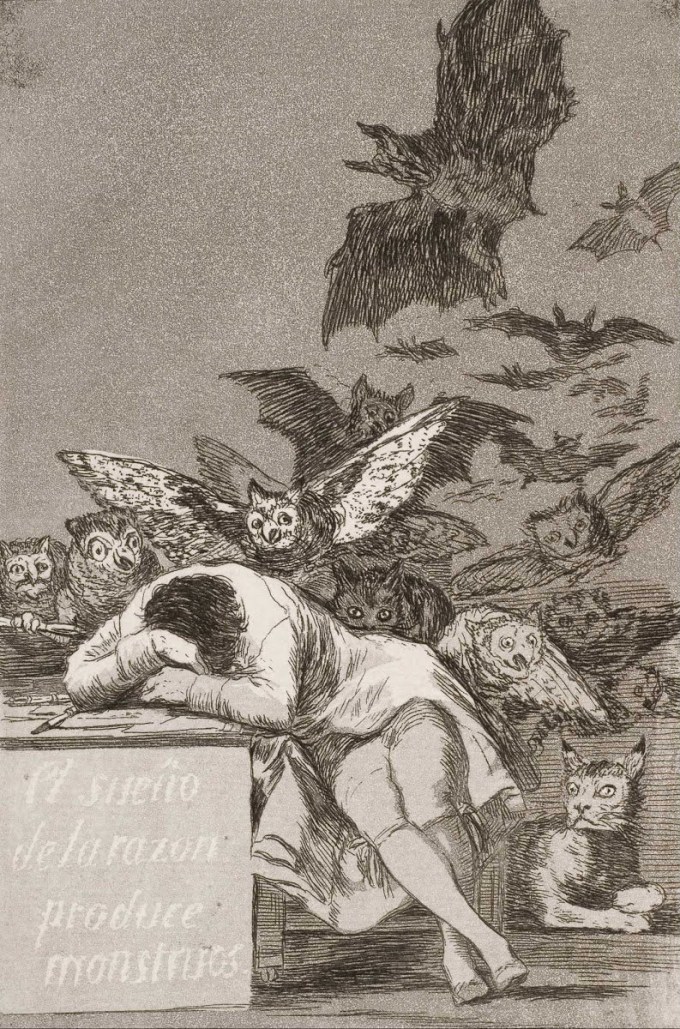
The sleep of reason (2) – Goya

I mentioned ‘the sleep of reason’ in my last post. I had in mind Goya’s Los Caprichos print series, and specifically plate 43, ‘the sleep of reason produces monsters’. Owls gather above the sleeping artist’s head, no owlish wisdom here, just confusion, compounded by bats swarming behind – the owls lit, the bats unlit, and below two cat-like creatures look out, lynxes maybe, one directly at us, black and ominous, drawing us in.

By 1799 when Goya published Los Caprichos the high hopes of the Enlightenment had faded – his time maybe not too similar to our own.

Sleep of reason

Goya is clear that we cannot live by reason alone. ‘Imagination abandoned by reason produces impossible monsters; united with her, she is the mother of the arts and source of their wonders.’

We have in recent times been short-changed on both. Imagination looking back not forward, reason pilloried as ‘expertise’. And for many us, for the first time in our lives, we feel the tide of human improvement, I won’t say progress, is running against us.

Can music help? Leonard Cohen’s words from his song, Anthem, have helped me. (I love singing it!) Simply the idea that there’s a crack, however formidable the surface textures might seem just now, there is a crack. A crack in everything.

Rings the bells that still can ring/Forget your perfect offering/There is a crack in everything/That’s how the light gets in.

Applies to the whole Brexit edifice. And the Trumpian. We haven’t come so far that we could now go back. Surely not.

I see that the artist Sarah Gillespie has made ‘the crack in everything’ the title of a painting. Maybe I’ll make it the title of a poem.

And another artist, Turner Prize-winner Wolfgang Tillmans, quoted in the RA Magazine: ‘ …this amorphous, right-wing, nationalist sentiment … has become the central issue of world politics …how, as a sort of avant-garde artist, do you engage with the number one political subject?’

How does an artist respond? Or a writer? A musician?

Propaganda has its place, but propaganda and art are not easy bedfellows. Caricature if it points up absurdity, gross behaviour and the like has a powerful role to play. But not if it only appeals to the already converted. In the hands of Hogarth, Rowlandson and Gilray caricature becomes an artform in itself. But we must tread carefully.

What we can’t do, in our anger or frustration, is allow ourselves to abandon reason, to let reason sleep awhile.

‘Imagination abandoned by reason produces impossible monsters; united with her, she is the mother of the arts and source of their wonders.’

The sleep of reason (1)

A post originally entitled the getting of wisdom. The sleep of reason is better. For more, specifically based on Goya’s etching, see my next post 

My focus here, two pre-eminent men of reason. Or two men of pre-eminent reason. Amartya Sen and Steven Pinker. (And one villain – one of many out there ! – see later.)

Both have signed books for me, after giving talks, and I remember a few words with Steven Pinker. Sen is simply a hero, a man of surpassing wisdom. Pinker likewise is a passionate supporter of reason. He overplays, to my mind, violence in human history in his book The Better Angels of Our Nature, but his compassion toward others in our own time is unwavering.

More on Pinker in a few moments. 

Way back I posted on the subject of Sen’s ideas about capability. Compassion and enterprise, justice and capability – they are the four ideas that drive my view of the world. 

Implicit in all four ideas, as I understand them, and as they balance each other, is reason. Exemplified brilliantly by Sen. ‘(Trump) has managed to unleash a kind of thinking which drew more on prejudice than on cool reasoning. And I would apply this to Brexit, where some of the sentiments of hatred of foreigners come into the story in a big way.’ Sen quotes Jefferson: ‘Eternal vigilance is the price of liberty.’ (I’m quoting from an interview in the March edition of Prospect.) 

How could reason, a rational man, be other than in the camp which opposes Brexit head on? I’ve found this a contentious position to hold, but should anyone doubt that it is a reasonable statement, listen to Sen in the subject:

‘Public discussion is extremely important both preceding a referendum and, I believe, following a referendum. I take a view of democracy like that of JS Mill: democracy is government by discussion. I’m really quite shocked that one vote on the basis of a campaign in which many factors were distorted …. (by) a small margin victory should be taken to be the end of all argument, no further argument, the rest is just engineering.’

Government by discussion – not by diktat. These are dangerous times. The recent Supreme Court decision saw the impartiality of judges challenged, by those who would wish to ensure that judges were partial – partial toward the views that they hold. Weighting the scales of justice – a game of fools.

Steven Pinker answers questions put to him in Prospect’s ‘Brief encounter’ feature. If given £1m to spend on other people what would he spend it on? His answer: ‘Giving What We Can, a meta-charity inspired by the Effective Altruism movement, which calculates which charitable donations can deliver the greatest human benefit.’ 

Curiously that chimes with David Edmond’s review of Paul Bloom’s Against Empathy: the Case for Rational Compassion. Empathy is defined by Bloom as putting yourself in another’s shoes, and, yes, this can work against reason. But to my mind that’s too rigid a definition. Empathy and reason need to work together. We can then be moved to tears, as Pinker was, by Malala’s 2013 speech to the UN General Assembly, without allowing sentiment to cloud our judgement. Empathy and compassion work best when they work together. 

Heroes… and villains. An altogether lesser character, and I’m sorry to be harsh… but Dominic Lawson writing in the Sunday Times demonstrates what we’re faced with. He imagines Remain supporters being gratified by data analysis showing that Leave support last June correlated strongly with lower educational achievement. Remain supporters he thinks will be gloating – their superior understanding vindicated. So are we gloating? It won’t get us far. But my anger is with his statement that ‘throughout history, the educated middle classes have fallen for, or concocted ideas, that turned out to be misguided’. He quotes Marxism, Nazism, eugenics. Was Marx middle class, Hitler? As for eugenics – well, that’s for another time. This is emotive nonsense, and Lawson as a rational man must know it. Is opposing Brexit, wishing to build with reason and compassion on the status quo, rather than seeking to reinvent the wheel, this time with a dodgy axle, some kind of novel idea?  

Marxism revisited? Have we a Hitler in our midst?  

God help us all. God I’m assuming is a rational being. Maybe not. But we as reasonable people have to hang in there.  

La Gomera – enchanted forest 

We’re in the Canaries, on the magic island of La Gomera. Just five degrees north of the Tropic of Cancer, mid Atlantic Ocean. 

It’s 11th Feb, and we break away from our poolside days on the south coast, and views out over the ocean – nothing between us and the Antarctic ice cap – now there’s a thought, and the full moon, and southern hemisphere stars such as Canopus (sacred to the pre-Conquest Gomerans), and we head for the mountains and the cloud, and the cool and rain and dripping wet – via Alajero, in our hired Corsa, climbing high, right turn at Pajarito then left on CV14 toward Hermigua, and our walk begins, winding down north then south (the contours are wild) through laurel and tree heather forest, trunks thick with moss, to Las Mimbreras, where a rushing stream, fed by the aquifer that the forest feeds, crosses our path, and we join the Alto de Garojonay walk, then north through dripping forest, touch of mist, until we turn east and wind down via a rocky slippery descent to a valley where palm and cacti sit incongruously amid the green and damp, to the El Cedro café restaurant, lunch of watercress soup with green and red pepper sauces, and tuna and salted potatoes – rustic, long tables, fire burning in an old iron stove, mist turns to downpour while we’re there, eases to drizzle before we leave, and head down to river and a rushing water tunnel, then wind round first south then north, climbing all the while to pick up our original path. 

Leaving 11.15, back 4.30, lunch took an hour, so for 5 ½ miles distance it was a slow walk – but atmosphere all the way, with damp drizzle mist drips endless drip drip and streams flowing fully formed which, given the parched landscape only maybe five miles south, is a miracle, a magic meteorological act, driven by the north-east trades and helped not a little by a remarkable geology – a volcanic land which has had two million years to erode and carve deep barrancas radiating out from the laurisilva forest which occupies the centre land. 

Enchanted land, magic misty sweep of forest, trunks and boughs thick on the ground and cross-crossing and intermingling, as dense as a tropical jungle, no place to get lost not just because you wouldn’t want to get lost there – you’d never get in there in the first place.

Amazingly this exotic land is Europe. The hand of Spain, the hand of our European continent – it stretches far.

Silence and sunsets

‘The magic hour — that purple-and-orange twilight cherished by generations of cineastes — seems to last for weeks on end.  The Griffith Observatory might as well be heaven itself.’ A quote from the NY Times review of La La Land, which I saw and loved two nights ago.

A very different twilight, last night, looking down from Cranham Common to Painswick (we’re the western edge of the Cotswolds), cold already biting into the ground, the sheen of frost, the evening star brilliant, as high in the western sky as it ever gets, orange glow along the horizon, and just a few pinpoints of light – a house or car headlight.

Hollywood and Cranham. Not normally names that go together. Hollywood – Mia and Seb, Emma and Ryan is real life, break into song and dance (‘hoofing and chirping’). Cranham can’t compete.

But they do have silence in common. Silence before the dance, silence before return to the family hearth. Silence before the TV news, and Trumperie and tweets.

Another quote (attributed to George Orwell, and borrowed from Roger Cohen in the NY Times): “In a time of universal deceit, telling the truth is a revolutionary act.”

Truth comes out of silence, out of time for reflection, a balancing of ideas, at each step, allowing us to hold that essential balance between fact and opinion. Truth will always be personal, but the more we give ourselves time to balance our truth against the truths of others – we will at least approximate to wisdom that way.

If only we could head out to the silence more often. Orwell by the way near the end of the life was holed up in a sanatorium in Cranham. The air is good here. I don’t know whether he ever appreciated the sunsets.

We need more like her…

I’ve just caught up with Marilynne Robinson on Radio 4, being interviewed by Robert McCrum. American authors in a R4 series are responding to Trump, inaugurated later this week. The original gold-plated inauguration.

Some forms of Buddhism equate nirvana with palatial splendour, as if it required the condition of princes to persuade people it was something worth aspiring to.

America – so strangely, hard-working America – last November also felt the need for bling.

Robinson is from a very different, almost backwoods, American tradition. The America, as she describes it, of possibilities. She highlighted, as authors to return to, four great 19th century figures, William James, Whitman, Thoreau, Melville… (Whitman was my companion when I greyhounded around America in 1971, and Thoreau has always inspired – so I’m with her all the way.) They were to her mind unique in world history in outlining the possibilities of what a society, American society, could achieve. There were many pessimists then of course, and there are now, but opportunity is still there.

An optimist? She hesitated when asked. The future is what we will make of it, and Americans engaging and re-engaging will make that future. And if, a year or two ago, political engagement for American writers and other like-minded souls would have seemed somehow unpalatable, now, as attitudes to foreigners, to the poor, to the environment, are threatened, she anticipates that will change.

Trump has brought out something deep in the American psyche, but the irony, as she sees it, is that social security and the Obamacare safety-net which benefit so many are precisely now what is under threat. She is also profoundly unhappy with the role of many Christian churches, who subsume their ethical responsibilities under a tribal, exclusive and excluding identity.

As for the UK – she wasn’t asked. But maybe the message isn’t so different – how could so many have invested power in people who have an agenda so different from theirs – so many who thought they were reclaiming sovereignty (Trump supporters likewise, but in protectionist terms, and protectionism is the last thing we need), but could have instead a radical economic agenda foisted on them by right-wingers who can’t believe they’ve struck so lucky. Right-wingers for whom social welfare has always been secondary – with their sense, given we’re all either strivers or shirkers, that we may not even need it.

Immigration. The enemy as Robinson sees it is fear, and that’s what’s been played in both countries. Muddled with identity.

Too many similarities. We, we Brits, have to engage. At a local level, yes – but at a national level as well. Even if we’ve normally left it to others. America and the UK desperately need new leaders on the centre and centre-left who can take up the challenge.

The LibDems are out there on their own.

We’ve Tristram Hunt, one of the good guys on the Labour side, abandoning one ship and heading off for another, one that rests permanently and very grandly in port along the Cromwell Road, the V&A… That is not good news. We need the likes of Tristram. But he has had to deal wth a bane that Americans are spared – all the stumbles and misdirections and fooleries of Corbynism.

We need a Marilynne Robinson or two over here. We need a voice, we need voices, of wisdom.  Philosophers, historians, politicians, scientists, novelists – even theologians! – speaking out. Though, damn it, they could all be stigmatised as experts.

I note that it’s Michael Gove, he who scapegoated experts, that The Times sent over to the USA to interview Donald Trump a day or two ago. No surprise they were both smiling so broadly.


Silence – Martin Scorsese

I’m just back from watching Scorsese’s new movie, Silence, described as ‘a powerful and haunting meditation on the nature of faith’. I focused in my last post on our Christian heritage, and how we downplay it in our own times. In an earlier ages, not least the 17th century, we Europeans did the opposite – we asserted our faith.

Inspired by the Counter-Reformation Jesuit missionaries took the gospel to Japan, and after a brief period of success, they were tortured, murdered, and the Christian faith driven out. Two Jesuits padres, Rodrigues and Garupe, seek out Ferreira, who led the mission in Japan, and is believed to have apostasised – converted to Buddhism.

Christianity as both personal quest and state religion, each reinforcing the other, with little room left for doubt.

The mission of Rodrigues and Garupe may have been very personal to them, but they wre also representatives of state power. The rulers of Portugal could only approve.

You only have to visit the National Gallery’s Beyond Caravaggio exhibition (on until 16th January) to see how far the patronage of popes, bishops and nobility supported the work of Caravaggio and those he influenced, such as Gentileschi, Ribera and Guido Reni. Caravaggio’s Supper at Emmaus is a powerful statement of faith, the spiritual operating at a very down-to-earth and human level, and yet it was commissioned by an aristocrat, kept in a private collection – and only since it became a part of a public collection can it be seen and appreciated by a wider audience.

Our Christian heritage is no simple thing. It expresses itself at a very personal level, but the higher levels of that culture were only available for the affluent and the educated. Which isn’t to devalue them, rather to be grateful that we live in a time when we can appreciate them.

The ironies and contradictions here are manifold, and I wouldn’t be able to unravel them in a thousand posts.

Likewise with the Scorsese movie. Christianity wasn’t out-argued in Japan, it was put down by brute force, by sustained sadistic torture, designed to dissuade and convert, all in the service of the state – violence of this kind had of course no place in Buddha’s teaching.

Rodrigues wanted some kind of message from God, to hear God speak as God spoke to Jesus in his despair on the cross, but none came. God keeps silence, and Rodrigues ultimately realises that God has been speaking to him in the silence. What that message is he must decide for himself. And how he should respond? Should he apostasise and thereby save the lives of the Japanese Christians who look to him, or hold to his faith and let them die?

History – political history, Christian history, Jewish history (as told so dramatically in the Old Testament) – is an endless succession crises, violence, treaties, of confusions and betrayals, dilemmas and ironies, and it will ever be so. But we can at least remind ourselves how others have been there before us, and how all the while they have conjured the beautiful and the spiritual, charity and compassion, peace and good neighbourliness out of all the contradictions of the past.

More than ever they now need to be our focus.


Chimes of freedom

Lest we forget, the civilization of which we’re all a part in the Western world is profoundly Christian. In the real sense of Christian. (Yes, I know this is a ‘zenpolitics’ blog, but do read on!)

We’re so mired down by the day-to-day that we forget, remove from our consciousness, that simple fact. And if we do connect to it, we secularise it, explain the music, literature, art, sensibility, the ethics of earlier times away as products of their own times, and allow only those ‘eternal values’ that suit our personal tastes and pleasure. We privatise history, recast it in our own image.

This attitude has long concerned me – part born of acquiesence, dealt with by an easy shrug, and part born of a determination to create a new, contemporary, ‘scientific’ understanding of the world.

The reality is that our history is as much as expression of the spirit as of the hand, and implicit in our everyday if we’d open our eyes to it. By downplaying it we remove the very binding of our culture.

The Christian focus on the unique status of everyone before God underpins our understanding of our individuality, and compassion for others lies at the heart of the Christian faith, as it does indeed of Buddhism.

And yet – Christianity for so many of us carries the taints of our upbringing, and by turning from the taint we disavow the substance. For the purposes of this blog the substance doesn’t have to be Christian faith as such, but simply an awareness that our heritage is Christian. Not the Christianity of violence, where politics takes over, but the Christianity that Jesus taught, of love and compassion.

Shouldn’t we be out there arguing, for compassion, for an open heart, an open mind? Taking the initiative. There’s much at stake. But we’re too often on the defensive. And we don’t help ourselves.

The American Pulitzer-prize winning novelist, Marilynne Robinson, is a redoubtable champion of our Christian heritage. She argues powerfully against a purely scientific and amoral worldview, but it is Christians who draw her ire – those Christians, legion in the USA, with a few too many over here too, in the UK, who allow Christianity as an ethic to be muddled with Christianity as an identity.

Ethic is inclusive, identity too easily excludes, becomes an ‘us and them’ tribalism.  The ‘them’ would include the generality of sinners, deemed worse than ourselves, the disadvantaged, the outcast.

I’m not arguing for a redefined, evangelical Christianity. This would hardly be the place. and it’s not my scene, not my world. But simply for a renewed awareness of what we take from our Christian heritage – a better understanding of who we are, which is ever harder in a 24/7 world.

I’ve quoted Dylan’s Chimes of Freedom before (and this is just an extract from the list of those for whom the chimes toll):

Tolling for the deaf an’ blind, tolling for the mute/For the mistreated, mateless mother, the mistitled prostitute/For the misdemeanor outlaw, chased an’ cheated by pursuit/An’ we gazed upon the chimes of freedom flashing.

I could also have quoted from the Sermon on the Mount. Dylan managed a pretty good paraphrase.

Boxing Day morning 

Sun shining this Boxing Day morning, horses out exercising on the Kempton Park racecourse below me, and a brisk walker, who I assume is a jockey working out a little Christmas stiffness. No traffic on the roads just yet, give it an hour or two and the punters will converge hoping for a new hero, maybe Thistlecrack, or a triumph for an old, Cue Card, or for another, at longer odds. The King George VI Chase puts Kempton Park on the calendar, the map and the news one day of the year.

I’m sitting here, with my freshly-squeezed orange juice, looking out, and listening to a Christmas present, the wonderfully inappropriate, for a bright morning, new and latest and last album from my hero, my anti-hero and my muse, Leonard Cohen. Back in 2009 at his London concert he referred to years of searching among the world’s great religions – ‘but cheerfulness kept breaking through’. I’m not finding too much that’s cheerful this time around, but I’m loving it all the same. 

If you are the dealer, I’m out of the game
/If you are the healer, it means I’m broken and lame /If thine is the glory then mine must be the shame /You want it darker /We kill the flame 

Well, the sun’s shining, thine, good Lord is the glory, and time for that orange juice, squeezed through the state-of-the-art orange-squeezer my son gave me yesterday – a labour-creating not a labour-saving device. The work of mine own hand, not mass-produced. And all the more satisfying for that. Like listening to vinyls, and having to leap up every few minutes to flip the disk – stops you taking the music for granted, relegating it to a background sound. 

Discussion over breakfast of the Obama legacy between father and daughter. This is the Collier family, and I like it. 

Happy Christmas, one day late, everyone! 

One final rant

And one for the road – a final rant on the subject of Brexit. Last of the year, I promise. ‘We’re all Brexiteers now.’ In the Cabinet, and across much of the Tory party. It’s a brave Tory who stands out. There’s been a coup, but coups don’t just happen. This one has been building many a year, and an eminence behind it has been Daniel Hannan, blogger, writer, arguer, obsessive. Though it pains me to say it, he’s done a brilliant job. Given the fact that he read history at my college in Oxford some 25 years after me, I guess I should be proud of him. That’s not easy.

The Guardian’s Long View piece of Hannan back in September makes fascinating reading. His case against the EU was ‘an upbeat argument of direct democracy and free-market capitalism’. He showed in conversation ‘no anxiety at all about the manner of Britain’s decision to leave the EU, or the scale of the diplomatic and economic challenges facing the country’. A current (Remain voting) Cabinet minister is quoted as observing that there’s no guarantee the agitation will now stop. ‘None of these people are builders, they are destroyers.’

In an earlier post, back in the summer, I referred to a Hannan article in the Telegraph painting a picture (‘rosy’ wasn’t in it) of what Britain would be like in 2025 if only we voted Leave. It was a post-Imperial paradise. Destroyers too often are dreamers.

The Guardian puts the by comparison ruthless and contrarian UKIP view: ‘the narrow Hannanite case for Brexit – mostly about deregulation and sovereignty – was a sideshow to the main event: a chorus of economic and cultural discontent’.

Back in the summer we often heard the sovereignty argument, in the crude form of ‘take back control’, but it wasn’t because people longed for a deregulated, free-trading economy – rather, they’d been bought into another Hannan obsession, disparaging elites, scorning expertise.

Let the people speak, another obsession – but only if they’re on message. The role of the press in ensuring that they are, including the regular exposure the Telegraph has given to Hannan, continues to be unexamined.

And Hannan all the while remains blissfully unaware of how immigration ultimately won the day for his side. (To quote the Guardian, his book Why Vote Leave ‘contains (but) a single sentence on immigration’.) Of course he doesn’t – he’s well aware. But such has been his obsession, all arguments, however unpalatable, were means to an end – and now he’s achieved that end, and a bizarre bunch of outsiders are now insiders.

Every day the chaos unfolds. We want free trade – but without a customs union. We will trade under WTO rules, but short of negotiating tariffs across the board, a task for a decade, and a recipe for many a disaster, we will have to accept arrangements as they stand. EU tariffs, EU quotas. Supply chains are international these days, manufacturers import and export components all over the world, as well as finished items. Motor manufacturers buy on a just-in-time basis, and for them tariffs and the delays they cause could be disastrous. A ‘ bonfire of regulations’ would mean exclusion from many areas of trade which require such regulations, on an EU and worldwide basis: there can be no such bonfire.

Absurdities pile on absurdities.

Back to Hannan, and a UKIP view: ‘So locked up in his own world that he can’t see what’s on the end of his well-formed aquiline nose.’ A little unfriendly, but probably spot on.

He muses on ‘the natural intelligence and fair-mindedness if the British people’. He grew up in Peru, and if there is such a thing as an old-school expat mentality, then Hannan has it. In Roger Scruton’s words, ‘the expat mentality is belonging to the old country, and the inability to accept that it is changed beyond repair.’

The Guardian article is the best explanation I’ve yet encountered of how a subversive element can insinuate and propagandise, and use leverage within parliament and press to stage what is more or less a coup, seizing a moment – and finding itself despite all the flummery to the contrary caught in the headlights.